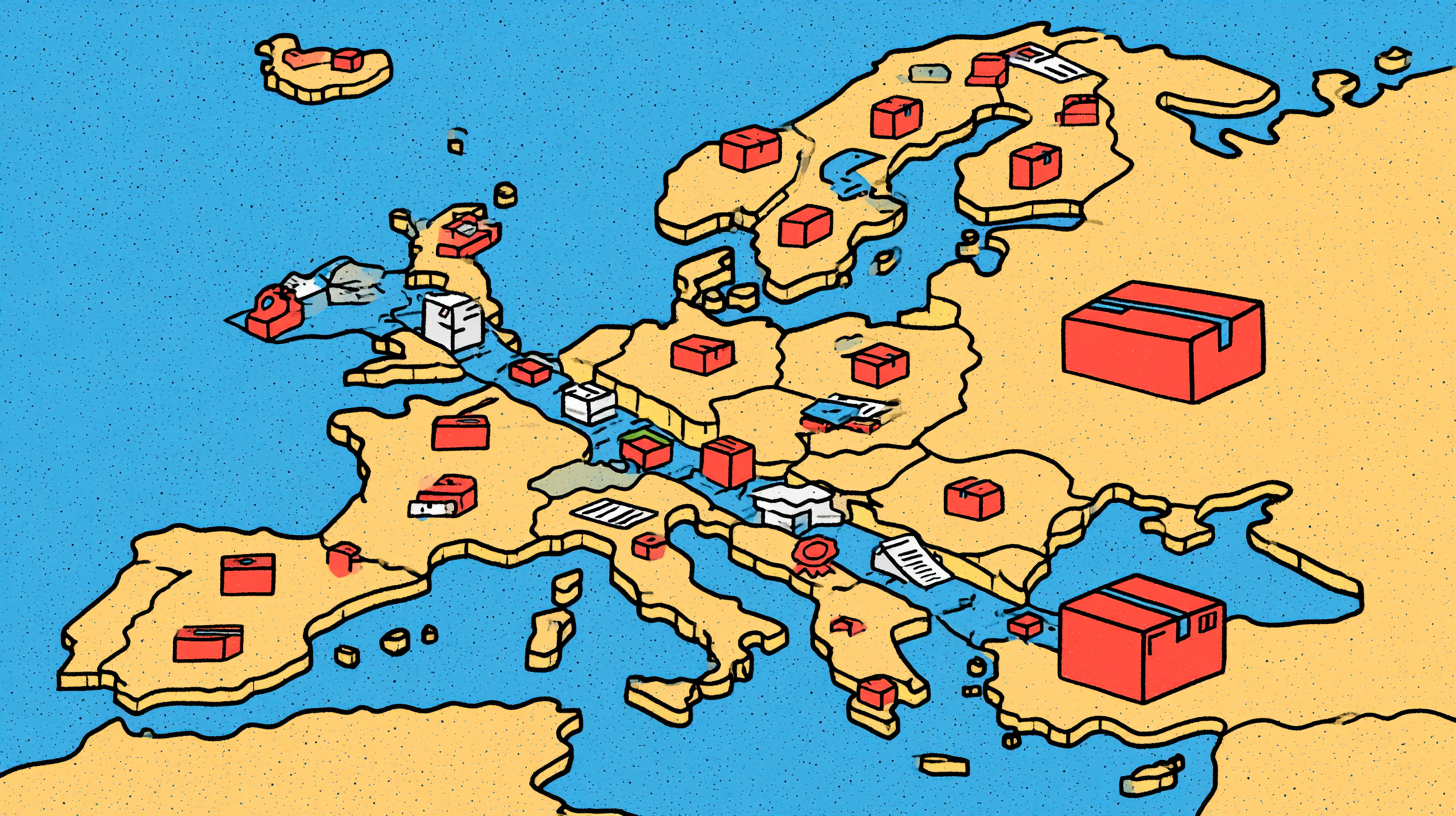
The European Commission has set out the documentary proof that steel importers must present at the border from 1 October 2026, publishing the implementing rules in the EU's Official Journal on 31 August. The measure operationalises the melt-and-pour transparency requirement embedded in the Steel Regulation, which entered into force on 1 July and targets what Brussels describes as the root causes of global overcapacity.
What the regulation demands
Every consignment of steel falling within the regulation's scope must be accompanied by a declaration of the country where the raw steel or iron was first produced in liquid form and then cast into its initial solid state, the so-called melt-and-pour origin. Without verifiable evidence of that origin, customs authorities will treat the shipment as non-compliant and reject it. The primary document is a Mill Test Certificate (MTC) that states both the melt-and-pour country and the heat number, a unique identifier for each batch of steel.
Where an MTC exists but omits either the melt-and-pour country or the heat number, customs officials may accept complementary evidence. The regulation lists invoices, delivery notes, quality certificates, contractual clauses, long-term supplier declarations, cost accounting or production records, customs documents from the exporting country, commercial correspondence and production descriptions as admissible alternatives. The hierarchy is deliberate: the MTC remains the gold standard, but the fallback list acknowledges that not all supply chains generate a certificate for every shipment.
Transitional period and the evidence hierarchy
A transitional regime runs from 1 October 2026 to 30 September 2027 for imports that cannot produce an MTC at all. During those twelve months, the same categories of complementary evidence, invoices, supplier declarations, production records and so on, are acceptable provided they contain the melt-and-pour country and the heat number. After the window closes, the Commission reserves the right to narrow the list of admissible documents, and it has signalled that the list will remain under continuous review and may be adjusted at any time. Importers should therefore treat the transitional period as a grace interval to align their supply-chain documentation, not as a permanent alternative.
A further practical consequence is that access to the EU's tariff-rate quotas (TRQs) will be suspended until the evidence supplied by the importer is officially verified. That verification step introduces a new source of delay at the border, particularly for traders who have previously relied on simplified customs procedures.
Market reaction since the Steel Regulation took effect
Since the Steel Regulation entered into force on 1 July, domestic steel prices have climbed despite what market participants describe as weak underlying demand. The combination of tighter import quotas, the Carbon Border Adjustment Mechanism (CBAM) and existing anti-dumping duties has created a cost floor that benefits European producers. Platts, part of S&P Global Energy, assessed domestic hot-rolled coil at €725 per tonne ex-works Ruhr on 28 August, up €45 from the 1 July assessment. In southern Europe, the ex-works Italy price stood at €715 per tonne, also a €45 increase over the same period.
Imported hot-rolled coil tells a different story. Platts assessed northern European CIF Antwerp prices at €585 per tonne on 28 August, unchanged from 1 July, while southern European CIF prices slipped €10 to €575 per tonne. The widening spread between domestic and imported material, now roughly €140 per tonne in the north and €140 in the south, reflects the cumulative effect of the new transparency rules, CBAM certificates and the quota regime. Traders note that the imported price stability masks reduced availability; several sources report that non-EU mills are holding back offers until the documentation requirements become clearer.
Why the melt-and-pour rule matters
How the Steel Regulation fits into the wider trade framework
Compliance challenges for importers and processors
Service centres, distributors and end-users who import steel directly face the steepest learning curve. Many have supply chains that run through multiple intermediaries, traders in Turkey, the UAE or Southeast Asia, who may not routinely request MTCs from the originating mill. Obtaining a heat number for every coil or plate can require contractual changes with suppliers who are not accustomed to providing that level of traceability. The regulation's acceptance of long-term supplier declarations helps, but only if the supplier is willing and able to certify the melt origin for each heat. Small and medium-sized importers without dedicated compliance teams may find the verification delay at customs particularly disruptive to just-in-time delivery schedules.
Steel producers inside the EU, by contrast, see the rule as a necessary complement to the quota system. Eurofer, the European steel association, has argued that without melt-and-pour transparency the quotas could be circumvented by rerouting. The Commission's decision to allow a twelve-month transitional period for shipments lacking an MTC suggests it recognises the practical difficulty of immediate full compliance, but the warning that the evidence list may be narrowed after September 2027 puts the onus on industry to adapt quickly.
What happens next
Organisations
European Commission · EU Customs · Platts · S&P Global Energy