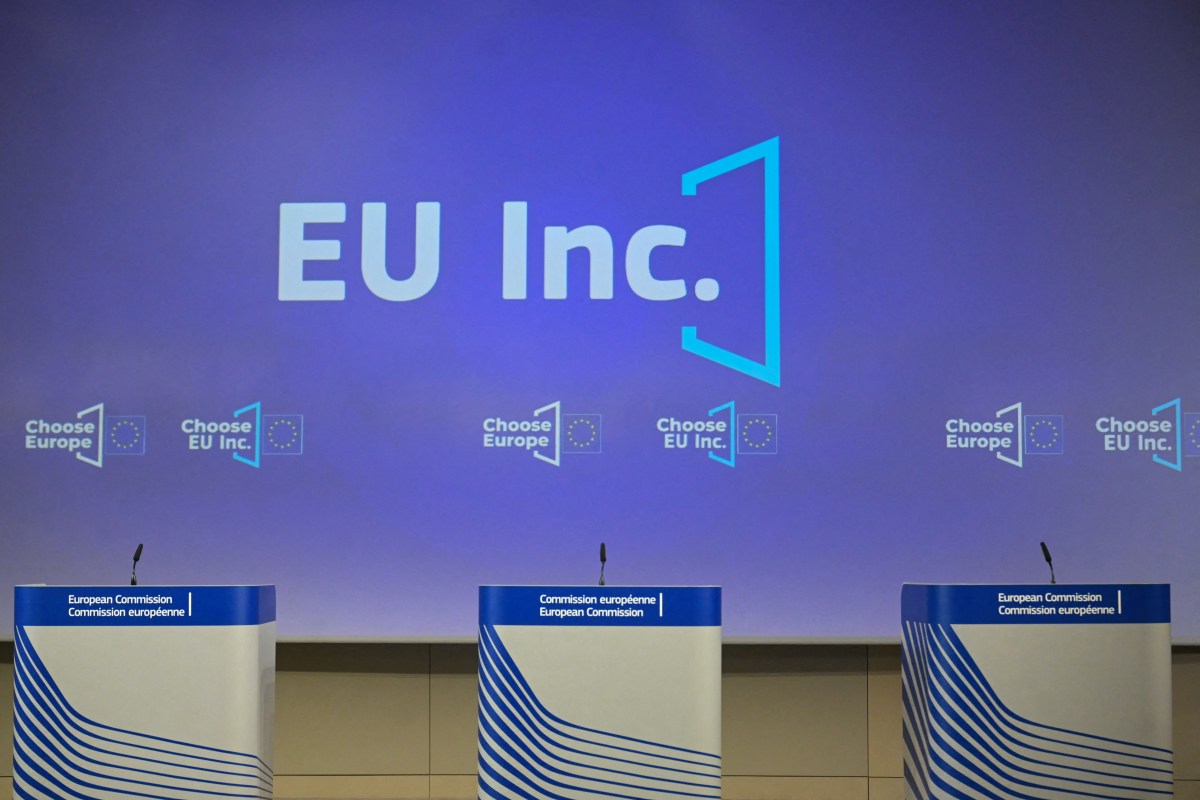
More than a hundred of Europe's most prominent founders and venture capitalists published an open letter on Thursday warning that the EU Inc proposal, a long-sought pan-European company statute, risks being diluted into something no founder would choose to use.
The letter, signed by figures including Atomico founder Niklas Zennström, Accel partner Sonali De Rycker and Sequoia partner Michael Moritz, as well as founders behind unicorns such as Mistral, ElevenLabs, Alan, Lovable and Synthesia, calls on European lawmakers to preserve the proposal's core features as negotiations between the European Parliament and Council enter their final stretch.
What EU Inc is supposed to do
The EU Inc campaign has been pushing for an EU-wide company form modelled loosely on the Delaware C Corporation, the standard vehicle for American startups. Its supporters argue that the absence of such a form forces European founders to navigate 27 different corporate law regimes, raising costs, deterring cross-border investment and pushing promising companies to incorporate abroad rather than in their home markets.
The European Commission has formally endorsed the idea. But formal endorsement is not the same as a usable law, and the letter's signatories are concerned that the final text will be hollowed out by compromise. They warn the statute could become "unusable if its central features are weakened," a phrase that amounts to a direct challenge to the legislative process now underway.
National resistance from Germany's notaries
As with most EU legislation, the proposal has attracted opposition from national interests. Germany's notaries association has publicly criticised aspects of the Commission's draft, arguing that a single European company form would undermine national corporate law traditions and reduce legal certainty.
The notaries' objections reflect a familiar pattern. European harmonisation projects routinely face resistance from professions and institutions whose business models depend on national regulatory fragmentation. Company law has long been treated as a national competence, and member states guard it accordingly. The risk for EU Inc's supporters is that each member state demands a carve-out, and the result satisfies nobody.
Two technical details that could decide everything
The letter highlights two provisions its signatories consider essential. The first is a single central registry. Currently, a company incorporated in France must register with French authorities, and expanding into Germany involves a separate process with German authorities. A genuinely unified company form would have one point of registration, valid across the bloc. Without this, EU Inc would merely add a 28th option to the 27 national regimes already on offer.
The second is stock option taxation. Under many European regimes, employees are taxed on stock options at the point of vesting, before they can sell them. The letter insists that employees should only be taxed when they actually dispose of their shares. Employee stock options are one of the main tools startups use to compete for talent against better-funded American rivals, and punitive taxation has long been cited as a reason European startups struggle to attract and retain engineers.
As Martin Mignot, a partner at Index Ventures and an early EU Inc supporter, put it in 2024: "the devil is in the details, and that's going to be where we're going to be very, very watchful." That warning has only sharpened as negotiations have progressed.
The Delaware problem
The subtext of the letter is hard to miss. Several of the unicorns whose founders have endorsed EU Inc have their headquarters in the United States. The message to Brussels is straightforward enough: create a genuinely usable company form, and founders will incorporate in Europe. Produce a compromise riddled with national carve-outs, and they will continue to opt for Delaware.
This matters because the EU has spent years trying to close the gap with the US on technology investment and startup formation. The Commission has pushed digital regulation, AI legislation and semiconductor subsidies, but the basic corporate law infrastructure that underpins company formation has remained stubbornly national. EU Inc is an attempt to fix that at the structural level, rather than through yet another subsidy programme.
What happens next
The European Parliament and Council have roughly 100 days to agree on a text before the winter recess. The key battlegrounds will be the central registry provision and the stock option taxation rules. If member states insist on preserving national registries or domestic taxation principles, the resulting statute may satisfy the notaries but fail the founders it was designed to serve.
People mentioned
-
Martin Mignot
-
Niklas Zennström
-
Sonali De Rycker
-
Michael Moritz
Organisations
European Commission · European Parliament · Council of the European Union · Index Ventures · Atomico · Accel