When European leaders gathered in Kyiv in late August, Russia paused its missile strikes on the Ukrainian capital. The temporary lull said something about Moscow's calculations: bombarding Kyiv while its visitors were still standing there would have unified European opinion even further. The delegation left, the bombardment resumed, but something had shifted in the war's political architecture.
Andy Burnham, Britain's new prime minister, used the visit to finalise an agreement that goes further than previous arms deliveries. Britain and France will transfer the technology needed to manufacture Storm Shadow and SCALP cruise missiles inside Ukraine. France had already committed its portion of the joint design. The deal does not change the fighting overnight; Ukraine operates few aircraft that can carry these weapons, and its F-16s are tied up intercepting incoming Russian cruise missiles. The significance lies elsewhere.
Weaving Ukraine into Europe's defence industry
By moving missile production onto Ukrainian soil, European governments are treating Ukraine's defence sector as an extension of their own. That decision directly contradicts one of Moscow's stated war aims: keeping Ukraine outside Western institutional structures. It also addresses the practical problem that shipping weapons across Europe invites delays, political disputes and logistical bottlenecks. Domestic production, even if months away, shortens the chain.
The Trump administration was conspicuously absent from the Kyiv ceremonies. Washington has effectively cancelled American leadership of the coalition supporting Ukraine, and European governments are now organising themselves without it. The question is no longer whether Europe can replace American contributions but whether it can do so fast enough to matter on the battlefield.
Moscow's threats lose their edge
Russia has threatened consequences at every previous Western escalation, from the delivery of Leopard 2 tanks in early 2023 to the seizure of Russian-linked tankers in August 2025. Each round requires a more specific and dramatic warning to register. The latest, that British military installations beyond Ukraine could be targeted, sets a new rhetorical mark. It is not credible: striking a NATO member's home territory would trigger the alliance's collective defence clause in a way that no Russian commander is prepared to test.
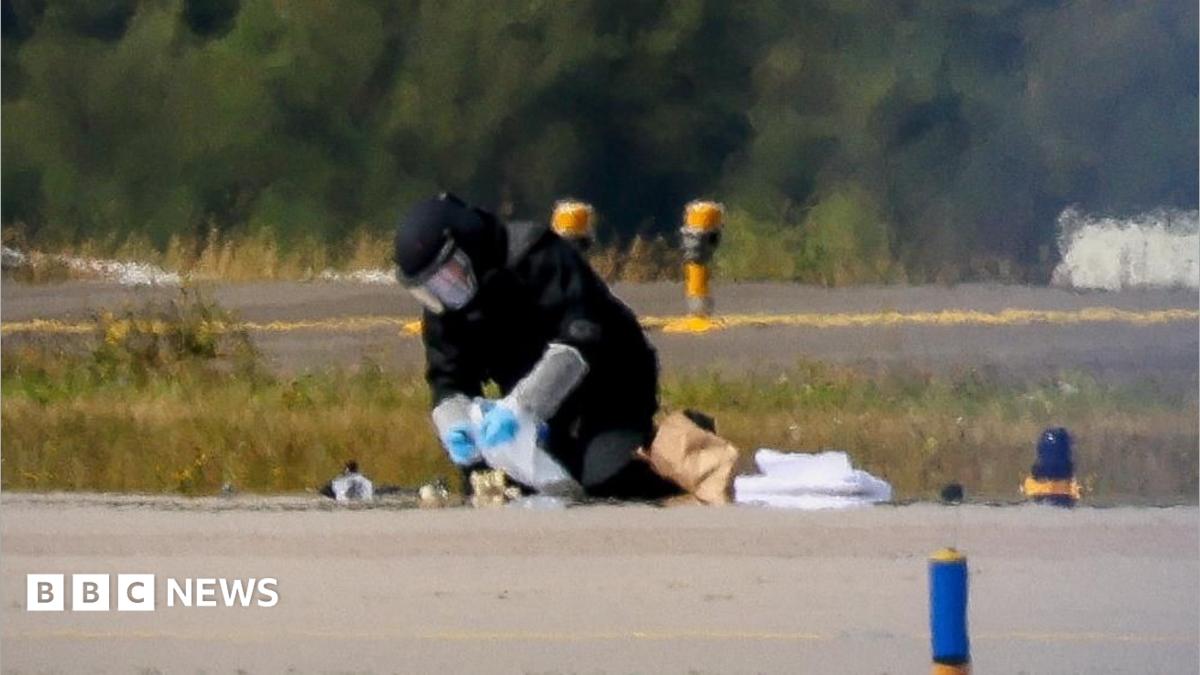
Moscow has also intensified what it calls hybrid operations inside Europe: sabotage attempts against military factories, cyberattacks, and disinformation campaigns. Security services across the continent have increased protection around defence plants. Yet the damage inflicted by these operations, often carried out by locally recruited individuals with minimal training, remains small compared with what Ukraine achieves with its own long-range strikes on Russian military infrastructure, such as the Kamensky ordnance plant in Rostov region.
Each Russian attempt to test European resilience has produced the opposite of its intended effect. Governments have invested more in protective measures, and EU sanctions have tightened steadily. The major infrastructure incidents of the past 18 months, the Heathrow blackout in March 2025 and the Iberian grid failure the following month, were not of Russian making, despite early suspicion.
Economic cracks beneath the bombardment
Russia's domestic economy tells a story its official statistics do not. Ukrainian strikes on the vast warehouse network of Wildberries, the online retailer that expanded aggressively during the war, have exposed a vulnerability that goes beyond destroyed consumer goods. Wildberries accumulated heavy debt, and VTB, the state-controlled bank that financed it, is now carrying losses that its chief, Andrei Kostin, cannot easily absorb. Kostin's Kremlin connections have not produced a bailout; the federal budget is deep in deficit and the government is reluctant to throw more money at a failing concern.
Andrei Klepach, a mainstream economist, warned in the spring that war expenditure was too heavy for a stagnating economy. By early autumn those warnings looked generous. Russians are responding to the gap between official optimism and lived experience in the most direct way possible: by pulling their savings out of bank accounts.
Two maritime theatres, opposite trajectories
In the Baltic, Russia's position has deteriorated sharply. Finland and Sweden, NATO's newest members, are building the capabilities needed to support the three Baltic states. Poland is increasing its defence budget faster than any other alliance member. Kaliningrad, once a heavily armed bastion bristling with anti-access systems, has been stripped of troops and weapons redeployed to the Ukrainian front. No amount of assertive rhetoric from Moscow can compensate for that gap.
The Black Sea is a different matter. Russia retains naval assets and is probing Romania's resolve with repeated aerial and naval drone incursions, while increasing pressure on Moldova. Yet Ukraine is shaping this theatre itself: mid-August drone strikes damaged the frigates Admiral Makarov and Admiral Essen inside Novorossiysk harbour. Turkey remains the key variable. The US Congress has approved Ankara's transfer of 70 M39 ATACMS tactical missiles to Ukraine. Russian commentators have strained to present this as an American rather than Turkish initiative, reflecting Moscow's anxiety about alienating a partner it needs.
A coalition wider than Brussels
The defeat of Viktor Orban's government in Hungary removes Moscow's most reliable advocate inside the EU. Putin's remaining hope rests on European bureaucracy and political division paralysing decision-making. To prevent that, European governments need a coalition that extends beyond the EU itself, with Britain, Norway, Turkey and Canada as active participants rather than sympathetic bystanders.
A 28-point draft peace proposal, leaked last November, heavily favoured Moscow and drew sharp objections from both Kyiv and Brussels. It was a product of the Trump administration's approach: pressure Ukraine toward concessions. That approach has not disappeared, but its influence has waned as European governments step into the vacuum. The question now is whether they can sustain the spending, the industrial integration and the political unity needed to outlast an adversary whose economy is showing serious strain but whose military capacity to inflict damage remains considerable.
People mentioned
-
Andrei Kostin
-
Andrei Klepach
Organisations
North Atlantic Treaty Organization · VTB Bank · Wildberries