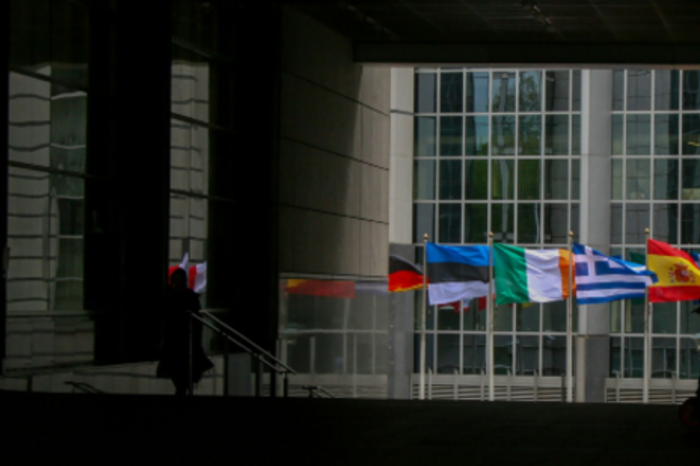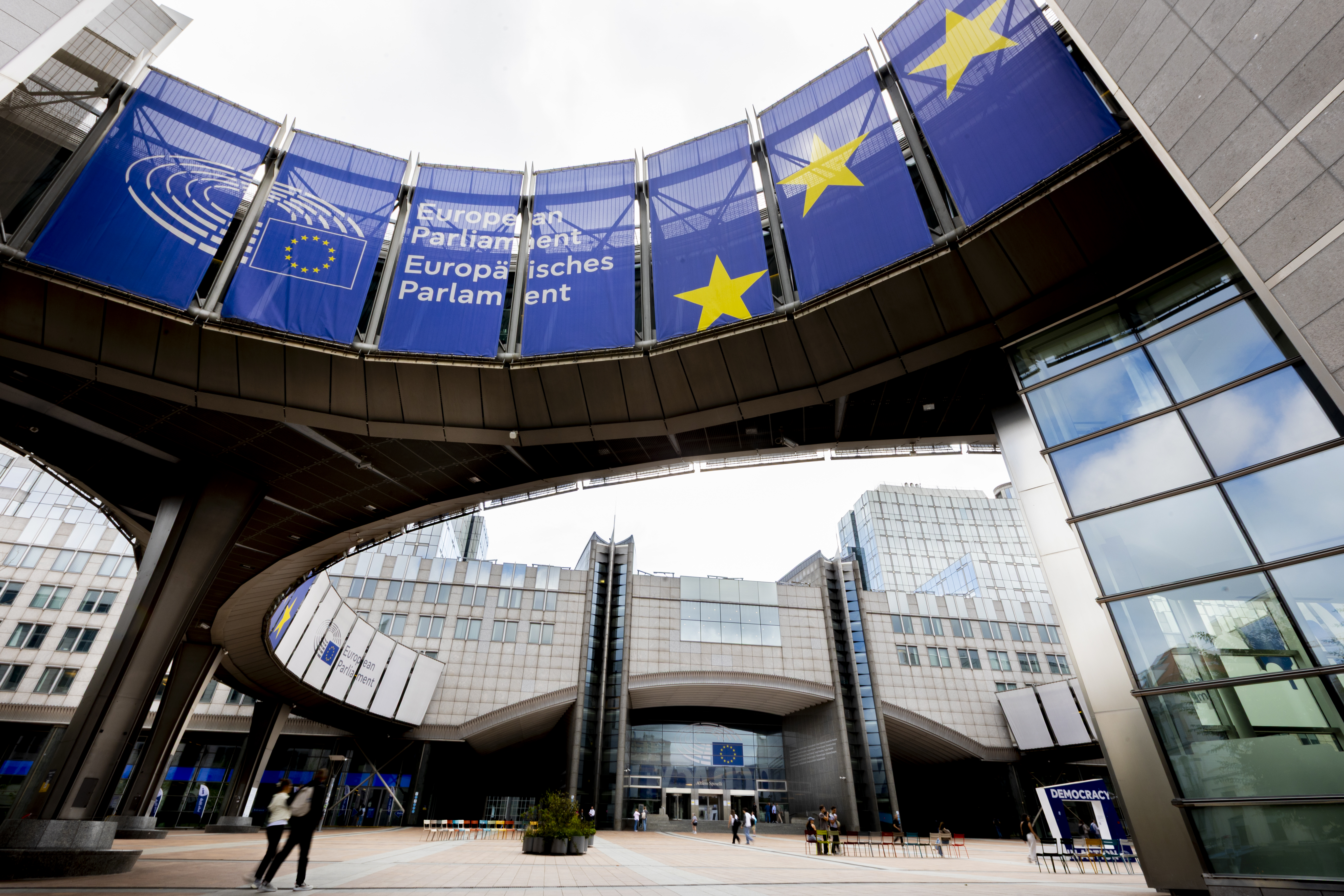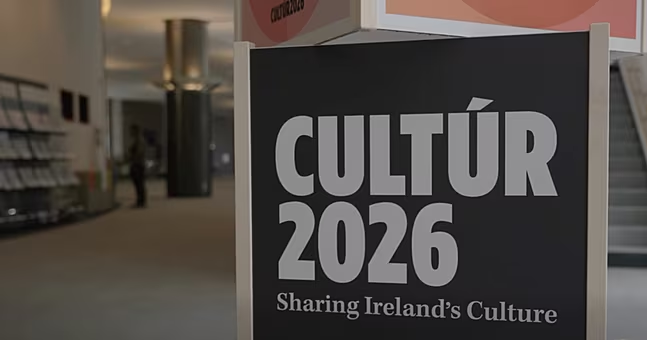
Ireland has installed a pop-up library inside the European Parliament in Brussels, featuring portraits and published works from 24 contemporary Irish writers. The display, which opened this week, is part of the cultural programme running alongside Ireland's presidency of the Council of the European Union.
What the exhibition contains
The project, titled Súil Amach / An Outward Eye, pairs each writer with a photographic portrait by Conor Horgan and a copy of one of their books. The writers were selected for what Culture Ireland describes as their "distinctive voices and international reach". The list spans established names such as John Banville, Anne Enright and Colm Tóibín alongside newer voices including Naoise Dolan, Nicole Flattery and Louise Nealon.
Horgan's portraits place each writer in a setting that holds personal or creative significance, from homeplaces to landscapes to everyday urban spaces that reflect their imaginative world, according to Culture Ireland. The approach is deliberate: these are not sterile author headshots but attempts to locate writers within the physical and imaginative territories that shape their work.
The exhibition takes its name from the Irish proverb An té a bhíonn siúlach, bíonn scéalach: those who travel have stories to tell. It is a fitting choice for a display mounted in one of the most transient workplaces in Europe, where MEPs and officials shuttle between Brussels, Strasbourg and their home countries.
Why contemporary writers, not the classics
Patrick O'Donovan, Ireland's Minister of Culture, Communications and Sport, made the point explicitly. Ireland is rightly celebrated for its incredible cultural heritage, with a long tradition of outstanding writers, musicians and artists that continue to inspire us today, he said. But, he added: "It is equally important to acknowledge the immense talent of our contemporary literary voices. Cultúr 2026 represents this spirit and this exhibition exemplifies this."
The emphasis on living writers is a deliberate diplomatic choice. When countries showcase culture abroad, the temptation is to lean on safe, canonical figures: Joyce, Yeats, Beckett. Those writers require no introduction in European literary circles. But showcasing living writers signals something different: that Ireland's literary culture is ongoing, not merely inherited. It also allows Ireland to present writers who engage directly with contemporary European concerns, from migration to identity to economic dislocation.
The translation angle
One detail in the exhibition's design carries more weight than it first appears. Culture Ireland notes that each featured writer's work has been translated into at least one of the EU's 24 official languages. In an institution where multilingualism is both a practical reality and a political principle, this matters. Translation is the mechanism by which a national literature stops being merely national. The European Parliament, which maintains interpretation and translation across all 24 official languages at considerable cost, is an apt venue for that argument.
The inclusion of writers working in Irish rather than English, among them Eiléan Ní Chuilleanáin, Doireann Ní Ghríofa, Tadhg Mac Dhonnagáin, Micheál Ó Conghaile and Darach Ó Scolaí, reinforces the point. Irish is recognised as an official EU language since 2022, a status that required institutional investment in translation capacity. Placing Irish-language writers alongside their English-language counterparts inside the Parliament makes a statement about linguistic diversity that goes beyond literary taste.
Council presidency cultural diplomacy
Every country holding the rotating six-month presidency of the Council of the European Union runs a cultural programme alongside the political and legislative work. These programmes serve multiple purposes: they raise a country's profile among EU officials and diplomats, they create favourable media coverage, and they soften the harder edges of political negotiation. The Council presidency rotates among member states, and each holder treats the accompanying cultural programme as part of the job.
Ireland's presidency in 2026 comes at a time when the country holds significant influence in Brussels. Ireland's position on corporate tax, on digital regulation, and on the EU's relationship with the United Kingdom has evolved since its last Council presidency in 2013. Cultural programming does not shift votes in Council meetings. But it does shape how a country is perceived by the officials and parliamentarians who staff the EU's permanent bureaucracy, and perceptions matter in a institution where informal relationships affect legislative outcomes.
The writers on display
The 24 featured writers span literary fiction, poetry, short stories and memoir. Several have received major international recognition. John Banville won the Booker Prize in 2005 for The Sea. Anne Enright won the same prize in 2007 for The Gathering. Paul Lynch won it in 2023 for Prophet Song, a novel about Ireland sliding into authoritarianism that resonated well beyond Irish readers. Colm Tóibín's work has been translated into more than 30 languages.
The younger generation is represented by writers such as Naoise Dolan, whose debut Exciting Times drew comparisons to Sally Rooney, and Nicole Flattery, whose fiction has been recognised with the London Short Story Award. The inclusion of Belfast writers Wendy Erskine and Jan Carson also quietly acknowledges the complexity of Irish literary identity across the island's political border.
Culture Ireland's role
Culture Ireland, the state agency responsible for promoting Irish arts worldwide, commissioned the project in partnership with Literature Ireland, which supports the translation and dissemination of Irish literature abroad. The collaboration between the two agencies is logical: Culture Ireland handles the international presentation, Literature Ireland handles the literary infrastructure, including translation support that makes it possible for these works to exist in French, German, Spanish and other European languages.
The exhibition will remain in the European Parliament for the duration of Ireland's Council presidency. Whether it reaches a wider audience after that period has not been confirmed.
People mentioned
-
Patrick O'Donovan
-
Conor Horgan
Organisations
Culture Ireland · Literature Ireland · European Parliament