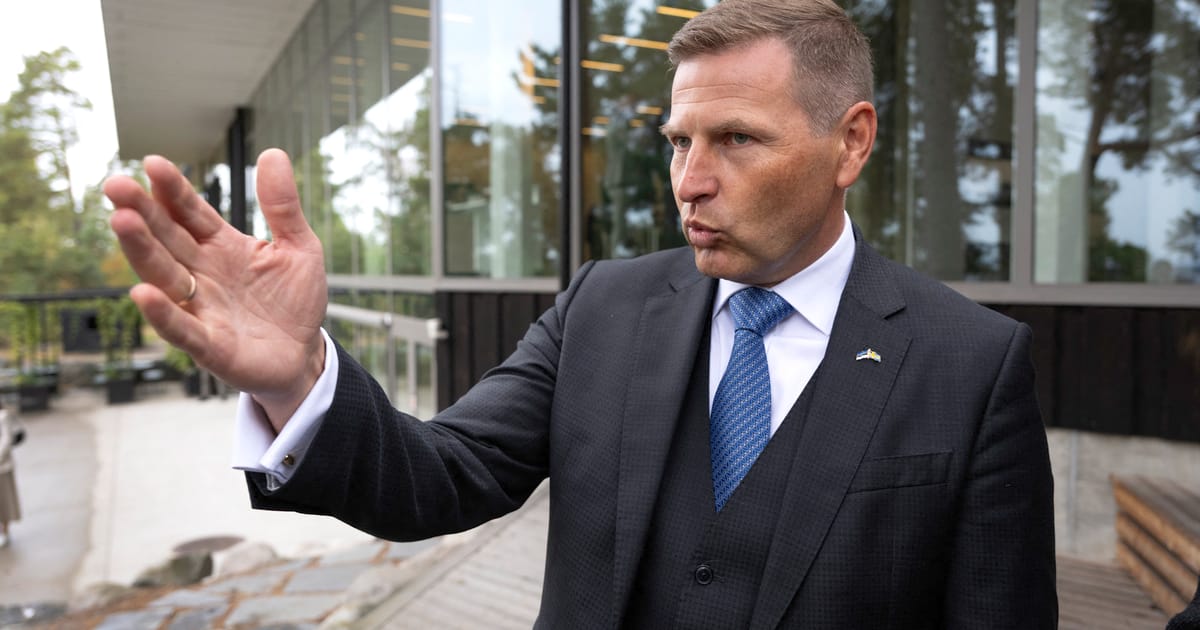
Estonia's defence minister Hanno Pevkur resigned on the evening of 2 September 2026, bowing to pressure after the country's national audit office exposed serious financial irregularities in his ministry and a botched €70 million ammunition contract intended for Ukraine. The centre-right politician, in post since 2022, said he would hand over to the prime minister at a suitable time.
A contract that delivered nothing
At the centre of the scandal is an artillery procurement contract awarded in 2024. Financed through the European Union's European Peace Facility, the deal was worth €70 million and was supposed to supply artillery shells. The contract went to Datasel S.R.L, a company registered in Italy but owned by an Indian firm, Neco Defence Munitions, which appears to have had no prior record of selling ammunition. The shells never arrived.
Estonia has since taken the case to the European Court of Arbitration, though the prospects of recovering the money or securing the ammunition remain uncertain. The episode raises immediate questions about how a contract of this size, funded partly by EU mechanisms, was awarded to a supplier with no verifiable track record in the defence trade.
What the auditors found
Estonia's National Audit Office reported last month that it had found "serious problems" in the defence ministry's use of funds and accounting of assets. This was not the first such warning. The watchdog made similar claims in 2025, suggesting that the problems were persistent rather than a one-off lapse.
The audit office's findings extended beyond the ammunition contract. The broader picture was one of a ministry struggling to manage a rapid expansion in spending without the administrative controls to match. Defence budgets in Estonia, as across much of Europe, surged after Russia's full-scale invasion of Ukraine in February 2022. The speed of that increase appears to have outpaced the ministry's capacity for oversight.
Pevkur himself acknowledged the scale of the change. Under his tenure, Estonia raised defence spending from 2 per cent of gross domestic product to 5 per cent, one of the highest proportions of any NATO member state. That increase was a deliberate policy response to the changed security environment. But money poured in faster than the institutional machinery could track it.
The minister's defence
Pevkur's explanation for the failed ammunition contract was striking. He said he had not read the contract, arguing that the ministry is not usually involved in procurement details. The actual contracting was handled by the Centre for Defence Investments, the procurement arm of Estonia's defence establishment, while the defence forces set the operational requirements.
"Although the minister does not count socks and ammunition or conduct contract negotiations, the National Audit Office's criticisms, primarily concerning the activities of the defence forces and the Center for Defense Investments, raise the question of political responsibility," Pevkur wrote in a social media post announcing his resignation.
The formulation is a familiar one in European politics. A minister accepts political responsibility not for a personal error but for systemic failures within the organisations they oversee. Pevkur was not accused of personally directing the contract to Datasel. The charge, rather, was that the system under his watch failed to perform basic due diligence on a supplier handling tens of millions of euros.
The European Peace Facility's role
The ammunition contract was financed through the European Peace Facility, an off-budget EU mechanism set up to provide military assistance to partner countries, most notably Ukraine. The facility has disbursed billions of euros since 2022, and its governance has attracted criticism before. Member states contribute financially, and the European Council authorises spending, but the actual procurement is often delegated to individual countries acting on behalf of the EU.
This arrangement means that the EU sets the strategic direction but relies on national authorities to execute purchases. When those national authorities fail to vet suppliers properly, as appears to have happened here, the EU's financial exposure is real but its direct oversight is limited. Estonia was acting as a conduit for EU-funded military aid. The failure is therefore not only Estonian but also European, in the sense that the EU's mechanism for arming Ukraine proved vulnerable to a basic procurement error.
The European Peace Facility has been a contentious instrument since its inception. Some member states have questioned whether the EU should be financing lethal military assistance at all. Others have argued that the facility's off-budget status weakens parliamentary scrutiny. The Estonian ammunition fiasco will give ammunition, so to speak, to both camps.
Due diligence failures
The most uncomfortable question is the simplest: how did a €70 million contract for artillery ammunition end up with a company that had no record of selling ammunition? Neco Defence Munitions, the Indian parent company, is not a name that features in the established defence trade. Datasel S.R.L, its Italian-registered subsidiary, appears to have been a shell through which the contract was channelled.
Defence procurement is not a sector where newcomers routinely win large contracts. Established manufacturers have track records, certifications, and supply chains that can be verified. The absence of these markers should have been a red flag at multiple stages: during the initial tender evaluation, during contract negotiation, and during any due diligence review required by EU funding rules.
That none of these checks caught the problem suggests either that the procedures were inadequate, that they were not followed, or that urgency overrode caution. Since 2022, European governments have been under intense pressure to source ammunition quickly for Ukraine. Speed has often been prioritised over thoroughness. In this case, the result was a contract that delivered nothing at all.
Estonia's defence spending surge
Estonia's decision to raise defence spending to 5 per cent of GDP is among the most ambitious commitments made by any NATO member. The country shares a border with Russia and has been one of the most vocal advocates within the alliance for taking the Russian threat seriously. Pevkur can reasonably claim that the spending increase happened on his watch and that it represented a necessary response to the security environment.
But rapid spending increases carry risks. When budgets double or treble in a short period, the institutions managing them are stretched. Staff who previously handled procurement worth tens of millions suddenly oversee hundreds of millions. Oversight mechanisms designed for smaller budgets may not scale. The audit office's complaints about asset accounting suggest that the ministry was struggling to keep track of what it had bought, let alone whether it had been delivered.
Estonia is not alone in facing this problem. Across Europe, defence ministries have expanded budgets at a pace that strains institutional capacity. The difference is that in Estonia the audit office has been willing to say so publicly, and the political consequences have followed.
Political consequences in Tallinn
Pevkur, a member of the centre-right Reform Party, has been a prominent figure in Estonian politics for years. He served as interior minister before taking the defence portfolio in 2022. His departure will be felt in Tallinn and in Brussels, where he has been a consistent voice for stronger European defence cooperation.
The resignation also comes at a delicate moment for the Estonian government. Prime Minister Kaja Kallas, also of the Reform Party, has staked her political reputation on a hard line against Russia and a rapid military build-up. Losing a defence minister to a procurement scandal undermines the narrative of competence that the government has tried to project on security matters.
Pevkur said he would pass the baton to the prime minister at a suitable time, suggesting that an interim arrangement may be in place while a replacement is identified. The phrasing also implies that Kallas may temporarily hold the defence portfolio herself, an unusual step that would concentrate significant responsibility in her hands during a period of institutional strain.
People mentioned
-
Hanno Pevkur
Organisations
National Audit Office of Estonia · Datasel S.R.L · Neco Defence Munitions · European Court of Arbitration