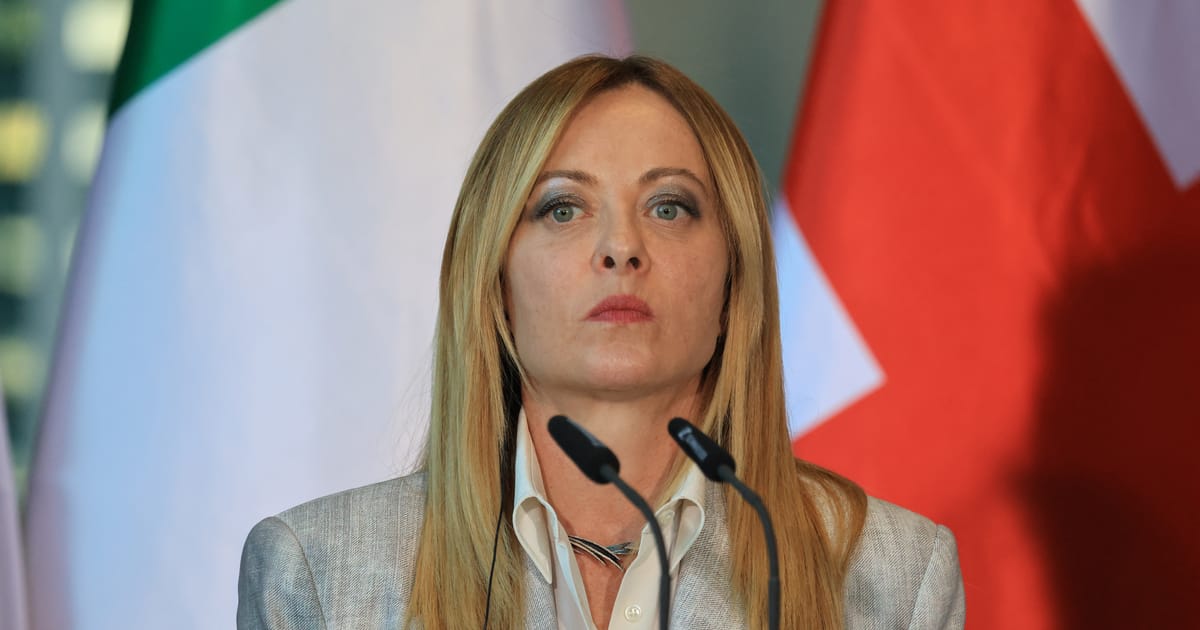
Giorgia Meloni marked 1,412 consecutive days as Italy's prime minister on 4 September, eclipsing Silvio Berlusconi's record for the longest unbroken stretch at the head of government since the republic's foundation. The milestone was celebrated at a rally in Bari with coalition allies, but the anniversary arrives as Meloni confronts a convergence of pressures that will determine whether endurance translates into a lasting political imprint.
A record built on stability, not transformation
Berlusconi's 1,412-day unbroken run was part of a cumulative 3,340 days across four separate mandates, a career defined by survival through electoral defeats, criminal trials and coalition collapses. His durability rested on personal wealth, a television empire and a party built entirely around his persona. Meloni, 49, possesses none of those structural advantages. What she does command is a polling lead that has held for years, a coalition in which she towers over her partners, and a reputation abroad that Berlusconi never achieved.
Lorenzo Pregliasco, a pollster who has tracked Italian politics for two decades, says voters continue to rate Meloni as the only credible prime ministerial figure on the right. "She is seen as fit to be prime minister in a way other party leaders maybe are not," he told me. That perception of competence, especially in European councils where she has forged working relationships with European Commission President Ursula von der Leyen and German Chancellor Friedrich Merz, has given Italy diplomatic weight that Rome lacked during the chaotic coalitions of the 2010s.
The electoral reform that could lock in a majority
The most consequential move of Meloni's fourth year is a proposed overhaul of the electoral law. Her parliamentary majority is pushing to replace single-member constituencies with proportional representation and award a substantial seat bonus to the winning coalition. The mechanism echoes the 2005 Calderoli law, engineered by Berlusconi, which handed him a commanding majority in 2008 before being partially struck down by the constitutional court.
If enacted before the 2027 general election, the reform would allow a centre-right victory to translate into a supermajority, strengthening Meloni's hand in two high-stakes appointments: the 2029 election of the president of the Republic, chosen by a joint session of parliament and regional delegates, and a potential revival of her stalled plan for the direct election of the prime minister. Both would require constitutional changes, which need two-thirds majorities or a confirmatory referendum, hurdles that have defeated previous leaders.
Economic headwinds shrink the pre-election budget
Meloni's room for manoeuvre is narrowing. The European Commission's spring forecast projects the Italian economy will slip into recession in the second half of 2026, while public debt is on course to surpass Greece's as the highest in the euro area relative to GDP. Energy costs remain elevated and NATO allies are pressing for higher defence spending. The autumn budget, the last before voters go to the polls, will be the first in Meloni's tenure where she cannot rely on expansionary fiscal policy to buy consent.
That constraint is already feeding criticism. Laura Boldrini, a Democratic Party MP and former speaker of the Chamber of Deputies, dismissed the longevity record as hollow. "Longevity is not a value per se. You have to implement policies that improve people's lives, make reforms and make a difference. And this hasn't happened," she said. Boldrini argues that stagnant wages, a cost-of-living crisis and money spent on failed migration deterrence schemes have left Meloni's base disappointed.
The Vannacci factor fragments the right
The clearest evidence of that disappointment is the rise of Roberto Vannacci, a former general whose self-published book attacking feminism, immigration and LGBT rights became a bestseller. Vannacci's entry into the European Parliament on a League list gave him a platform, and he has since built a personal following that polls suggest could command 5 to 7 per cent of the national vote. His rhetoric is explicitly more radical than Meloni's, and he has attracted voters who believe the prime minister has governed as a conventional conservative rather than the transformative nationalist she campaigned as.
Boldrini predicts the centre-right will ultimately be forced to accommodate Vannacci. "The right-wing coalition has a big problem called Vannacci: a fascist, racist, misogynist, who is collecting a lot of resentment from those who have been disappointed by Meloni's government. They say they won't run together but I think they will or they won't win," she said. Meloni's allies publicly rule out an alliance, but the arithmetic of a fragmented right makes some form of understanding probable if the electoral reform does not deliver a bonus large enough to offset vote-splitting.
International credibility tested by migration rules
Meloni's standing in Brussels and Berlin has been an asset. She negotiated the EU's new migration and asylum pact from a position of influence, securing provisions on external border procedures and safe-third-country designations that aligned with Rome's priorities. But the pact's implementation is now creating friction. Germany, Ireland and several northern member states are invoking the regulation's 'take-back' clauses to return asylum seekers whose first EU entry was in Italy. The new rules oblige Italy to readmit them, reopening the north-south fault line that dominated EU summits a decade ago.
Meloni's government has signalled resistance, arguing that frontline states cannot absorb secondary movements while also managing primary arrivals. The dispute will test whether her personal rapport with von der Leyen and Merz translates into concrete flexibility, or whether the EU's legal framework forces a climbdown that damages her domestic narrative of sovereignty.
Berlusconi's shadow and the presidency question
Berlusconi's death in 2023 removed a figure who, despite his diminished parliamentary weight, retained a media empire and a pro-Russian stance that complicated Meloni's Atlanticist positioning. His absence cleared space for Meloni to become the undisputed centre of gravity on the right, a role Roberto D'Alimonte, a political scientist at Luiss University, compares to Angela Merkel's dominance of the CDU. "She has become the centre of gravity for the right," D'Alimonte said. "There is no alternative leader in that coalition."
Yet Pregliasco cautions that Meloni has so far inherited and managed Berlusconi's architecture rather than building her own. "I wouldn't consider her as defining a figure as Berlusconi," he said. "Berlusconi created the modern centre-right in 1994 and reshaped Italian politics around his highly personalised leadership. Meloni has dominated that architecture rather than creating her own." The electoral reform, if successful, would be her first structural imprint on the system.
Beyond a second term, allies speculate about the presidency of the Republic. Nicola Procaccini, a Brothers of Italy MEP who has known Meloni since their youth-wing days, says the role would suit her after three decades in public life. "She is not a leader by chance. Everyone knows what to expect from her," he said. Procaccini laughs at the idea of another 20 or 30 years in Palazzo Chigi, "gruelling" at her intensity, but sees her remaining a political force for decades.
The next twelve months decide the legacy
People mentioned
-
Laura Boldrini
-
Italo Bocchino
Organisations
Brothers of Italy · Italian Government · European Commission · Democratic Party