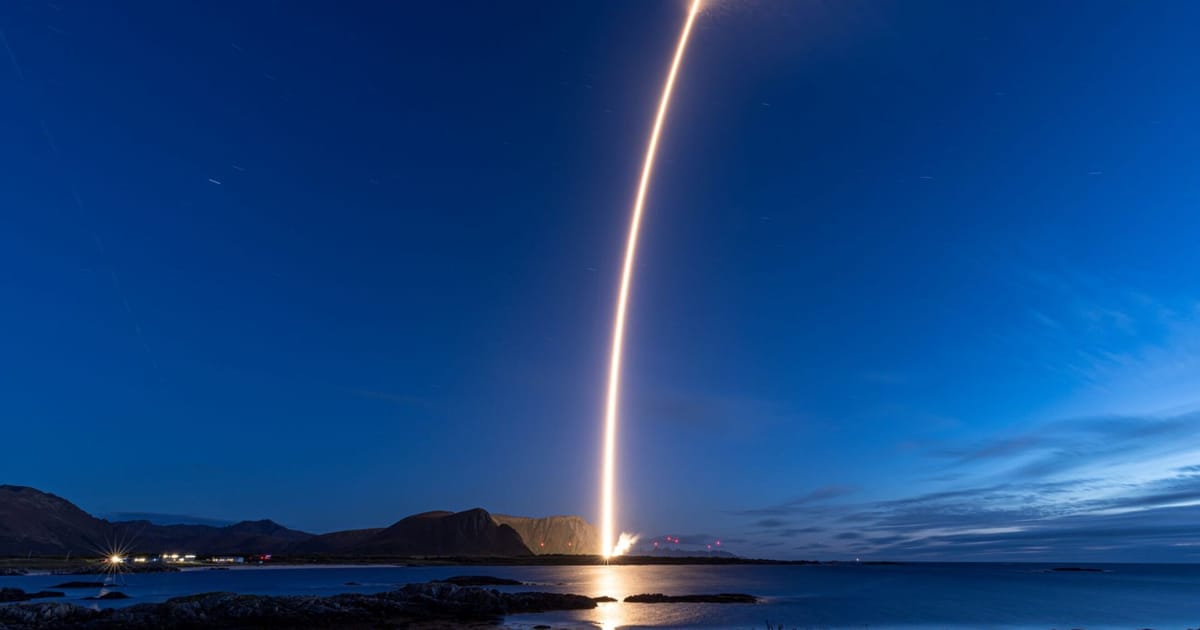
A 28-metre rocket lifted off from a snow-dusted pad on Andøya island in northern Norway on Saturday night, climbed through the Arctic darkness and, nine minutes later, released five small satellites into a polar orbit. For the German startup Isar Aerospace, the flight, its second attempt after a debut that ended in the North Sea last March, was the moment a private European company finally proved it could do what only state-backed programmes had managed before: reach orbit from the continent's own soil.
A decade of dependency
The launch arrives at a moment when Europe's access to space has never looked more fragile. Since Russia's invasion of Ukraine severed Soyuz flights from Kourou, and with the Ariane 6 still working through its early missions, the continent has leaned almost entirely on Elon Musk's SpaceX for medium and heavy lift. In 2024, European institutional payloads flew on Falcon 9 more often than on any European vehicle. That dependency is not merely commercial; it is strategic. Satellites for secure communications, earth observation and early warning cannot wait for a foreign provider's schedule or political clearance.
Chancellor Friedrich Merz put it bluntly when he visited Andøya in March: Europe has been "dependent on other supply chains and other countries in the world for far too long." The sentiment is shared across capitals, but turning rhetoric into reliable launch capacity has proved stubbornly difficult. Vega-C remains grounded after a 2022 failure. Ariane 6 flew once in July 2024 and is not expected to reach a sustainable cadence before 2026. Into that gap step the startups.
From Munich to the Arctic
Isar Aerospace, founded in 2018 near Munich, has raised more than €400 million from investors including HV Capital, Lakestar and the NATO Innovation Fund. Its Spectrum rocket burns liquid oxygen and propane, a choice the company says simplifies handling and reduces cost compared with kerosene. The first flight, in March 2025, lost thrust vector control seconds after liftoff and was terminated. Saturday's mission, dubbed "Onward and Upward," carried a mix of commercial and research payloads for customers in Germany, Norway and the United States.
The Norwegian site matters. Andøya Space, owned by the Norwegian state, offers high-inclination orbits without overflying populated areas, a rarity in Europe. Isar has a long-term lease on a dedicated pad, giving it operational control that Kourou's shared facilities cannot. The company is also building a second site in Canada, aiming for a similar latitude advantage over the Atlantic.
A crowded field
Isar is not alone. Spain's PLD Space has flown its suborbital Miura 1 and targets an orbital Miura 5 debut in 2026. France's MaiaSpace, an ArianeGroup spin-off, aims for a first flight in 2026. Germany's Rocket Factory Augsburg and the UK's Orbex are further back. Arianespace, the incumbent, still operates from French Guiana, legally European territory but 7,000 kilometres from Brussels. The question is not whether Europe can produce rockets, but whether the market can sustain several.
The small-satellite launch market is projected to grow, but it is also brutally price-sensitive. SpaceX's rideshare missions offer a kilogram to sun-synchronous orbit for roughly $6,000. European startups must match or beat that while flying far less frequently. Isar's target of 30-plus Spectrum rockets a year implies a cadence of one every twelve days, a rate no European launcher has ever sustained.
Politics meets the pad
The launch coincides with the International Space Summit in Paris on 9, 10 September, where delegations from more than 120 countries will gather. Ursula von der Leyen will deliver her first speech devoted entirely to space policy, and the Commission is expected to unveil the European Space Shield, an action plan to protect the bloc's satellites from interference, collision and cyber attack. The Trump administration has reportedly discouraged US companies from attending, a reminder that transatlantic space cooperation cannot be taken for granted.
The Shield is part of a broader push: the EU's proposed IRIS² multi-orbit connectivity constellation, a European launcher alliance to aggregate demand, and a space law to harmonise liability and licensing across member states. None of these move fast. Isar's flight moved fast, two years from first metal cut to orbit.
The commercial test begins
Isar's next steps are concrete. The company says it will analyse flight data, qualify the vehicle for commercial service and begin integrating customer payloads for the third flight, tentatively scheduled for late 2026. It must also transition from a development organisation to a production line, hiring, qualifying suppliers and certifying processes. The Canadian site adds regulatory complexity: export controls, environmental permits and range agreements with Transport Canada.
A European capability, not yet a European industry
Saturday night's success is real, and it deserves the superlatives it received. But a capability demonstrated once is not an industry. The European Space Agency's Josef Aschbacher called it "yet another step towards a more diverse autonomous European launch service sector", note the word "towards." The sector will be judged not by the altitude reached on 5 September, but by the number of flights logged in 2027, the price per kilogram offered to customers, and the willingness of European governments to buy tickets on their own rockets rather than defaulting to the American alternative. That story is still being written.
People mentioned
-
Josef Aschbacher
Organisations
Isar Aerospace · European Space Agency · European Commission · Arianespace · PLD Space · MaiaSpace