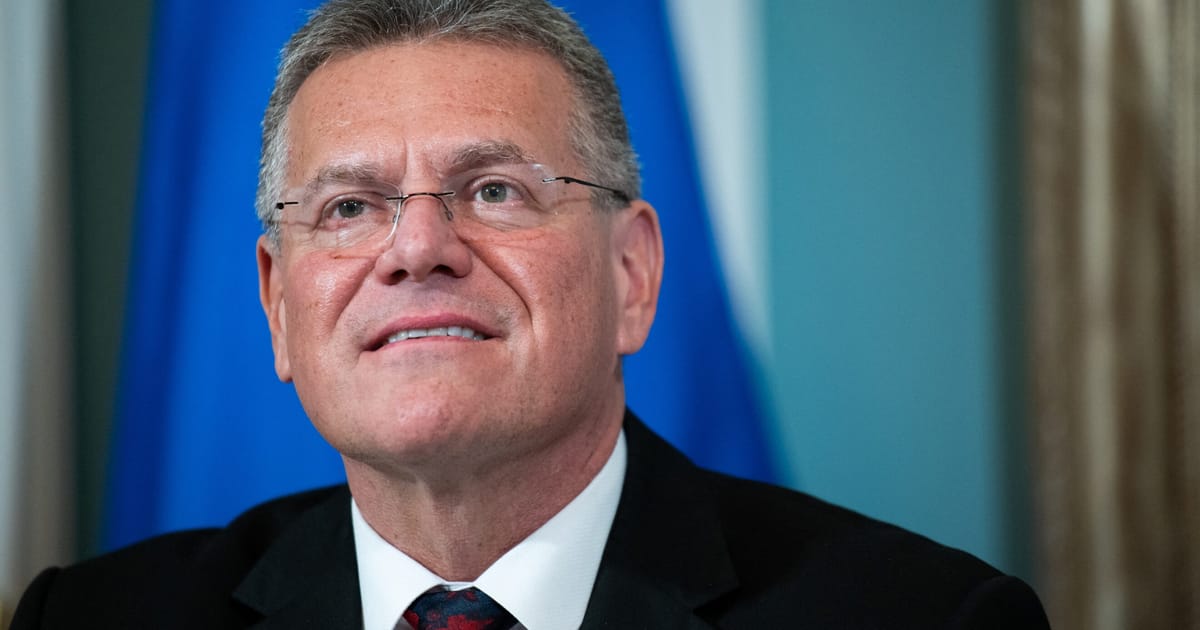
The European Commission has signalled a marked shift in its China strategy, moving beyond reactive trade defences toward a managed-trade framework that would ask Beijing to restrain export volumes while opening its market to more European goods. In an interview on Monday, Trade Commissioner Maroš Šefčovič said the bloc's €1 billion-a-day goods deficit with China cannot be resolved by European exports alone. "Mechanically, if you look at our deficit issue, what's needed is the increase of European products to China … We also need to look at how to manage better the Chinese exports to the European Union," he said.
A deficit that concentrates political minds
The figure of €1 billion per day, cited by member states in June, has become a rallying point for national leaders who demanded concrete tools from Brussels within months. Two months on, the pressure has only intensified. Chemical producers and car manufacturers across the Union are idling plants and cutting jobs, unable to match the pricing of Chinese rivals benefiting from what the Commission describes as sustained state subsidies. The political calendar is unforgiving: EU leaders expect "clear deliverables" by the mid-October European Council, including pilot schemes to address what Brussels calls China's supply glut.
Šefčovič confirmed a videoconference with his Chinese counterpart, Wang Wentao, for mid-September, followed by a visit to Beijing at the start of October. A team of EU negotiators is already in China this week. The commissioner characterised the discussions as "very open, very tough," with "all topics … on the table." The language suggests a negotiation rather than a dialogue, a distinction that matters in a relationship where Beijing has historically resisted quantitative limits on its exports.
Echoes of the 1980s voluntary restraints
The approach Šefčovič outlined recalls the voluntary export restraints negotiated with Japan and South Korea in the 1980s, when Tokyo and Seoul agreed to cap shipments of cars, steel and electronics to Europe and the United States. Those arrangements were political compromises, not market outcomes, and they eventually gave way to WTO rules that frown on quantitative restrictions. The Commission knows this history. Its current thinking is framed as a response to distortions that "are not generated on the pure economic performance or pure market logic," in Šefčovič's words.
What the EU would like to sell is relatively uncontroversial: agricultural products, medical devices, cars that do not fall into sensitive technology categories. The difficulty lies in what it wants to restrict. Chinese overcapacity spans steel, aluminium, solar panels, batteries and increasingly electric vehicles, sectors where Beijing's industrial policy has created production far exceeding domestic demand. Managing those flows without triggering retaliation or violating WTO commitments will require legal creativity the Commission is still developing.
Safeguards, steel and the search for calibration
The Commission's recent use of updated safeguard measures on steel imports in early July offers a template, and a caution. The move irritated trading partners, notably Brazil and China, and Šefčovič acknowledged the tool is "very heavy-handed." His department is now drawing lessons to make future investigations faster and more calibrated. The goal is a safeguard regime that can be deployed surgically rather than as a blunt instrument, targeting specific surges in specific sectors without collateral damage to unrelated supply chains.
Parallel to this, Brussels is finalising a "diversification instrument" designed to incentivise companies to source critical inputs, rare earths, lithium, certain semiconductors, from alternative suppliers. "Of course, diversification brings costs," Šefčovič said, pointing to higher prices for critical minerals and green-tech components. But he argued that some firms are concluding "the cost of diversification is smaller than the cost of disruption." That calculation will be tested as the instrument moves from concept to regulation.
Inflation constraint narrows the policy space
Any measure that raises the price of Chinese imports feeds directly into an inflation picture that remains uncomfortable. Eurozone headline inflation reached 2.9% in July, well above the European Central Bank's 2% target, driven in part by energy-price spillovers from the Iran conflict. The ECB's governing council has signalled reluctance to cut rates further until services inflation eases. Trade restrictions that function like tariffs, whether safeguards, anti-dumping duties or voluntary restraints, act as a tax on European importers and, ultimately, consumers. That makes the Commission's task politically delicate: leaders want relief for producers, but not at the cost of a new inflationary impulse.
The Commission's own analysis, shared with member states in recent weeks, models several scenarios. In the most aggressive, a broad-based safeguard package could add 0.3 to 0.5 percentage points to headline inflation over twelve months. That is not trivial when the ECB is calibrating policy to the decimal point. It also explains why Šefčovič emphasises a negotiated outcome: a Chinese agreement to moderate exports in specific sectors would achieve the volume effect without the price effect of a tariff.
The fallback: full use of trade defences
If the September-October engagement yields no movement, Šefčovič was explicit about the alternative. "We are working with very concrete proposals. Let's see how our Chinese counterparts would react to them … But if simply there will be no action, then of course it will be much more difficult for us just to talk about these issues," he said. That is diplomatic code for a shift to enforcement: anti-subsidy investigations, anti-dumping cases, safeguard triggers, and potentially the Foreign Subsidies Regulation, which allows the Commission to unwind acquisitions or block tenders distorted by non-EU state support.
The steel safeguard of early July was the first live test of the updated framework. It imposed tariff-rate quotas on a range of steel products, with the Commission arguing that a surge of imports threatened serious injury to EU producers. China and Brazil challenged the measure at the WTO within weeks. The Commission's legal team believes the new methodology, which incorporates a "critical circumstances" provision allowing faster action, will withstand scrutiny. But the disputes will take years to resolve, during which the measures remain in force.
Diversification as strategic imperative
Beyond the immediate deficit, the diversification instrument reflects a deeper reassessment of economic security. The pandemic, the energy crisis after Russia's invasion of Ukraine, and the weaponisation of critical-mineral supply chains by Beijing have convinced policymakers that efficiency cannot be the sole criterion for sourcing. The instrument will likely combine taxonomy, defining which inputs and sectors count as strategic, with financial incentives such as grants, loans or tax credits for qualifying diversification projects.
Industry reaction has been mixed. The European Chemical Industry Council (Cefic) has warned that forced diversification raises production costs in a sector already struggling with high energy prices. The European Automobile Manufacturers' Association (ACEA) has been more circumspect, acknowledging supply-chain risks while opposing measures that could provoke Chinese retaliation against European car exports. Germany, whose carmakers derive roughly a third of their global revenue from China, has been the most cautious voice in the Council. France and Italy have pushed harder for protective tools.
What Beijing calculates
From Beijing's perspective, the EU's demand for export restraint arrives as China's own economy contends with a property-sector crisis, weak domestic consumption and youth unemployment above 17%. Export-led manufacturing has been the one reliable growth engine. The Chinese leadership has signalled willingness to discuss market access, Premier Li Qiang told visiting European executives in June that "China's door will only open wider", but has resisted any language that implies managed trade or voluntary caps. Wang Wentao's ministry has consistently framed overcapacity as a global issue requiring coordinated investment, not unilateral restriction.
There is precedent for limited accommodation. In 2018, China agreed to a "voluntary restraint" on steel exports to the US as part of a broader trade truce, though the arrangement collapsed when the broader deal unravelled. More recently, Chinese solar manufacturers have informally coordinated pricing to avoid triggering EU anti-dumping measures. These are tactical adjustments, not structural concessions. The Commission's challenge is to secure something durable and verifiable, pilot schemes with monitoring, review clauses and snapback provisions, rather than a gentlemen's agreement that evaporates when market conditions shift.
People mentioned
Organisations
European Commission · European Council · European Central Bank