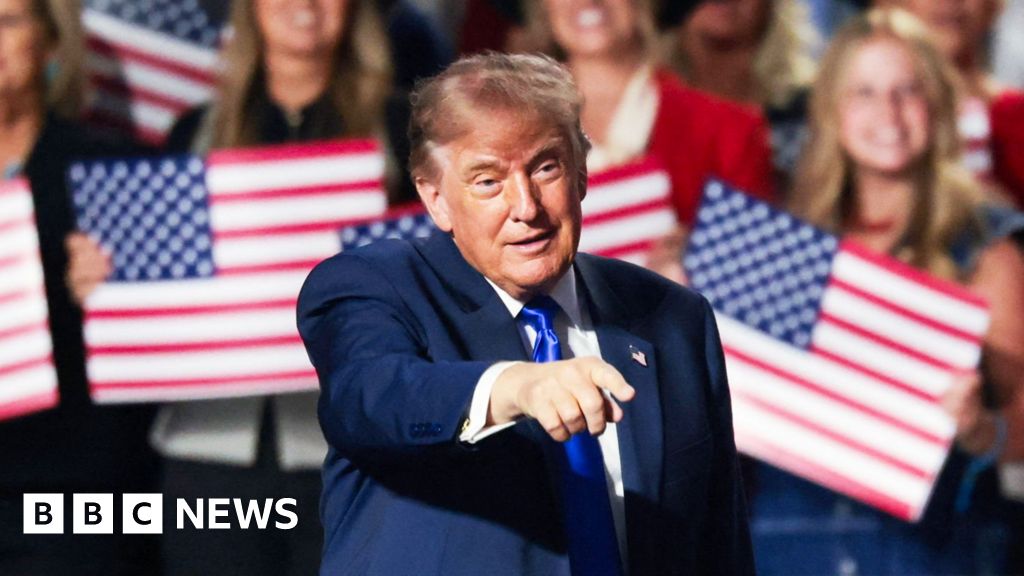
Donald Trump used the Republican Party's first midterm convention of his second term to promise a $5,000 cash payment to every adult American citizen, conditional on his party retaining control of both the House of Representatives and the Senate in the 3 November elections. The pledge, made to raucous applause in Dallas, Texas, would carry a price tag of roughly $1.3 trillion given the United States' adult population of nearly 270 million.
The president offered no legislative detail, no funding mechanism beyond a vague reference to tariff revenue, and no explanation of how the spending would be monitored to ensure the money remains inside the United States. "We don't want you going to Canada to spend the money," he told the hall. "We don't want you going to China, to Germany. You got to spend the money in the United States of America."
Tariff revenue claim contradicted by Supreme Court ruling
Vice-President JD Vance sought to anchor the promise in the administration's trade policy, telling Fox News that "we're taking in an extraordinary amount of revenue because the president of the United States is actually standing up to both foreign companies but also foreign countries who've been taking advantage of America's workers." The claim sits uneasily with a February Supreme Court decision that struck down most of Trump's tariff programme as unlawful. No replacement legislation has been enacted, and no federal dividend programme exists.
The administration has previously floated similar ideas. During the 2024 campaign Trump proposed $2,000 cheques funded by tariffs; those payments never materialised. Robert Moran, a former Republican strategist, told the BBC World Service that the latest promise should be seen firmly in electoral context: "It is an extraordinary promise, and I'm not sure where that money is going to come from, but it is campaign season." He noted the historical pattern in which the president's party typically loses congressional seats at the midterms.
War with Iran keeps Strait of Hormuz closed
The convention took place against a backdrop of a conflict that began in February when the United States and Israel launched military action against Iran. Iranian retaliation has included attacks on US bases and Gulf allies, and the effective closure of the Strait of Hormuz. About one-fifth of the world's oil and liquefied natural gas previously transited the strait, according to International Energy Agency data. The blockage has injected persistent volatility into global energy markets, with direct consequences for European importers.
Trump acknowledged the economic pain, telling supporters the war would not end before the midterms and that oil prices would not fall until then. He framed the conflict as a necessary sacrifice to prevent Tehran from developing nuclear weapons. For European capitals, the prolonged disruption of a critical energy chokepoint compounds the inflationary pressure that the European Central Bank has been navigating since 2022.
Legal experts split on vote-buying question
Federal law prohibits payments intended to influence voting. The issue surfaced during the 2024 presidential campaign when Elon Musk offered cash incentives to registered voters in swing states who signed a petition. Trump's promise raises the same question in a different form. John Day, a lawyer in New Mexico, told the Associated Press the plan would be legal because it constitutes a campaign promise to all adult citizens rather than a payment to individuals conditional on voting behaviour.
An election law expert quoted by the New York Times argued the promise is also protected by the First Amendment's free-speech guarantee. The distinction matters: if the payments are characterised as a future tax cut or universal dividend, they fall within normal campaign rhetoric. If they are structured as a conditional transfer tied to electoral outcome, they risk violating 52 USC § 10307 and related statutes.
Congressional approval would be required
Under the US Constitution, Congress authorises all federal spending. Trump did not say whether he would ask the House and Senate to appropriate the $1.3 trillion, nor did he address how the programme would be administered. The midterm elections will decide whether Republicans retain the majorities needed to pass such legislation. Current polling suggests a competitive environment in both chambers, with the president's party historically vulnerable.
Historical parallels and precedents
Democrats in Georgia promised $2,000 relief payments during the 2020-21 Senate runoffs, a pledge fulfilled through federal Covid legislation after they won. Trump's version is larger in scale and lacks a legislative vehicle. The "Trump Dividends" branding suggests an attempt to personalise the benefit, a tactic that echoes the stimulus cheques of 2020 and 2021 which bore the president's name. Those payments were authorised by Congress with bipartisan support; this proposal has no such momentum.
European exposure to the Hormuz closure
While the dividend promise dominates US headlines, European policymakers are tracking the energy fallout. The EU imported roughly 10% of its crude oil and 15% of its LNG via the Strait of Hormuz before the closure, according to Eurostat trade data. Rerouting has increased shipping times and insurance costs, feeding into industrial input prices at a moment when the euro area is attempting to revive stagnant growth. The European Commission has accelerated its REPowerEU diversification targets, but replacement infrastructure takes years.
Trade tensions add a second channel of exposure. Trump's tariff programme, even in its truncated post-Supreme Court form, has targeted steel, aluminium, and automotive imports from the EU. The administration's argument that tariff revenue can fund domestic dividends implies a permanent protectionist posture. World Trade Organization dispute settlement remains paralysed, leaving European exporters with limited recourse.
A campaign promise without a policy
The $5,000 dividend functions as a political instrument, not a policy proposal. Its scale exceeds the entire discretionary federal budget for 2025. Its funding source has been judicially invalidated. Its legal status is contested. Its conditionality on an election outcome places it in a grey zone that the courts have not definitively resolved. For the 270 million Americans who would supposedly benefit, the only certainty is that the cheque is not in the mail.
People mentioned
Organisations
Republican Party · White House · United States Congress · United States Supreme Court