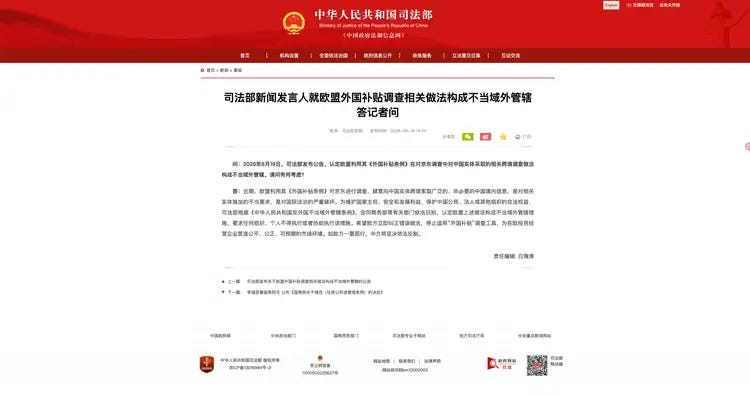
Beijing has, for the second time this year, told Chinese companies and banks to ignore demands from the European Commission's Foreign Subsidies Regulation investigators. Announcement No. 8 of 2026, issued on 19 August by China's Ministry of Justice, declares that certain cross-border information requests sent to Chinese entities as part of the FSR probe into JD.com amount to "improper extraterritorial jurisdiction" and prohibits anyone in China from complying with them.
The wording mirrors Announcement No. 5 of 15 May, which covered the Commission's investigation into security-scanner maker Nuctech. Two near-identical orders in three months suggest Beijing has settled on a repeatable template for pushing back against the regulation, and that the EU's use of FSR powers against Chinese-owned acquirers will now run into a structured Chinese counter-response each time it is deployed.
The deal caught in the middle
The dispute sits inside a single transaction. In April, JD.com, one of China's largest e-commerce groups, notified Brussels of its plan to buy CECONOMY, the German-listed parent of the MediaMarkt and Saturn electronics chains, for roughly €2.2 billion. The Commission opened an in-depth FSR investigation on 28 May, suspecting that the Chinese retailer had benefited from preferential financing, tax advantages or government grants that may have allowed it to outbid rivals and, after closing, to undercut competitors on the European market.
By 22 July the case had reached a Statement of Reasons, a formal document outlining the Commission's concerns, putting JD.com under mounting pressure to produce evidence about its financing and broader group support. The Commission's original deadline for a decision, approval with conditions or prohibition was 2 October. China's blocking order lands in the final stretch of that timetable.
JD.com has insisted throughout that the acquisition will be funded through commercial bank loans and its own operating cash, with no Chinese government subsidies involved. The problem, as several trade lawyers have noted, is that the Commission's questions range well beyond the price tag. Investigators want to know whether the wider JD.com group has received "foreign financial contributions" of any kind, loans, tax breaks, grants, in the preceding three years, and whether any of that support helped build the company now bidding for CECONOMY. Pointing to clean acquisition financing does not, on its own, answer that broader inquiry.
Trapped between two regulators
Announcement No. 8 does not tell JD.com to walk away from the deal. Beijing has explicitly stopped short of demanding that the Commission terminate its review, or of asserting that the EU has no jurisdiction over a Chinese bidder for a European company. What it prohibits is the cross-border investigative activity: requests for information sent to institutions inside China, banks, suppliers, government bodies, other companies, which Beijing considers enforced from Brussels without Chinese consent.
The result is an unusually stark conflict of laws for a single corporate defendant. If JD.com, or any Chinese bank or supplier caught up in the probe, hands over the material the Commission has asked for, it risks falling foul of the Chinese prohibition. If it refuses, the Commission is entitled under the FSR to draw adverse inferences, treating non-cooperation as evidence in itself and potentially moving towards a prohibition decision.
JD.com's lawyers will now have to triage every outstanding request, separating information held within the EU, ordinary commercial data already in JD.com's group files, and any item that would require a third party in China to dig through domestic records. The first two categories are unlikely to be covered by the prohibition. The third is precisely what Beijing says Chinese organisations may no longer do.
Beijing's extraterritoriality playbook
The legal scaffolding behind Announcement No. 8 has been under construction for six years. After Washington began using secondary sanctions to coerce Chinese counterparties out of trade with Iran and Russia, China started building domestic instruments that would allow it to punish companies, including its own, that complied with foreign long-arm measures.
The 2020 Unreliable Entity List and the 2021 Rules on Counteracting Unjustified Extra-territorial Application of Foreign Legislation laid the first bricks. The Anti-Foreign Sanctions Law, adopted later that year, elevated the regime to national legislation and explicitly barred organisations and individuals from implementing or assisting foreign discriminatory measures against Chinese parties. Article 33 of the 2023 Foreign Relations Law widened the basis further, authorising countermeasures against conduct that breaches international law and harms Chinese sovereignty, security or development interests.
What changed this year was the targeting. In July 2024, the Ministry of Commerce opened a trade and investment barriers investigation into the EU's application of the FSR, focusing on what it called the disproportionate concentration of cases against Chinese firms, an overly expansive reading of "foreign financial contributions" and excessive requests for information located in China. A final determination in January 2025 confirmed those findings. In April 2026, the State Council promulgated the Regulations on Countering Improper Extraterritorial Jurisdiction by Foreign States, giving the Ministry of Justice, working with the Ministry of Commerce and other agencies, the power to investigate foreign measures, publish blocking announcements and ultimately authorise further countermeasures. Nuctech was the first test of that framework; JD.com is the second.
Where Brussels and Beijing disagree
The Commission's position is straightforward. JD.com wants to buy a company that runs stores and websites across the European market. The transaction has an obvious territorial nexus with the EU, and the Commission says it needs full visibility into JD.com's finances to decide whether the deal will distort competition once completed. From that perspective, the information requests are an ordinary condition of access to the European market, not long-arm enforcement.
Beijing draws the line elsewhere. A state may exercise jurisdiction beyond its borders, in its telling, only where there is a genuine and reasonable link to the conduct at issue, and only with the consent of the territorial state. Compelling Chinese banks, suppliers or government bodies to produce documents held in China, without Chinese consent, is enforcement on Chinese territory, not a routine regulatory request. No international court has ruled on the question, and the gap between these two readings of where jurisdiction ends is now the central fault line in EU-China economic diplomacy.
What happens next
JD.com and its advisers are expected to seek a negotiated compromise with the Commission's case team, offering aggregated or anonymised financial data, independent audit reports or alternative documentary routes that stop short of forcing Chinese institutions to respond directly. Whether DG Competition's competition commissioner accepts such substitutes will signal how much weight Brussels places on preserving a workable FSR against the political cost of a public rupture with Beijing.
Beijing's warning that it will take "countermeasures in accordance with the law" leaves a wide menu of escalation options open, including further blocking announcements, additions to the Unreliable Entity List, or trade measures under MOFCOM's separate FSR investigation. The Commission's 2 October decision deadline is now the next fixed point. If it slips, that will be the clearest sign that the JD.com file has shifted from a competition review into a bilateral jurisdictional standoff.
People mentioned
-
Ministry of Justice spokesperson
Organisations
Ministry of Justice of the People's Republic of China · Ministry of Commerce of the People's Republic of China · European Commission · JD.com · CECONOMY · Nuctech