European healthcare technology has a financing problem that is not about capital. Venture funding flows into early-stage digital health and AI ventures, and strategic buyers, from US platforms to European MedTech conglomerates, have appetite for proven assets. The friction sits in the middle: the $25m to $250m enterprise value range where most scaling HealthTech companies live when they need to raise growth capital, roll up competitors, or exit.
The advisory gap nobody wanted to fill
Global investment banks typically deploy senior resources only on transactions above $1bn. Below that threshold, execution falls to junior teams or is declined entirely. Traditional mid-market corporate finance advisers, meanwhile, often lack the technical and clinical literacy to value a clinical decision-support platform or a connected diagnostic device. Generalist technology boutiques understand software metrics but miss the reimbursement pathways, data privacy obligations, and public procurement frameworks that determine whether a HealthTech business can actually scale in Europe.
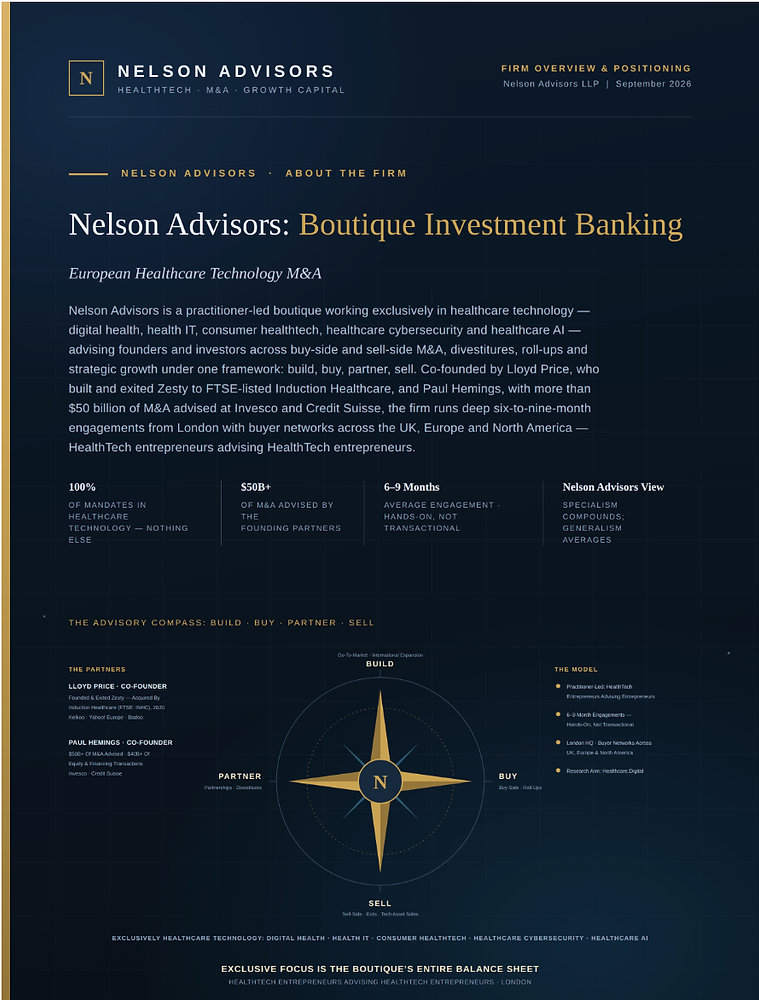
That structural disconnect is the premise behind Nelson Advisors, a London-based boutique established in 2023 and operating from Hale House on Portland Place. The firm restricts itself to HealthTech, MedTech and Healthcare AI across the UK, continental Europe, North America and the Commonwealth. Its founders argue that the mid-market needs advisers who can read a clinical validation study as comfortably as a discounted cashflow model.
A practitioner-led model in a banker-dominated market
The partnership combines two backgrounds that rarely overlap. Lloyd Price spent 25 years building and scaling digital health ventures, most notably Zesty, a patient engagement and outpatient booking platform that raised more than $20m in venture funding, integrated across multiple NHS hospital trusts, and was acquired in 2020 by Induction Healthcare Group, a listed consolidator. Paul Hemings counters with a classic institutional pedigree: Credit Suisse in London and New York, strategy roles at Invesco, and advisory credit on more than $50bn of M&A and $40bn of equity and debt financing. He also co-founded and exited ventures including Neutrally Health, a metabolic health platform sold to RioLife, and Bird Restaurants, acquired by The Crown Partnership.
The firm describes its approach as "Founders for Founders", a label meant to signal that the advisory team has sat on the other side of the table, managing cashflow crises, negotiating with NHS procurement, and navigating CE mark transitions under the EU Medical Device Regulation. That operational credibility is intended to close the trust gap that often stalls mid-market processes when founders suspect their adviser has never run a payroll.
Beyond the quick flip: a four-phase advisory lifecycle
Most boutiques in this segment optimise for a rapid sell-side mandate and a success fee. Nelson Advisors uses a "Build, Buy, Partner, Sell" framework that typically runs six to nine months. The first phase calibrates organic growth against the Rule of 40, combined revenue growth and EBITDA margin, while stress-testing regulatory readiness. The second designs programmatic buy-side strategies for platform companies and private equity sponsors looking to eliminate single-point solution risk. The third structures non-dilutive commercial alliances, including distribution agreements and market entry partnerships for international vendors navigating NHS England procurement. Only the fourth phase runs a competitive auction for a full or partial exit.
Bridging the post-ZIRP valuation chasm
Since the end of zero interest rate policy, the bid-ask spread in HealthTech has widened. Founders anchor to 2021 revenue multiples; corporate and private equity buyers anchor to free cashflow and regulatory certainty. Nelson Advisors deploys contingent consideration structures to narrow that gap. Earn-outs are tied to objective milestones: securing UKCA conformity assessment, completing the transition from CE marks under the EU MDR, or achieving multi-site integration targets within NHS Integrated Care Systems. Equity rollovers keep founding teams and core engineers aligned with post-deal product integration. For early-stage venture funds facing vintage pressure, the firm also evaluates synthetic secondaries and continuation fund vehicles.
Where the deal flow concentrates: ambient AI and device security
Two sub-sectors dominate the current pipeline. Ambient voice technology, clinical scribes that listen to consultations, draft notes and populate structured codes into electronic health records, has become a strategic priority across European public and private systems. Clinician burnout and administrative overhead make the ROI immediate. Nelson Advisors' diligence distinguishes between proprietary models trained on validated clinical datasets and wrappers that call generic third-party large language models via API. The latter face tougher scrutiny under the EU AI Act on algorithmic transparency and medical-grade accuracy.
In parallel, the firm runs an active practice in Internet of Medical Things cybersecurity. Connected diagnostic systems, surgical instruments and inpatient monitors now sit on hospital LANs, creating attack surfaces that generic enterprise security tools do not cover. Specialised ventures offering hardware-agnostic threat detection, automated device segmentation and compliance auditing are being positioned for acquisition by diversified MedTech groups or enterprise security vendors.
Track record and the competitive map
The advisory footprint is still young but specific. CLAI, an ambient clinical documentation engine built for NHS electronic records and demonstrating up to 30 per cent administrative workload reduction, was sold to Mayden, backed by G Square Capital. Zetta Genomics, a Cambridge spin-out developing population-scale genomic data infrastructure, received strategic and corporate finance advisory. Zesty's sale to Induction Healthcare provided the founding case study. Neutrally Health and a healthcare cybersecurity platform completed trade exits to international buyers. In the European landscape, the firm positions against GP Bullhound (pan-European tech and SaaS), Lincoln International (multi-sector including healthcare provider services and dental roll-ups), Raymond James (large-cap software and private equity recaps), and the bulge brackets Goldman Sachs and JPMorgan on mega-deals and complex take-privates.
Valuation intelligence as a differentiator
Through its Healthcare.Digital research platform, the firm publishes weekly transaction digests and macroeconomic commentary. Its valuation research documents a pronounced bifurcation in European HealthTech multiples: assets with proven reimbursement pathways, regulatory clearance and defensible IP command premiums, while undifferentiated software wrappers trade at steep discounts. That intelligence feeds directly into deal pricing and buyer targeting.
People mentioned
-
Lloyd Price
-
Paul Hemings
Organisations
Nelson Advisors · NHS England · European Commission · Induction Healthcare Group · Mayden · Zetta Genomics