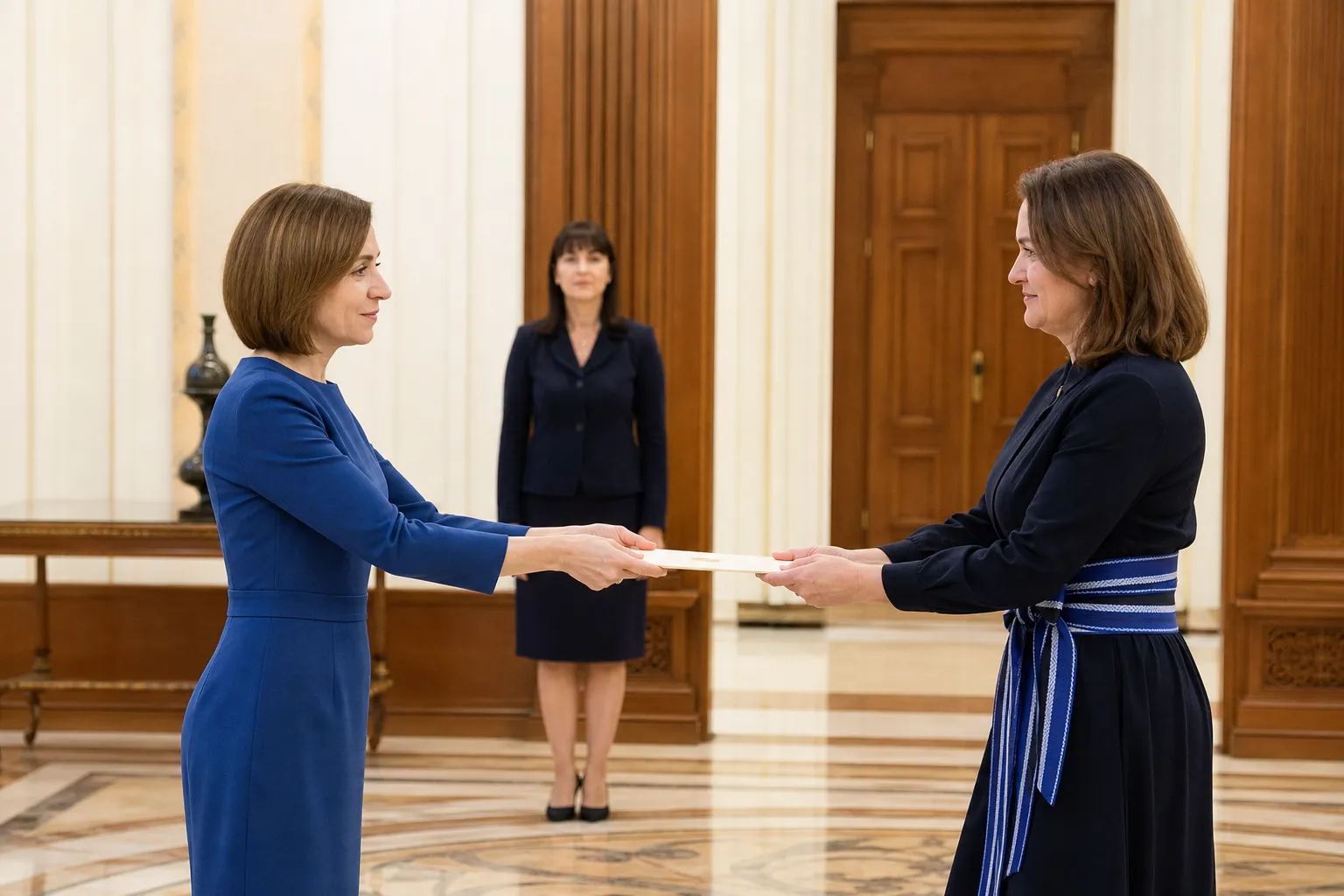
Estonia has upgraded its diplomatic presence in Moldova with the appointment of a resident ambassador for the first time since the latter regained independence in 1991. Siiri Königsberg presented her credentials to President Maia Sandu in Chisinau on Monday, 7 September, marking the start of a mission that Tallinn hopes will translate its own post-Soviet transformation into practical assistance for a neighbour seeking European Union membership.
A digital partnership rooted in Estonian experience
The centrepiece of Estonia's offer is expertise in digital governance and cybersecurity, areas where the Baltic state has built an international reputation since the 1990s. Königsberg told Sandu that Tallinn intends to provide "effective assistance by using its own experience and expertise in digital affairs and cybersecurity." Estonia's e-government architecture, from digital identity to paperless cabinet meetings, is frequently cited as a model for countries modernising public administration. Moldova, which began its own digital transformation in earnest after 2020, has already adopted elements of the Estonian X-Road data exchange layer.
The embassy opening, scheduled for October, will give this cooperation a permanent institutional home. Until now, Estonia's ambassador to Moldova was based in Bucharest, a common arrangement for smaller EU states covering multiple capitals in the region. The shift to a resident posting signals that Tallinn expects the relationship to deepen rapidly as Moldova advances through the EU accession process.
Security concerns frame the relationship
Moldova shares a 1,200-kilometre border with Ukraine, placing it on the front line of the war's spillover effects. Russian missiles have crossed Moldovan airspace, energy infrastructure has been targeted, and the breakaway region of Transnistria hosts a Russian military contingent. During the credentials meeting, both sides addressed the war's impact on Moldova's security and economy. Königsberg framed EU enlargement as a security imperative, arguing that "EU enlargement strengthens security, prosperity, and the community of European values."
Estonia, which borders Russia and has invested heavily in collective defence since regaining independence, views Moldova's integration through a similar lens. Tallinn has been among the most vocal EU members in favour of accelerated enlargement for Ukraine, Moldova and the Western Balkans. The ambassador's own background reinforces this perspective: she served as deputy permanent representative to NATO and later chaired the EU Council working group on relations with African, Caribbean and Pacific countries.
The Ukraine Recovery Conference invitation
A concrete diplomatic step emerged from the meeting: Königsberg invited Moldova to participate in the Ukraine Recovery Conference that Estonia will host in Tallinn in January 2027. The conference series, which began in Lugano in 2022 and continued in London, Berlin and Warsaw, aims to coordinate international support for Ukraine's reconstruction. Moldova's inclusion reflects the intertwined nature of the two countries' recovery challenges, from energy grid repairs to refugee integration.
For Moldova, the invitation offers a platform to highlight its own reconstruction needs, which are substantial. The World Bank estimated in 2024 that Moldova's war-related costs, including refugee support and lost trade, exceeded 1.5 billion euros annually. Participation also reinforces Chisinau's positioning as a constructive partner in European security architecture.
Königsberg's career spans NATO, EU and Nordic postings
The ambassador brings a career shaped by Estonia's integration into Western institutions. After early postings in Stockholm and Oslo, she served at Estonia's permanent representation to the European Union in Brussels, then as deputy permanent representative to NATO. Between 2023 and 2026 she led the Europe Department at the Estonian Ministry of Foreign Affairs, overseeing bilateral relations across the continent and coordinating Tallinn's positions on enlargement. Her experience with the EU Council working group on ACP relations adds a development policy dimension that may prove relevant as Moldova accesses pre-accession funding.
Embassy opening marks a shift from non-resident representation
Estonia's decision to establish a physical embassy in Chisinau follows a pattern among Baltic and Nordic states. Lithuania opened its embassy in 2006, Latvia in 2010, while Finland and Sweden have maintained resident missions for decades. For Estonia, the move completes a diplomatic map that now includes resident ambassadors in all EU candidate countries in Eastern Europe and the Western Balkans. The Chisinau embassy will be Estonia's 41st diplomatic mission worldwide, a notable network for a country of 1.3 million people.
The upgrade also reflects Moldova's rising diplomatic profile. Since Sandu's election in 2020, the country has secured EU candidate status, opened accession negotiations, and attracted a wave of new embassies. The United States, United Kingdom, France and Germany have all expanded their missions. Estonia's arrival adds a partner with specific technical expertise that aligns with Moldova's stated priorities.
What the move signals for Moldova's EU path
Moldova's accession negotiations formally opened in June 2024, but the road remains long. The European Commission's 2024 enlargement report noted progress on judicial reform and anti-corruption measures while flagging persistent weaknesses in media freedom and oligarchic influence. Estonia's engagement focuses on areas where it can claim credible success: digital public services, cyber resilience, and the administrative capacity to absorb EU funds. These are also chapters where Moldova must demonstrate tangible results to advance.
The embassy will serve as a channel for technical assistance projects, many funded through EU pre-accession instruments. Estonia has already implemented digital governance projects in Ukraine, Georgia and the Western Balkans. The Moldovan programme is expected to cover e-services for citizens, business registry modernisation, and cybersecurity capacity building for critical infrastructure.
People mentioned
-
Siiri Königsberg
Organisations
Estonian Ministry of Foreign Affairs · Office of the President of Moldova · European Union · NATO