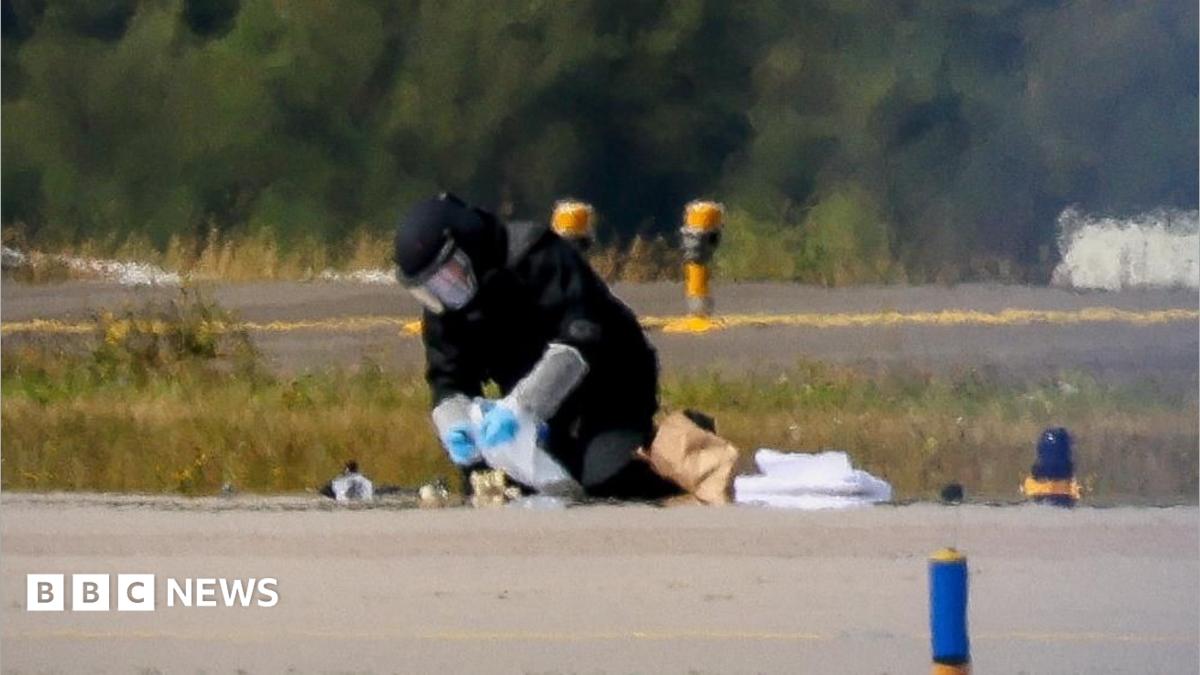
The attempted drone strike on Leipzig airport last month has crystallised what NATO defence planners have been warning about in private: Europe is not prepared for a prolonged confrontation with Russia, and the hybrid war may already be tilting in Moscow's favour.
Drone attack on Leipzig sharpens focus on hybrid threat
At a closed-door forum convened by the Munich Security Conference this week, officials from Europe's largest military powers acknowledged that the continent lacks the public resilience, industrial depth and political cohesion to sustain a war of attrition. The discussion, held under non-attribution rules, revealed a level of pessimism that rarely surfaces in public communiqués.
"Europe is stagnating at a time when the external threats were assuming a dimension which is really very serious," Wolfgang Ischinger, the MSC chair, told the gathering. "These are really huge and existential challenges requiring greater integration in defence."
The Leipzig incident on 4 August, in which an armed drone exploded near the airport, provided a tangible case study. German authorities identified a suspect as a Belarusian citizen holding a Russian passport who had entered the Schengen area on an Italian tourist visa. The attack, while limited in physical damage, demonstrated the ease with which hostile actors can operate inside European borders.
NATO planners confront Europe's readiness gap
Behind the immediate security concern lies a deeper strategic problem. Successive British prime ministers, according to a UK diplomat at the conference, have done nothing to explain the scale of the hybrid threat to the public. The result, the diplomat said, is that "the level of the debate has been at that of a kindergarten." Ministers now face the task of persuading unprepared voters to redirect welfare spending toward defence.
The UK government has so far failed to act on its own 2025 strategic defence review, which called for a national conversation on the security threat and measures to build resilience. A former cabinet member was blunter: the West had been "crap" at educating its populations about the hybrid conflict already underway.
The E5 proposal and the American question
One response gaining traction is the E5 grouping, the five European nations with substantial defence industrial capacity, including the United Kingdom, France, Germany, Italy and Poland. The MSC has been advocating for these countries to coordinate more closely on procurement of capabilities currently supplied mainly by the United States: integrated air and missile defence, deep precision strike, and space-based early warning systems.
E5 defence ministers already meet regularly, but joint procurement remains at an early stage. Decisions in Washington on troop deployments, expected in the coming months, could effectively leave Europe responsible for its own conventional defence. Yet diplomats worry that the United States may block a stronger European pillar inside NATO. "The US are better at talking about burden shifting than power sharing," one diplomat noted. The NATO summit in Ankara this summer underscored the urgency.
Italy's exposure to Russian interference
Italy, one of the E5 members, illustrates the political vulnerability. Foreign Minister Antonio Tajani disclosed that the country suffers daily cyber-attacks and warned that next year's general election, potentially as early as April, may face Russian manipulation. It was the first time an Italian politician has explicitly flagged election interference as a live risk.
Defence Minister Guido Crosetto, a close ally of Prime Minister Giorgia Meloni, has been equally candid. "We don't have the antibodies and we're penetrable: analyse bots and you'll see it. The increase occurred thanks to social media," he said at the NATO summit in Ankara this summer. On Tuesday, he added that the Russian threat was growing across multiple domains: social media, artificial intelligence, cybersecurity, databases and critical infrastructure.
Crosetto also cautioned against attributing all government unpopularity to Russian disinformation. Moscow exploits real grievances, low wages, war fatigue, the cost of supporting Ukraine, and misidentifying the malaise as purely foreign-induced risks missing the domestic roots of discontent.
Populist surge complicates coordinated response
The rise of parties sympathetic to Russia adds another layer of difficulty. Germany's Alternative für Deutschland, Italy's Futuro Nazionale led by Roberto Vannacci, and similar forces in France and Poland could gain ground in elections next year. Most oppose continued military aid to Ukraine and favour a negotiated settlement on Moscow's terms.
Vannacci, responding to accusations that his party acts as a Russian proxy, mocked the charge. "Just discovered that I am a 'Manchurian candidate' sent by the Russian federation to complain about the unaffordable petrol prices in my country Italy," he said. "Forgive me, but I still find it hard to accept the idea that dissent from Brussels' orthodoxy is now, in practical terms, tantamount to disloyalty towards the west."
Ukraine's drone industry offers a contrast
While Europe debates coordination, Ukraine is demonstrating what rapid defence innovation looks like. The country is producing 200,000 drones a month, with a target of more than seven million by the end of 2026. Five hundred small and medium-sized enterprises have emerged, assembling drones in small workshops using mostly Chinese components. Former Ukrainian Defence Minister Mykhailo Fedorov has been recruited by Crosetto as an unpaid innovation adviser, a move Ischinger praised as recognition that Ukraine now fields the most modern army in Europe.
Decisions awaited in Washington and European capitals
The coming months will test whether European governments can translate private alarm into public policy. The US troop deployment review, the trajectory of populist parties in national elections, and the ability of the E5 to move from discussion to joint procurement will determine whether the continent can close the readiness gap before a crisis forces the issue.
People mentioned
-
Wolfgang Ischinger
Organisations
Munich Security Conference · NATO · Italian Government · Futuro Nazionale · Ukrainian Ministry of Defence