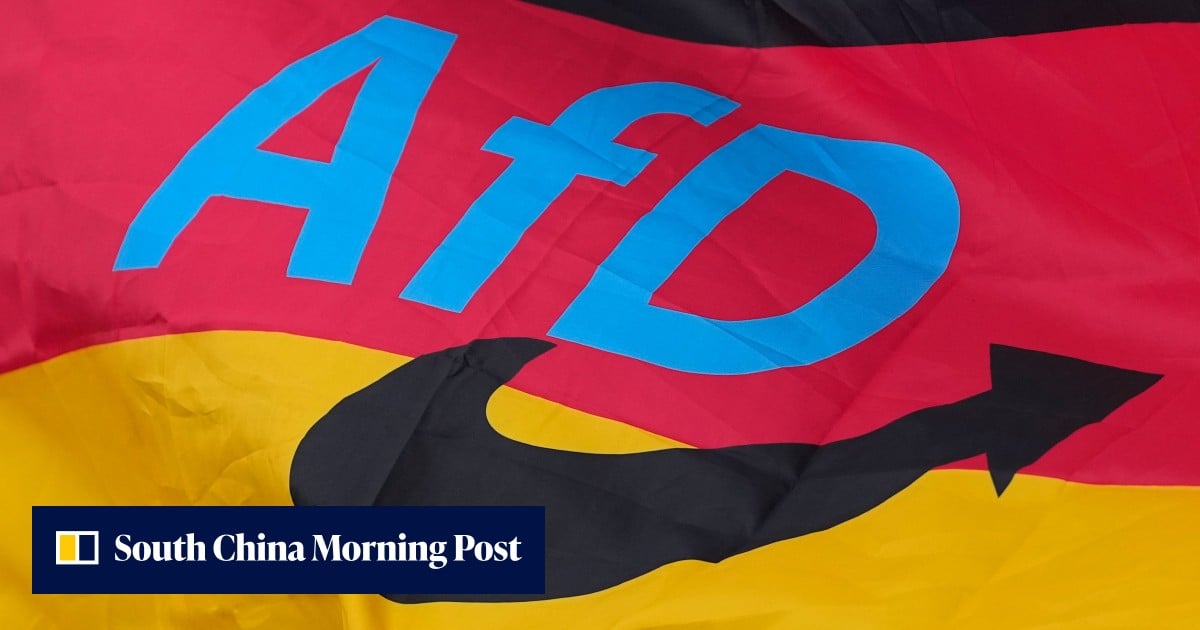
On Sunday, voters in Saxony-Anhalt go to the polls in a state election that could deliver the Alternative for Germany (AfD) its most consequential result yet: a share of state-level government. If the far-right party enters a governing coalition, it would be the first time a party of its kind has held power in a German state since the founding of the Federal Republic in 1949.
The AfD is expected to finish strongly in Saxony-Anhalt, one of Germany's six eastern states, continuing a pattern that has made the former East German territory the party's electoral heartland. Its anti-immigration platform and sympathetic posture towards Moscow resonate in a region where trust in mainstream institutions has never fully recovered from the shock of reunification.
Three decades of eastern disillusionment
When the Berlin Wall fell in November 1989, ending four decades of the communist German Democratic Republic, many East Germans expected rapid convergence with the prosperous west. What followed instead was economic devastation. The Treuhandanstalt, the state agency charged with privatising East German industry, closed hundreds of state-owned enterprises deemed uncompetitive. Unemployment soared. Between 1989 and the mid-1990s, the eastern economy contracted sharply, and the promised "blossoming landscapes" of then-chancellor Helmut Kohl's rhetoric failed to materialise for many communities.
Elisabeth Kaiser, the federal government's commissioner for eastern Germany and a lawmaker from Thuringia, argues that this experience created a lasting psychological scar. "That was a difficult experience for many East Germans, one that has persisted across generations, becoming part of a collective East German memory," Kaiser said. "It involved this sense of devaluation, this experience of loss and the realisation that everything can change overnight."
The word "devaluation" in Kaiser's account refers not only to economic loss but to a feeling that East Germans' skills, qualifications and life experience were treated as worthless by the new system. GDR professional credentials were often not recognised. Former state employees found themselves marginalised in a market economy they had not chosen.
The demographic hollowing out
The economic disruption triggered a demographic crisis that compounds the political one. Young people, especially women, left the east in large numbers during the 1990s and 2000s, seeking work and opportunity in western cities. Federal statistics have documented the resulting population decline: entire towns aged rapidly as their younger residents departed, leaving behind communities with shrinking tax bases, closed schools and limited public services.
The exodus of young women in particular has had a disproportionate social effect. In some eastern communities, the ratio of men to women became significantly imbalanced, contributing to a sense of isolation and frustration that researchers have linked to radicalisation. A region that feels abandoned by its own country is receptive territory for a party that promises to overturn the established order.
Why the AfD finds fertile ground
The AfD's appeal in the east draws on several currents. Its opposition to immigration taps into communities that feel their concerns about rapid demographic change have been dismissed by mainstream parties. Its friendlier posture towards Russia, including scepticism about sanctions and military support for Ukraine, resonates in a region where cultural and economic ties to the east were severed abruptly at reunification. Its general anti-establishment rhetoric speaks to voters who have never felt fully represented by the parties that have governed Germany since 1990.
The pattern is not unique to Saxony-Anhalt. Across the former East German states, from Thuringia to Brandenburg, the AfD has consistently polled above its national average. In some eastern constituencies, it commands more than a third of the vote. What makes Sunday's election distinctive is the realistic possibility that the AfD could not merely be the largest party but could enter a governing coalition.
What state-level power would mean
No far-right party has governed a German state in the post-war era. The AfD's entry into state government in Saxony-Anhalt would carry practical and symbolic consequences. At the practical level, a party under observation by Germany's domestic intelligence service for suspected extremism would control a state administration, including police, education and cultural policy. At the symbolic level, it would break a norm that has held for nearly eight decades.
Other eastern states are watching closely. State elections in Thuringia and Saxony have already produced strong AfD results. If Saxony-Anhalt breaks the governing taboo, the pressure on mainstream parties in neighbouring states to consider coalition arrangements with the AfD would intensify.
The limits of economic explanation
Economic hardship alone does not explain the AfD's eastern strength. Parts of western Germany have experienced similar deindustrialisation and population decline without producing comparable far-right surges. The Ruhr valley, once Germany's industrial heartland, lost hundreds of thousands of mining and steel jobs from the 1980s onwards, yet the AfD polls well below its eastern averages there. Eurostat's regional data shows that economic disadvantage does not map neatly onto far-right support across Europe.
The difference lies in the specific character of East German disillusionment: not just economic decline, but the experience of having an entire political and economic system declared invalid overnight, and of being told that the skills and qualifications you held were worth nothing. That sense of collective devaluation, as Kaiser describes it, is not simply a material grievance. It is an identity wound.
Whether governing responsibility would moderate the AfD remains uncertain. The party's internal divisions between a more pragmatic wing and a hardline faction have been visible at the national level. State government would force difficult choices between ideological purity and administrative competence. Sunday's vote will determine whether the AfD gets the chance to make them.
People mentioned
-
Elisabeth Kaiser
Organisations
Alternative for Germany · Treuhandanstalt