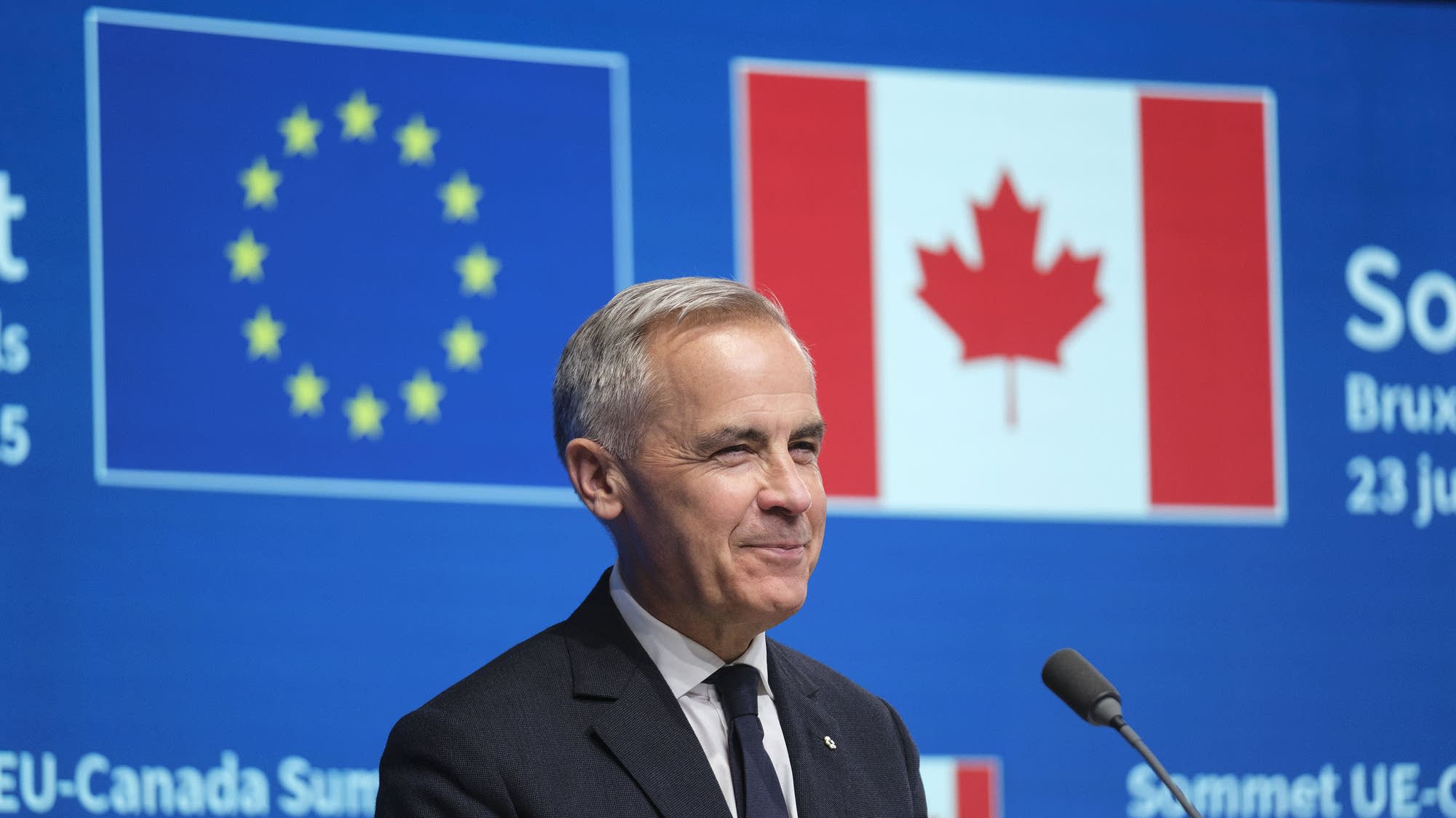
Canadian Prime Minister Mark Carney is scheduled to address the European Parliament later this month, a visit that crystallises a remarkable shift in Ottawa's strategic posture. Since the United States imposed sweeping tariffs on Canadian steel, aluminium, automotive parts and agricultural products in early 2025, the government has been searching for ways to reduce an economic dependence that sees roughly 75 per cent of Canadian exports flow south. The speech in Strasbourg will be Carney's most prominent European engagement since he argued at the World Economic Forum in January that the post-war rules-based order had become a "fiction" and that middle powers must band together to resist hegemonic interference.
An idea migrating from academia to the political mainstream
The notion of Canada joining the European Union has circulated for decades in think-tank papers and university seminars, but it has acquired new urgency since the return of protectionist trade policy in Washington. Ishan Tharoor, global affairs columnist at The New Yorker, told Marketplace Morning Report that the conversation "has taken a new form and shape in the shadow of Trumpism." He was careful to stress that accession is not imminent: "Canada is not about to join the European Union," he said, "but this conversation has been there, and it's been there for many years in academic circles and in some kind of wonky policy circles in Brussels and Ottawa."
What distinguishes the current moment is the openness with which European politicians now discuss the prospect. Members of the European Parliament from several member states have floated the idea in public forums, and the European Commission has not dismissed it outright. The alignment is easy to sketch: Canada is a social-democratic federation with abundant critical minerals, energy reserves and agricultural capacity that the EU's green transition desperately needs. In return, the single market of 450 million consumers offers Canadian businesses a regulatory environment far more predictable than the current US alternative.
CETA provides a foundation but falls short of membership
The Comprehensive Economic and Trade Agreement (CETA), provisionally applied since September 2017, already eliminates 98 per cent of tariffs between the two economies and includes provisions on regulatory cooperation, sustainable development and investment protection. Bilateral goods trade reached €72.4 billion in 2024, making Canada the EU's twelfth-largest trading partner. Yet CETA does not grant Canadian firms the full rights of single-market participation, freedom of movement for workers, mutual recognition of professional qualifications, or a seat at the table when EU regulations are written. For sectors such as financial services, aerospace and digital technology, those gaps are commercially significant.
The procedural mountain: unanimous consent and a hard border
Any application would confront Article 49 of the Treaty on European Union, which limits membership to "European states", a geographic criterion the Court of Justice has interpreted strictly. Morocco's 1987 application was rejected on those grounds. Canada would need a treaty amendment or a creative legal interpretation, either of which requires unanimous agreement from all 27 capitals. Several member states already harbour enlargement fatigue after the western Balkan process stalled; adding a transatlantic applicant would test the EU's institutional elasticity to breaking point.
Even if the legal barrier were cleared, the practical consequences would be immediate. EU membership obliges Canada to adopt the acquis communautaire in full, including the common external tariff. That means a hard customs border with the United States, its largest trading partner by a wide margin. Rules of origin checks, regulatory divergence inspections and tariff collection would appear along the 8,891-kilometre boundary that has functioned as one of the world's most open frontiers for generations. The economic shock to integrated supply chains in automotive, agri-food and energy would be severe.
Canadian public opinion runs ahead of the political class
Polling conducted by Angus Reid Institute and Leger in the first half of 2026 showed between 51 and 56 per cent of respondents favouring EU membership, with support highest in Quebec and British Columbia. The same surveys reveal a sharp partisan divide: Liberal and New Democratic voters back the idea by margins of two to one, while Conservative voters oppose it by a similar ratio. No federal party has adopted membership as official policy. The Liberal government's line remains "deepening the strategic partnership", a phrase that leaves the door ajar without committing to the legislative and constitutional upheaval accession would entail.
A canary in the coal mine for the western alliance
Tharoor described Canada as "the canary in the coal mine when it comes to thinking through the new world that we live in." For eight decades, Ottawa's foreign policy has been anchored in the assumption that US security guarantees and market access were permanent. The breakdown of that assumption forces a re-evaluation that extends beyond trade. Canada is a founding member of NATO, a Five Eyes intelligence partner, and a participant in every major US-led military coalition since Korea. If the economic pillar crumbles, the political and military pillars cannot remain unaffected. European capitals are watching closely: a Canadian pivot would signal that the transatlantic compact is fracturing at its strongest point.
What happens before Strasbourg and after
Carney's address to the European Parliament on 24 September will be followed by a Canada-EU summit in Ottawa in October, where the next phase of CETA implementation, notably mutual recognition of conformity assessment for medical devices and electrical equipment, is expected to be finalised. Officials in both capitals are also exploring a critical minerals strategic partnership that would fall short of single-market integration but go beyond existing trade provisions. The membership question will not be on the formal agenda, but it will shape every corridor conversation. The real test comes when the US mid-term elections in November 2026 clarify whether Washington's protectionist turn is cyclical or structural. Until then, Ottawa keeps its options open, and Brussels keeps its door slightly ajar.
People mentioned
-
Ishan Tharoor
-
Kimberly Adams
Organisations
European Union · European Parliament · Government of Canada · The New Yorker · Marketplace Morning Report