European unity on foreign policy is rare enough. Rarer still is unity that cuts across the continent's deep divisions over how to handle Donald Trump. Yet when ambassadors from the 27 member states gathered in Brussels on September 9 to discuss a deeper partnership with Canada, not a single capital raised an objection, not even those led by governments that have made a point of cultivating the US president.
The meeting took place just hours after the White House announced fresh tariffs on Canadian dairy, alcohol and motorbikes, the latest escalation in a trade dispute that has seen Washington treat its northern neighbour as an adversary rather than an ally. That timing was not lost on the diplomats in the room. One described the absence of dissent as "very strong support" for Commission President Ursula von der Leyen's outreach to Ottawa, adding that the mood was to proceed despite the obvious risk of being seen to side against Washington.
A coalition that includes Trump's European friends
The significance lies in who stayed silent. Giorgia Meloni's Italy, Andrej Babiš's Czech Republic and Robert Fico's Slovakia have each, in different ways, sought to keep channels open to the Trump administration. All three have avoided positions that might provoke Washington. Yet none broke ranks. A senior EU official confirmed the consensus, saying the aim was "to clearly signal the intention and ambition on both sides to upgrade our partnership."
That partnership is still taking shape. The October 29-30 summit will be a political launchpad rather than a signing ceremony. Officials stress that talks are at an early stage, with the immediate goal to demonstrate ambition and identify concrete workstreams. The Commission and Council jointly presented the preparatory work, covering technology, research, innovation, critical raw materials and the removal of trade barriers.
Carney's European tour and the Arctic angle
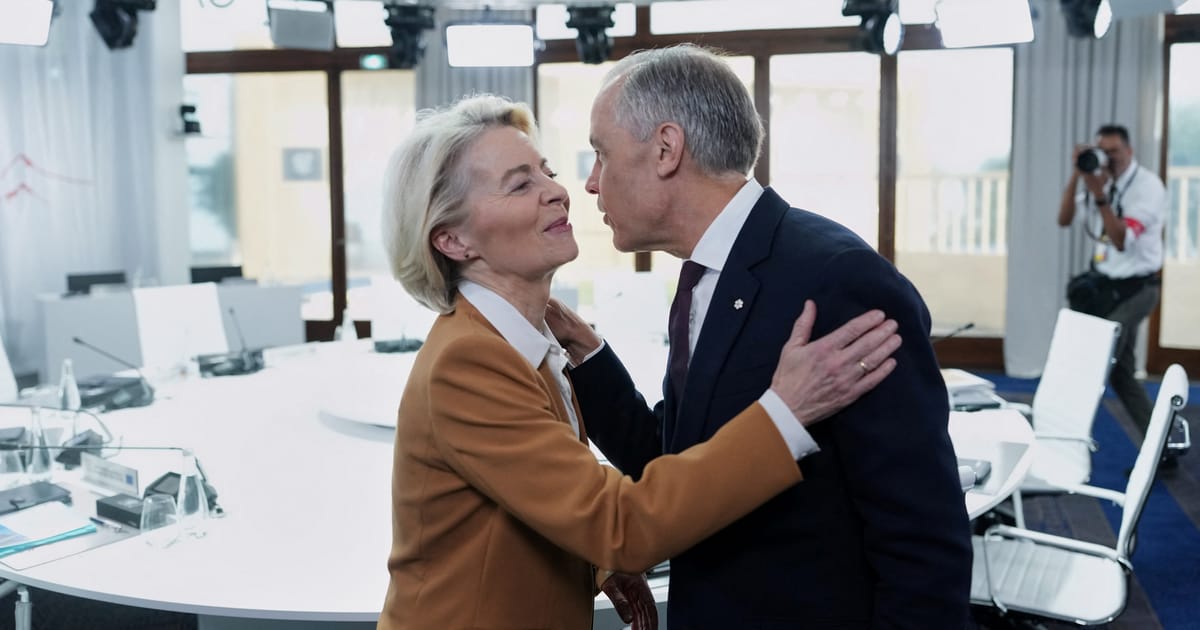
Canadian Prime Minister Mark Carney arrives in Strasbourg next week to address the European Parliament, a visit timed to coincide with von der Leyen's State of the Union speech. Carney has made no secret of his objective: to build what he calls a club of like-minded, pro-free trade democracies as a hedge against US unpredictability. His speech is expected to set out practical next steps for the EU-Canada relationship.
Among the ideas circulating in Brussels are Canadian participation in the Erasmus student exchange programme, alignment on Arctic security and defence, and military-industrial cooperation. The Arctic has emerged as a particularly promising bridge. Von der Leyen returned from Greenland in August declaring that Europe wanted to become "more engaged in the Arctic." The Commission is finalising an updated Arctic policy, now renamed the North Neighbourhood and Arctic Strategy, due for publication on October 20.
Security as the entry point
One EU official described security and defence as von der Leyen's "happy place," suggesting any overture to Carney in her State of the Union address would likely centre on an Arctic security initiative. That would fit a pattern: the Commission has increasingly framed strategic autonomy through the lens of defence, and the High North is where Russian activity, Chinese interest and melting ice converge.
But the Arctic conversation extends well beyond hard security. Officials who have worked on the new strategy point to critical raw materials, subsea cables, specialised ice-capable vessels and cleaner shipping as areas where EU and Canadian interests overlap, and where they diverge from the United States, which has lobbied against decarbonisation measures in the International Maritime Organization.
Raw materials and the supply chain logic
Critical raw materials are the economic backbone of the prospective partnership. Canada holds substantial deposits of lithium, cobalt, nickel and rare earth elements, all essential for the EU's green transition and digital ambitions. The bloc's Critical Raw Materials Act, which entered into force in 2024, sets a target of sourcing 10% of annual consumption from domestic extraction, 40% from processing and 15% from recycling by 2030. Canada is already a strategic partner under the Act; the summit would deepen that designation into joint projects and investment.
Trade barriers remain a stubborn obstacle. The Comprehensive Economic and Trade Agreement (CETA) has been provisionally applied since 2017, but ratification by national parliaments is incomplete. France's Senate rejected it in 2024, and several other member states have yet to complete the process. Officials acknowledge that a new political declaration cannot bypass national ratification, but it can create momentum for sector-specific agreements that operate within CETA's framework.
The limits of unity
Consensus at ambassador level is not the same as implemented policy. The Erasmus proposal, for instance, requires a Council decision and Parliament approval, and would need Canadian legislation to match. Military-industrial cooperation runs into the thicket of national defence procurement rules and the EU's own defence fund eligibility criteria. Clean shipping standards face opposition from flag states with large conventional fleets.
Moreover, the Trump factor is not static. A future US administration could reset relations with Canada, altering the urgency of the EU's hedge. For now, though, the calculation in Brussels is that the cost of inaction, watching a G7 ally squeezed by Washington without offering a structural alternative, outweighs the diplomatic friction of engagement.
What happens next
The next concrete milestone is Carney's speech to the European Parliament, where he is expected to outline specific proposals. That will be followed by von der Leyen's State of the Union address, which may reference an Arctic security initiative. The Commission's Arctic strategy on October 20 will provide the policy framework. The summit itself will produce a joint declaration and a work programme; officials say the test will be whether working groups can convert political ambition into funded projects before the next EU budget cycle.
People mentioned
Organisations
European Commission · European Council · European Parliament · Government of Canada