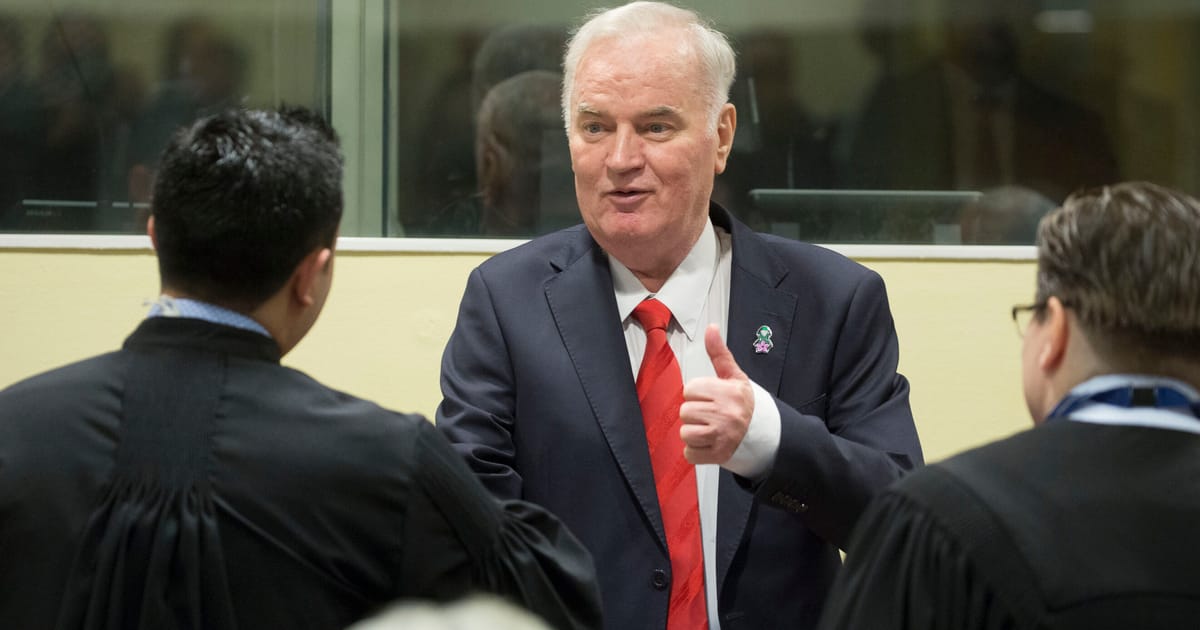
A Serbian government aircraft touched down in Belgrade on Thursday carrying the coffin of Ratko Mladić, the former Bosnian Serb army commander who died in a Dutch prison hospital while serving a life sentence for genocide, crimes against humanity and war crimes. The casket was draped in the Serbian flag. On Monday, a public service will be held at the House of the Army before burial at Topčider Cemetery. Thousands are expected to attend. For the European Union, the ceremony is a test of whether a candidate country can honour a man the international courts convicted of orchestrating the slaughter of more than 8,000 Bosnian Muslim men and boys at Srebrenica and the near four-year siege of Sarajevo.
The EU's red line on war criminals
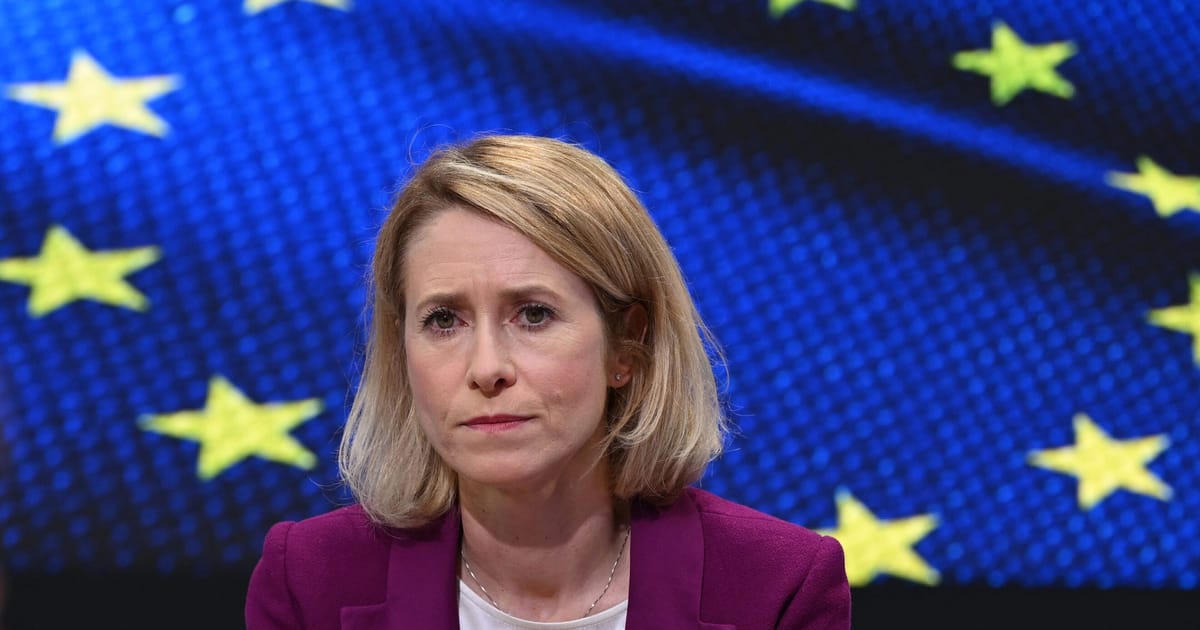
Marta Kos, the European Commissioner for Enlargement, did not mince words when she spoke to reporters in Dublin on Friday. "The glorification of war criminals has no place; it goes really, really strong against European values and has no space, not in the EU member states, but also in our candidates," she said. The Commission, she added, is "observing the situation very carefully" and will assess the government's actions in the coming days. Her intervention marks a sharpening of language from Brussels, which has long insisted that reconciliation and cooperation with the International Criminal Tribunal for the former Yugoslavia are non-negotiable conditions for accession.
Kos linked the issue to a broader shift in the enlargement framework. "The strategic alliances or strategic orientation on the field of common security and foreign policy is getting even more and more important," she said. That formulation signals that alignment with the EU's foreign policy positions, including recognition of the ICTY's judgments, is now weighed alongside the traditional acquis chapters. For Belgrade, which has sought to balance its European path with close ties to Moscow and Beijing, the warning carries weight.
Ireland's presidency adds pressure
The timing is deliberate. Ireland holds the rotating presidency of the Council of the European Union and is chairing a meeting of candidate countries in Dublin on Friday. Thomas Byrne, the Minister of State for European Affairs, struck a similarly firm tone. While he acknowledged that "there's not actually a state funeral taking place," he warned that "there may well be senior figures from government memorializing that man, so that's not acceptable." Byrne framed the issue as one of regional healing: "It is certainly time to bury the past and to work and continue reconciliation in that region." His remarks reflect a consensus among several member states that the Western Balkans cannot move forward while convicted war criminals are celebrated.
Belgrade's careful distancing
Serbian officials have moved quickly to create distance between the state and Monday's proceedings. A government source, speaking on condition of anonymity, insisted the defence ministry and the general staff are not organising the event. Instead, the Association of Retired Generals, a veterans' group, is the formal host. The official also noted that Mladić will not be interred in the Alley of the Greats or the Alley of Distinguished Citizens, the sections of Belgrade's main cemetery reserved for national heroes. The distinction is meant to signal that the state is not bestowing official honours, even as it provides a government plane and allows a public venue.
Few in Brussels find the separation convincing. The use of a state aircraft to repatriate the body, the flag-draped coffin, and the choice of the House of the Army, a military institution, all bear the imprint of official sanction. Diplomats in Belgrade have privately described the arrangement as a "state funeral in all but name," designed to appease domestic nationalist sentiment while maintaining plausible deniability for the EU accession file.
Domestic politics and the hero narrative
The political calculus in Belgrade is shaped by polling that has barely shifted in fifteen years. When Mladić was arrested in 2011, a precondition for Serbia's candidate status, surveys showed roughly 40 percent of Serbs regarded him as a hero. That figure has proved resilient. President Aleksandar Vučić's government relies on nationalist voters who see the ICTY as a partisan instrument and Mladić as a defender of Serb interests. Publicly condemning the funeral would risk a backlash; permitting it risks the European trajectory Vučić also claims to champion.
The Association of Retired Generals, which is organising Monday's service, has long acted as a conduit for revisionist narratives about the 1990s wars. Its leadership includes officers who served under Mladić. By delegating the ceremony to this group, the government satisfies its base without formally endorsing the glorification that Kos condemned. It is a tactic Belgrade has used before: allowing veterans' associations, parliamentary clubs, or municipal authorities to stage events the state cannot officially sponsor.
Regional reverberations
The funeral's impact extends well beyond Serbia's borders. In Republika Srpska, the Serb entity within Bosnia and Herzegovina, Milorad Dodik, its president and a longtime ally of Vučić, declared that "Mladić was respected by the Serbian people. As a commander he stood to defend Serbs." Tributes were held in majority-Serb towns across Bosnia in the days after Mladić's death. For Bosniak and Croat communities, and for the families of Srebrenica's victims, such statements reopen wounds that the Dayton Agreement never fully closed. The EU's insistence on reconciliation is not abstract; it is a prerequisite for the region's stability.
The International Criminal Tribunal for the former Yugoslavia concluded its work in 2017, but its judgments remain the legal baseline for the EU's engagement with the Western Balkans. The Mechanism for International Criminal Tribunals, which succeeded the ICTY, continues to oversee the enforcement of sentences and the protection of witnesses. Brussels has made clear that any attempt to undermine those judgments, whether through honouring convicts or denying established facts, will be treated as a breach of the values clause in the stabilisation and association agreements.
The enlargement context
Serbia opened accession negotiations in 2014 and has so far opened 22 of 35 chapters, closing two. Progress has stalled in recent years over the rule of law, media freedom, and the normalisation of relations with Kosovo. The Mladić funeral adds a new complication. While the EU has not threatened to freeze the process, Kos's language, "we will see what will happen in [the] next days", suggests the Commission is preparing a formal assessment. That assessment could feed into the next enlargement package, due in autumn, where Serbia's chapter benchmarks are reviewed.
The European Parliament has also signalled its intent to scrutinise the funeral. The Committee on Foreign Affairs is expected to request a briefing from the Commission and the European External Action Service. MEPs from several groups have tabled questions asking whether the government's facilitation of the ceremony constitutes a violation of the Copenhagen criteria, specifically the requirement to respect human rights and the rule of law. A critical resolution, while non-binding, would increase political pressure on the Council to harden its stance.
What happens next
Monday's service will be the immediate focus. Diplomats will watch for the presence of ministers, senior military officers, or presidential advisers. Any official representation will be documented and raised in the next round of technical talks. The Commission's enlargement report, typically published in October, will almost certainly reference the episode. For Serbia, the choice is becoming sharper: maintain the fiction that the state is not involved, or accept that the European path requires a public break with the mythology that still surrounds the wars of the 1990s. The coffin arrives in Belgrade on a government plane. The flag is Serbian. The venue is military. The EU has said that is not compatible with its values. The next move belongs to Vučić.
People mentioned
-
Milorad Dodik
-
Ratko Mladić
Organisations
European Commission · Government of Serbia · International Criminal Tribunal for the former Yugoslavia · Association of Retired Generals