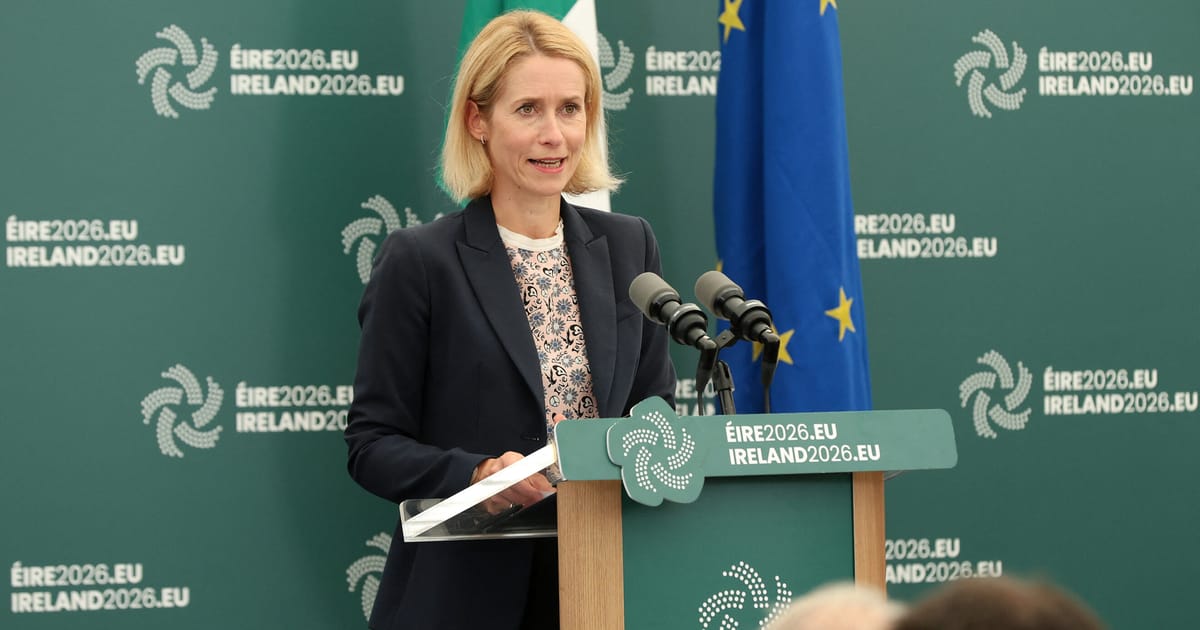
Kaja Kallas has told France and Germany that their plans to restructure the European External Action Service are unnecessary, saying most EU governments prefer the current arrangement and that the real deficit is enforcement, not architecture.
Speaking after a meeting of EU foreign ministers in Wicklow, Ireland, on Wednesday, the high representative said a "majority" of countries had backed "the current institutional setup" of the EEAS, the bloc's diplomatic corps, and that there was "broad support" for making it work without major institutional changes.
What the Franco-German paper proposed
Paris and Berlin have been circulating a discussion paper that calls for root-and-branch reform of the EEAS. Among the ideas: giving Kallas formal oversight of Commission policy units that deal with external relations, covering migration, trade and development aid. The paper was seen by Politico before the Wicklow meeting.
The logic behind the proposal is straightforward enough. The EU's foreign policy apparatus is split between the EEAS, which Kallas leads, and the Commission, which controls the budgetary and regulatory levers that often matter more in practice than diplomatic statements. Bringing those levers under the high representative's authority would, in theory, give the EU a more coherent external voice.
Kallas: the treaties already say what they need to say
Kallas was having none of it, at least not in the form the two governments presented. "The problem is not the treaties, the institutional setup," she told a news conference. "The problem is the implementation."
Her argument is that existing EU legal texts already assign her responsibility for coordinating external relations across the institutions. The gap, she says, is between what the treaties promise and what happens on the ground. Reforming the structure without first enforcing the rules as they stand would be premature.
The Commission's expanding footprint
The debate is not happening in a vacuum. The European Commission has been building its own foreign policy capacity, most recently by creating a unit dedicated to the Middle East and Africa, areas that fall squarely within the EEAS's mandate. That move has triggered a turf war between Rue de la Loi and the EEAS headquarters across town.
Kallas's position is constitutionally awkward by design. As high representative, she sits in the European Council and coordinates the foreign policy positions of all 27 member states. As a vice president of the Commission, she reports to Ursula von der Leyen. The dual role was always supposed to bridge the gap between intergovernmental foreign policy and supranational external action. In practice, it has often left the postholder squeezed between two power centres.
"There was not support for concentrating everything in the Commission without having this role practically implemented," Kallas said, referring to her position as high representative and vice president. "If I have somebody above me who is actually deciding, then it doesn't work that way." The implication was clear: she will not accept changes that hand von der Leyen more direct authority over foreign policy.
Why smaller states are wary
The Franco-German proposal faces resistance beyond Kallas's office. Several smaller member states are suspicious of anything that concentrates foreign policy inside the Commission, an institution they see as already too powerful and too responsive to the largest capitals. The current setup, for all its frustrations, at least gives the Council a formal grip on strategic direction through the high representative.
Budget pressures are sharpening the argument. The EEAS has been told to do more with less at a time when relations between major powers are deteriorating and the EU's ability to project influence is being tested from the Sahel to the South China Sea. Critics say the service is no longer fit for purpose. Kallas's answer is that the machinery works if you operate it properly.
The deeper tension
What is playing out in Wicklow is not simply a bureaucratic squabble. It is a contest over where foreign policy sovereignty sits in the EU. The Commission, under von der Leyen, has been assertive in expanding its reach into geopolitics, from joint procurement of ammunition to trade deals framed as strategic tools. The EEAS, by contrast, is the institutional expression of member state sovereignty over foreign policy, an area where unanimity remains the rule and where capitals guard their prerogatives fiercely.
Franco-German proposals to fold more Commission units under the high representative might look like a gift to Kallas. In reality, three EU diplomats told reporters before the meeting that she was unlikely to welcome anything that could be read as strengthening von der Leyen's hand over her. The high representative's authority depends on being able to act independently of the Commission president. Accepting a formal restructuring that places Commission units under her oversight could come with strings attached, making her more dependent on the very institution she is supposed to be independent of.
People mentioned
Organisations
European External Action Service · European Commission · European Council