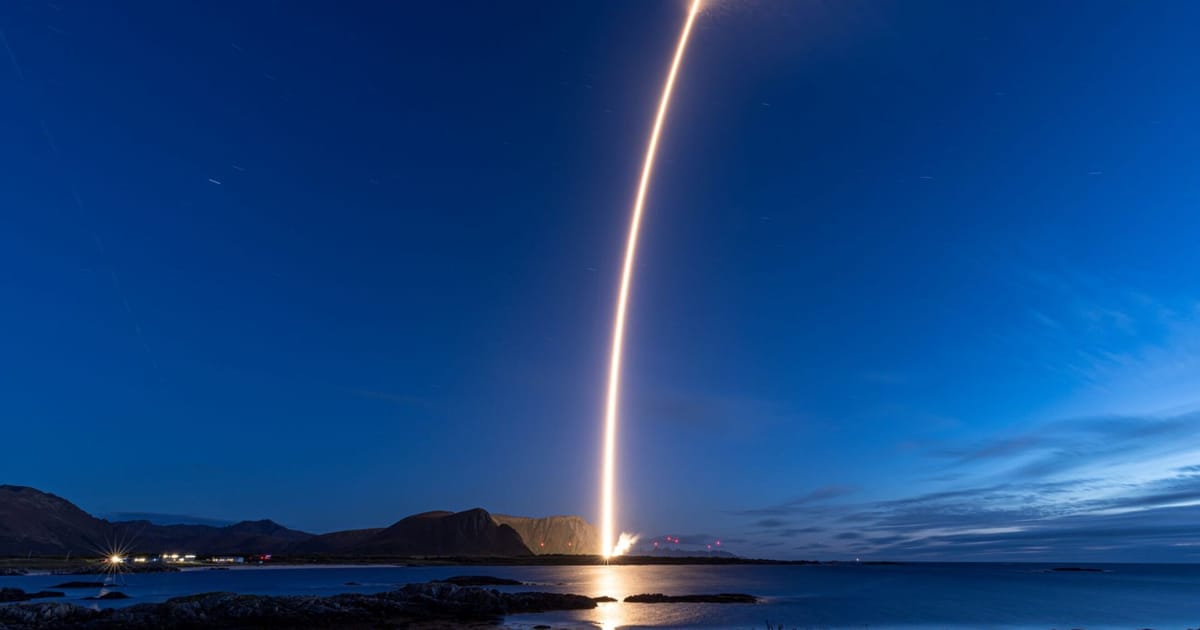
A German start-up founded eight years ago in a Munich garage has become the first European company to put a commercially developed rocket into orbit from European territory. Isar Aerospace's two-stage Spectrum vehicle lifted off from the Andøya spaceport on Norway's northern coast at 22:12 local time on Saturday, crossed the Kármán line and, after a tense half-hour loss of telemetry, confirmed that its payload had been released into the planned orbit.
A launch that exceeded expectations
The flight profile looked routine until ten minutes after lift-off, when the video feed from the upper stage cut out. Controllers in Munich and at the launch site waited 30 minutes before re-establishing contact with the second stage. When the link returned, the data showed that the stage had completed its burn and deployed the entire payload stack as designed. Nico Perakis, Isar's chief engineer, described the moment as "einfach unglaublich und das Ergebnis von harter Arbeit", simply incredible and the result of hard work.
Daniel Metzler, the company's chief executive, appeared at a post-flight press conference with a hoarse voice from the overnight vigil. He called the mission a historic milestone and said the team had given "Blut und Schweiß", blood and sweat, since the company's founding in 2018. The launch also marked the first orbital flight from the Andøya facility, which Norway has been developing as a polar-orbit launch site for more than a decade.
Funding round validates the technical milestone
Weeks before the launch, Isar closed a €270 million financing round that valued the company at €2 billion post-money. The round was led by existing backers including HV Capital, Lakestar and the NATO Innovation Fund, with participation from the German government's Future Fund. The capital is earmarked for scaling production of Spectrum, developing a larger follow-on vehicle and building out mission-assurance capabilities for institutional customers.
The valuation places Isar among the most valuable space start-ups in Europe, alongside France's The Exploration Company and the UK's Orbex. Investors cited the successful static-fire campaign earlier in 2026 and the company's contract backlog, reported at more than €500 million, as key drivers. The round also included a strategic tranche from a consortium of European defence primes, signalling military interest in assured access to orbit.
Political and military weight behind the programme
Chancellor Friedrich Merz, who visited Andøya in early 2026, issued a statement within hours of the launch calling it the "Beginn einer neuen Ära", the beginning of a new era, for European space sovereignty. The Bundestag's defence committee has already scheduled a hearing with Isar executives to discuss dual-use launch capabilities. The Bundeswehr's space command, established in 2021, has been explicit about the need for a European launcher that can deploy replacement satellites rapidly in a crisis.
That strategic dimension distinguishes Isar from purely commercial ventures. The company's Spectrum rocket is sized for the 1,000-kilogramme-to-sun-synchronous-orbit class, a sweet spot for reconnaissance and communications smallsats. Arianespace's Vega-C serves a similar market but has faced reliability setbacks and depends on Italian industrial leadership. Isar's all-German supply chain, with final integration in Munich, offers a different risk profile for Berlin and Brussels.
European launch landscape reshaped
Until Saturday, every orbital launch from European soil had been conducted by a national agency or by Arianespace under intergovernmental mandate. SpaceX's Falcon 9 dominates the commercial market, launching from Florida and California. European institutional customers have been forced to buy rides on US vehicles or wait for Ariane 6, which flew its first mission in mid-2024 but remains in a ramp-up phase. Isar's success introduces a third option: a privately funded, commercially operated European launcher with a declared price point below €30 million per flight.
The European Space Agency (ESA) has watched the development closely. In 2023 the agency awarded Isar a €15 million boost contract under its Commercial Space Transportation Services programme, intended to seed a competitive European launch market. ESA's director general, Josef Aschbacher, has repeatedly argued that Europe needs at least two independent commercial launch providers to avoid a monopoly. Isar's orbital debut suggests that policy is bearing fruit.
Technical choices that paid off
Spectrum uses nine Aquila engines on the first stage and a single vacuum-optimised Aquila on the second, all burning liquid oxygen and propane, a combination Isar chose for its clean combustion, high specific impulse and ease of handling compared with kerosene. The engines are 3D-printed in Inconel at the company's Ottobrunn factory, allowing rapid iteration. The first stage is designed for eventual recovery, though the maiden flight was expendable. Telemetry showed the first stage performed nominally through stage separation, a validation of the propulsion architecture.
The payload on this flight was a cluster of three technology-demonstration cubesats for European universities and a hosted payload for the German aerospace centre DLR. No commercial customer risked a satellite on the inaugural mission, a standard industry practice. Isar has said the next flight, tentatively scheduled for the first quarter of 2027, will carry the first paying passengers.
Production scaling the next hurdle
Moving from a single successful flight to a reliable launch service is where many new-space ventures falter. Isar's factory in Ottobrunn is configured for a rate of six vehicles per year, but the supply chain for propellant tanks, avionics and qualified fasteners remains thin in Europe. The €270 million round is intended to qualify second sources and build inventory. Metzler has set a public target of three launches in 2027 and monthly cadence by 2028.
Regulatory clearance is another variable. The Norwegian Civil Aviation Authority issued the launch licence for Andøya under a new framework aligned with EU space law. Future flights from Kourou in French Guiana or from a proposed North Sea platform will require coordination with French and Dutch authorities respectively. Isar has engaged the European Union Aviation Safety Agency early, but a harmonised European launch licence does not yet exist.
Competition and cooperation
Orbex in the UK and PLD Space in Spain are pursuing similar small-lift vehicles, but neither has reached orbit. Arianespace's Vega-C returns to flight in late 2026 after a 2022 failure. The market for dedicated small-satellite launch is crowded globally, Rocket Lab, Firefly and ABL Space in the US all operate or are near operations, but European institutional demand for sovereign access creates a protected niche. Isar's backers argue that the company's German industrial base and NATO-aligned funding give it a structural advantage for European government contracts.
ESA's next ministerial council in 2027 will decide whether to extend commercial launch subsidies. A successful second flight by then would strengthen Isar's case for a multi-year anchor contract. The company has also hinted at a partnership with Airbus Defence and Space for a larger vehicle, tentatively named Spectrum Heavy, that could address the medium-lift gap left by Ariane 6's high per-flight cost for single-satellite missions.
People mentioned
-
Daniel Metzler
-
Nico Perakis
Organisations
Isar Aerospace · Bundeswehr · European Space Agency