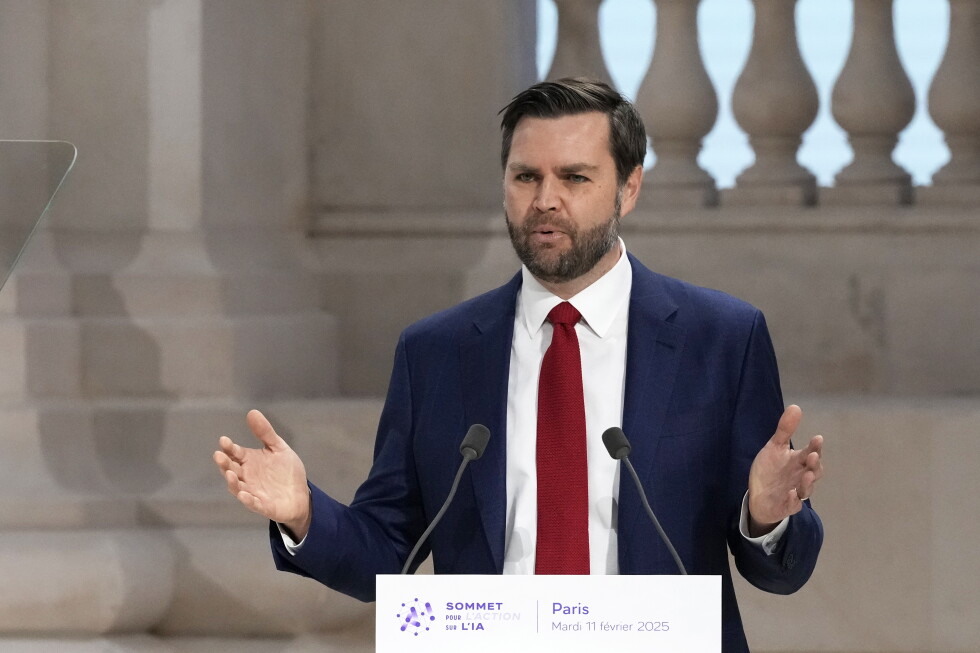
JD Vance arrived at the Paris AI Action Summit on 11 February 2025 and delivered a message that left no room for diplomatic ambiguity: the United States thinks Europe regulates artificial intelligence far too heavily. In his first major foreign policy address as vice president, Vance argued that excessive regulation would stifle innovation and entrench incumbents, a direct challenge to the European Union's AI Act, which entered into force just six months earlier.
A deliberate rebuke
The speech was not subtle. Vance warned that burdensome rules risked killing a growing industry before it reaches its potential, and he made clear that Washington views the EU's approach as a model to avoid rather than emulate. The EU AI Act, which took effect in August 2024, classifies AI systems by risk level and imposes obligations on developers ranging from transparency requirements to outright bans on certain applications. It is the most comprehensive AI law anywhere in the world, and American technology companies have lobbied against it since before it was passed.
Vance's presence in Paris was itself a signal. The Trump administration sent its vice president to an event where European officials expected to showcase regulatory leadership, and he used the platform to reject the premise entirely. Rather than engaging with the substance of the EU's rules, he framed regulation itself as the problem.
The summit declaration Washington refused to sign
The rift became even more visible when the summit concluded. The final declaration, which called for inclusive and sustainable AI development, was signed by roughly 60 countries. The United States and the United Kingdom both declined. The refusal was not a drafting accident. American officials had signalled beforehand that they would not endorse language implying that regulation should be a precondition for AI growth.
For European diplomats, the parallel with climate negotiations was hard to miss: a US administration walking away from a multilateral text that the rest of the developed world supported. The British decision to join Washington rather than Brussels was particularly uncomfortable for EU officials who had assumed the UK would at minimum sign the declaration.
What the EU AI Act actually does
The law at the centre of the dispute imposes a tiered system of obligations based on risk. AI systems used in critical infrastructure, law enforcement and hiring are classified as high-risk and must meet strict requirements around data quality, transparency and human oversight. Some applications, such as social scoring by governments, are banned outright. General-purpose AI models, the category covering large language models like those produced by OpenAI and Google, face transparency obligations and, for the most powerful systems, additional safety assessments.
European officials argue the Act is proportionate and necessary, pointing out that it does not restrict most low-risk AI applications at all. American critics counter that the compliance costs fall disproportionately on smaller companies and that the very act of categorising risk creates legal uncertainty that slows deployment.
France's investment counterpoint
While Vance criticised European regulation, his host was busy demonstrating that Europe can also write cheques. President Emmanuel Macron used the summit to announce roughly 109 billion euros in private investment commitments for AI development in France, a figure designed to show that Paris intends to compete with American and Chinese AI infrastructure, not merely regulate it.
The investment figure, which bundles commitments from French and international companies over several years, is substantial but should be read with care. It includes money that would likely have been spent on data centres and computing infrastructure regardless of the summit. Still, the timing was deliberate. Macron's message was that France can pursue both regulation and investment, a framing that Vance's speech implicitly rejected.
Who benefits from the divide
The transatlantic split has commercial winners. Large American technology firms, which already hold dominant positions in AI development, benefit from lighter regulation in their home market and face higher compliance costs in Europe. If the US government can weaken international support for EU-style rules, those firms gain a competitive advantage in markets that might otherwise follow Brussels.
European AI startups, meanwhile, face a paradox. They must comply with the AI Act from day one, while their American competitors operate under no equivalent federal law. Some European founders have already relocated to the US, citing the regulatory burden as a factor. Vance's speech will not help Brussels retain them.
The enforcement question
Even within Europe, the AI Act's effectiveness is unproven. Most of its provisions will not be fully enforced until 2026 at the earliest. The European Commission must still hire and train the staff to police it, and member states must establish national authorities. Enforcement will depend on political will in capitals that are simultaneously trying to attract AI investment. France, for instance, has pushed for looser implementation of the Act's general-purpose AI rules, putting it at odds with the Commission's more restrictive interpretation.
The EU's regulatory framework for AI is ambitious on paper. Whether it works in practice, and whether enough of the world follows it, will depend on decisions taken long after the Paris summit has closed.
People mentioned
Organisations
European Union · United States government