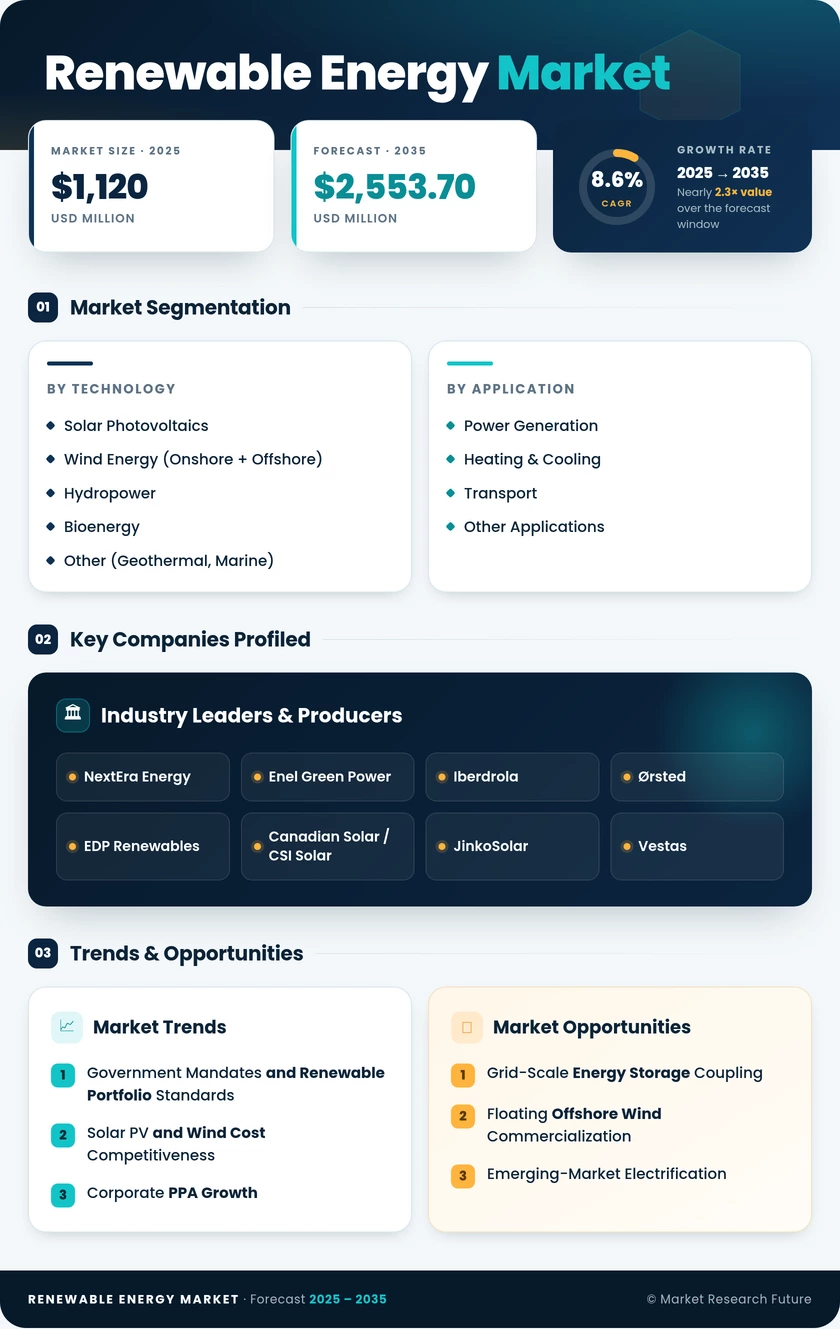
The global renewable energy market crossed the trillion-dollar threshold in 2025, reaching an estimated $1.12 trillion in revenue, with Europe securing roughly a quarter of that total. The figure, drawn from a triangulated analysis of investment databases, project pipelines across 85 countries and proprietary demand modelling, puts the continent's share at about $280 billion, a number driven less by solar volume than by the capital-intensive offshore wind farms rising in the North Sea and the Baltic.
REPowerEU rewrites the permitting rulebook
The European Commission's REPowerEU plan, launched in response to the 2022 energy crisis, has compressed permitting timelines for solar and wind across all 27 member states. Where projects once spent years in administrative queues, the new rules mandate maximum deadlines, one year for ordinary projects, two years for those requiring environmental impact assessments. The effect has been measurable: project risk premiums have fallen, and institutional capital has flowed into European renewables at a pace that would have seemed improbable three years ago.
The plan also designated 'renewables acceleration areas' where strategic environmental assessments replace project-by-project reviews. Germany, Spain and the Netherlands have moved fastest to implement the directive, though Poland and France have lagged in transposing the rules into national law. The uneven rollout means the 25% revenue share masks wide disparities in deployment speed across the single market.
Offshore wind anchors Europe's position
Unlike the United States, where utility-scale solar dominates new capacity, or China, where onshore wind and solar manufacturing scale drive down costs, Europe's growth engine is offshore. The North Sea alone hosts more than 30 GW of installed offshore capacity, with another 60 GW in various stages of development across British, German, Danish, Dutch and Belgian waters. The Baltic adds a further pipeline, though grid connections there remain a bottleneck.
This concentration on offshore wind explains why Europe's revenue share exceeds its capacity share. Offshore projects cost roughly twice as much per megawatt as onshore equivalents, but they deliver higher capacity factors, often above 50% compared with 25-30% for onshore wind in northern Europe, and generate power when solar output is low. The trade-off is a supply chain under strain: turbine manufacturers, foundation fabricators and installation vessels are all booked solid through 2027.
The transatlantic subsidy race
The US Inflation Reduction Act unlocked over $370 billion in clean-energy incentives through 2032, creating a powerful gravitational pull for capital and manufacturing. European developers have not been immune: several major utilities have shifted investment priority to the US market, where tax credits provide revenue certainty that European contract-for-difference schemes struggle to match. The European Commission's Net-Zero Industry Act, adopted in 2024, aims to counter this by targeting 40% of annual deployment needs from domestic manufacturing by 2030, but the gap in incentive design remains wide.
North America's 22% market share, valued at roughly $246 billion in 2025, is growing faster than Europe's in percentage terms, propelled by utility-scale solar deployment supported by production and investment tax credits. The IRA's domestic content requirements have also spurred a wave of factory announcements, solar module assembly, battery cell production, electrolyser manufacturing, that Europe is now racing to replicate.
Asia-Pacific's manufacturing gravity
The Asia-Pacific region commands 42% of global renewable revenue, approximately $470 billion, and is growing at a 10.2% compound annual rate, the fastest of any region. China's dominance is structural: it produces more than 80% of the world's solar modules, 60% of wind turbine components and a similar share of battery cells. India's auction pipeline, now regularly exceeding 50 GW per year, provides a demand base that sustains this manufacturing ecosystem.
For European buyers, this creates a strategic dependency. The Net-Zero Industry Act and the Critical Raw Materials Act both attempt to diversify supply, but lead times for new European polysilicon, wafer and cell capacity stretch to 2028 at the earliest. Until then, the continent's energy transition remains tethered to Chinese factories, a fact that sits uncomfortably alongside the rhetoric of strategic autonomy.
Corporate buyers rewrite demand curves
Corporate power purchase agreements (PPAs) have moved from niche to mainstream, now representing over 160 GW of contracted clean capacity globally. In Europe, the PPA market has matured rapidly: 2024 saw a record 15 GW of new corporate contracts, led by technology firms, data centre operators and industrial offtakers seeking to lock in power prices and meet Scope 2 emissions targets. The shift matters because corporate PPAs bypass state auction schedules, providing developers with bankable revenue streams that accelerate financial close.
The trend is also reshaping project design. Hybrid systems, solar plus storage, wind plus storage, or all three, are becoming the default for new corporate deals, allowing offtakers to match generation profiles to load curves. This in turn drives demand for battery storage, where Europe's manufacturing base remains negligible compared with China and, increasingly, the United States.
Grids and supply chains: the binding constraints
The International Energy Agency projects annual renewable capacity additions will rise from 510 GW in 2024 to 650 GW per year by 2030. Europe's share of that growth depends on two factors that policy alone cannot solve quickly: grid infrastructure and supply-chain resilience. The North Sea grid plan, envisioning hybrid interconnectors that link offshore wind farms to multiple national markets, remains largely on paper. Permitting for onshore transmission lines faces the same local opposition that delayed wind projects a decade ago.
On the supply side, the European Wind Charter, signed by 26 governments and industry in late 2023, committed to streamlining auction design, improving indexation and supporting domestic manufacturing. Early results are mixed: auction volumes have risen, but indexation mechanisms vary wildly between member states, and the manufacturing commitments have yet to translate into significant new capacity. Turbine makers Vestas, Siemens Gamesa and Nordex have all warned that order visibility beyond 2027 remains thin.
The next five years will test the model
The market research projects the global renewable energy market will reach $2.55 trillion by 2035, implying Europe's share could approach $640 billion if it holds its 25%. That assumption rests on three conditions: that REPowerEU's permitting gains survive political cycles, that North Sea grid interconnectors are built on schedule, and that the Net-Zero Industry Act stimulates enough domestic manufacturing to reduce import dependence. None is guaranteed.
Organisations
International Energy Agency · European Commission · BloombergNEF