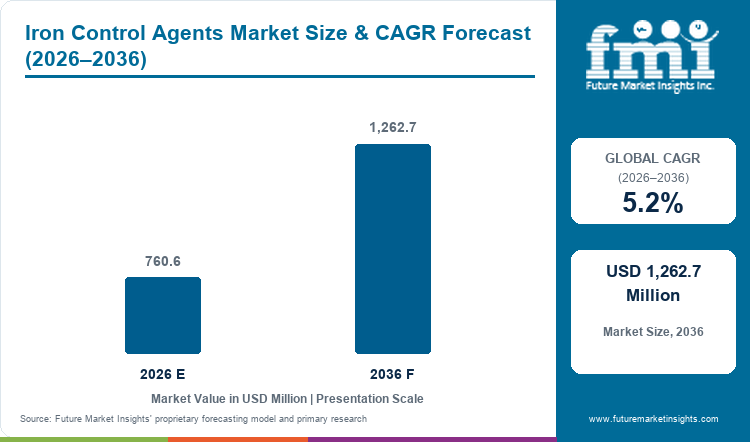
A small but stubborn problem in oil and gas production is becoming a bigger business. Iron control agents, the chemicals that keep dissolved iron from wrecking well treatments, are on track to grow from $760.6 million this year to $1,262.7 million by 2036, according to projections from Future Market Insights. The compound annual growth rate sits at 5.2%, modest by the standards of headline-grabbing technology sectors but meaningful for a specialty chemistry category that operators cannot easily skip.
Why dissolved iron matters
When acid is pumped into a well to stimulate flow or remove scale, it dissolves iron compounds along the way. As the spent fluid returns to the surface and its acidity drops, that dissolved iron can precipitate, forming solids that block pore throats and undo the treatment's benefit. Iron control agents exist to prevent this. They either reduce ferric iron to its more soluble ferrous form, chelate the metal, or sequester it within the fluid system. The chemistry has to work inside the same cocktail as corrosion inhibitors and scale treatments, because adding one solution that creates another problem is a fast route to an expensive failure.
Nikhil Kaitwade, principal consultant at Future Market Insights, frames the commercial proposition plainly. "Iron control earns its place only when the formulation keeps mobilized iron soluble without worsening corrosion or downstream deposits," he said. "Commercial value depends on laboratory compatibility and field dosage support plus reliable local chemical availability."
The North Sea and offshore demand
Offshore operations change the economics of these chemicals in ways that matter to European production. A failed treatment on a platform means mobilising a vessel, and vessel time is expensive. Operators therefore favour chemical packages that work the first time and reduce the need for repeat interventions. The Norwegian Offshore Directorate reported in January 2026 that the country's petroleum production reached roughly 240.5 million standard cubic metres of oil equivalent in 2025. Mature fields in the North Sea keep stimulation and restoration work active, even if the specific additive demand varies from one reservoir to the next.
ConocoPhillips gave Halliburton a five-year North Sea stimulation contract in August 2025 that includes converting a vessel for advanced well stimulation. For chemical suppliers, these long offshore contracts represent a different kind of opportunity than one-off sales. Once an additive proves compatible with the corrosion and scale chemistries already approved for a given field, switching costs are high. The International Energy Agency's data on North Sea production tracks the broader output context in which these contracts sit.
Unconventional gas and repeated treatments
Onshore unconventional work creates a different purchasing pattern. These wells require repeated high-intensity treatments, and each one may need a fresh fluid design as return-fluid chemistry shifts. Aramco reported in February 2026 that its Jafurah unconventional gas field had started production after technology reduced drilling and stimulation costs. SLB, meanwhile, announced a five-year contract with Aramco in December 2025 covering stimulation, intervention and frac automation for Saudi unconventional gas fields.
The implication for iron control suppliers is not straightforward. More frac activity does not automatically mean more iron control orders. The chemistry has to prove a defined role inside the overall treatment recipe, and formulators test dosage and compatibility before committing to a product line.
Market segments and the companies contesting them
Reducing agents are expected to hold 24% of the market in 2026, favoured because they convert ferric iron to ferrous and slot into established acid recipes with minimal reformulation. HCl acidizing accounts for a larger 34% share, reflecting how routine carbonate stimulation can mobilise iron from corrosion products. The two figures overlap, since reducing agents are often deployed within HCl systems.
The competitive landscape splits three ways. Integrated stimulation companies, principally SLB and Halliburton, combine chemistry with field execution. Oilfield chemistry specialists such as Innospec, Clariant and Nouryon focus on formulation depth. Then there are broader chemical businesses, including BASF and SNF Group, which address adjacent treatment needs alongside iron control. ChampionX, now an SLB business, and TETRA Technologies round out the main listed competitors. SNF Group owns the former Syensqo oil and gas division, consolidating its position in the sector.
Geography reshapes the growth rate
The spread between the fastest and slowest national growth rates is 2.5 percentage points. Argentina, at 6.0%, leads the projections, driven by intensive shale work. Saudi Arabia and the UAE sit in the same upper band, reflecting offshore and unconventional activity. Brazil's deepwater development also pushes its rate upward. The United States and Norway follow, despite their mature service capacity. Japan, at 3.5%, sits at the bottom because its domestic upstream is limited and its companies depend more on overseas projects where they may not specify the chemistry.
Comparable growth rates mask very different entry conditions. Treatment frequency, service infrastructure, and the availability of local chemical blending all vary materially by country. A supplier looking at Argentina's 6.0% CAGR faces a different set of distribution and qualification challenges than one targeting Norway's slightly lower figure.
Qualification as a barrier
Innospec launched its LaZuli deepwater production chemistry line in March 2025 after testing against API 17TR5 and API 17TR6 guidance. The exercise illustrates a point that runs through this market: qualification is both a cost and a moat. Offshore operators tend to retain approved formulations for longer periods because replacing chemistry requires fresh compatibility testing under the target field's specific conditions of temperature, metal loading and return-fluid composition.
For the companies that can prove their additives work alongside the corrosion and scale packages already in use, the reward is a recurring revenue stream locked inside multi-year contracts. For those that cannot, the market remains fragmented and price-sensitive, with regional formulators competing on availability rather than technical differentiation.
People mentioned
-
Nikhil Kaitwade
Organisations
Future Market Insights · SLB · Halliburton · Baker Hughes · Innospec · BASF