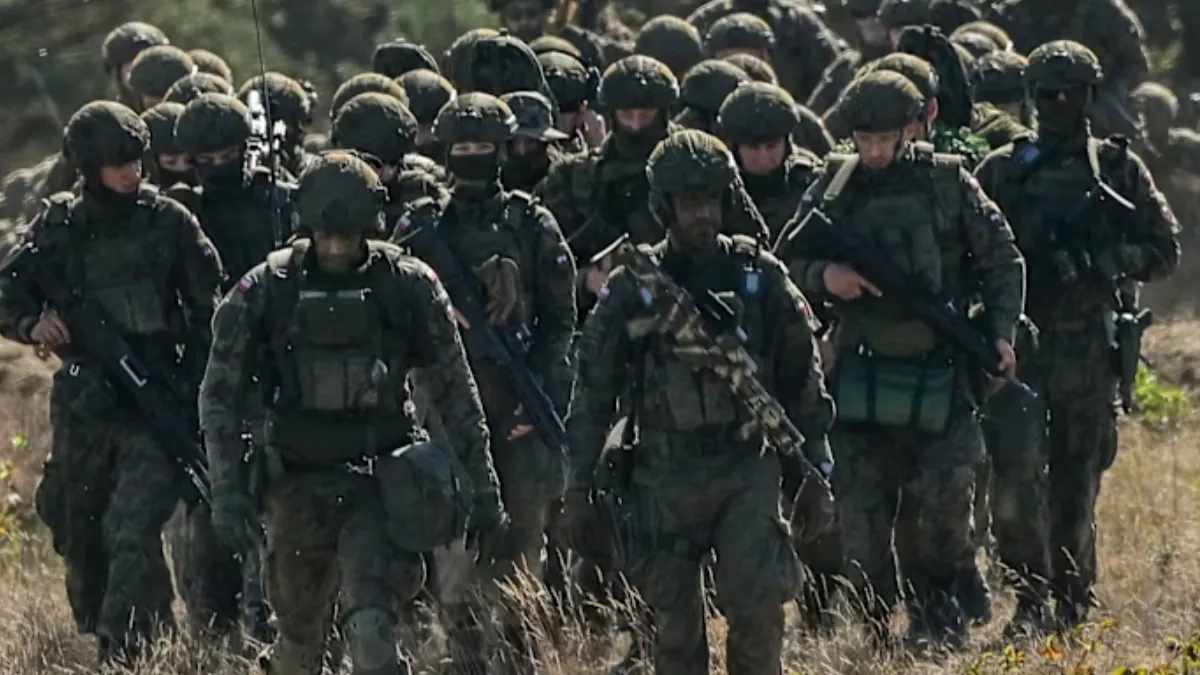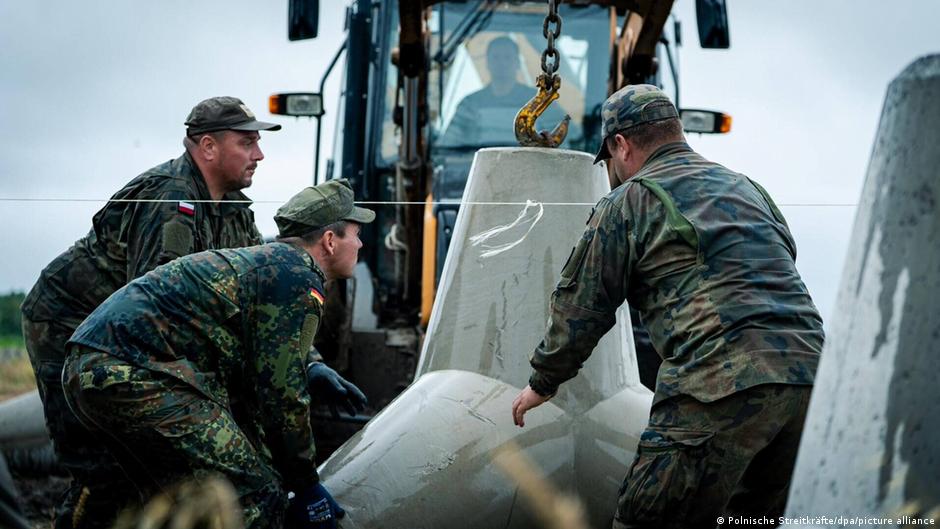
German combat engineers are building anti-tank defences on Poland's border with Russia. The deployment, which began in June 2026, places Bundeswehr soldiers roughly 200 metres from the frontier with the Russian exclave of Kaliningrad, in a stretch of Masurian countryside near the village of Budry. Around 40 German sappers are installing concrete anti-tank obstacles known as Czech hedgehogs as part of Poland's East Shield: a planned 800-kilometre defensive system along the country's borders with Russia and Belarus.
The East Shield project
Poland began constructing the East Shield in 2024. Prime Minister Donald Tusk inspected the first completed section in November that year, declaring the project was meant to "deter and discourage a potential aggressor" and was "truly an investment in peace." The full system will combine physical barriers, anti-tank obstacles, ditches and mineable zones stretching across the entirety of Poland's eastern frontier.
The undertaking reflects how fundamentally Russia's invasion of Ukraine in February 2022 reshaped Poland's threat assessment. Poland's 2026 defence budget stands at 200 billion zlotys, roughly 46 billion euros: almost 5 per cent of GDP, the highest ratio in NATO. Warsaw has also been buying advanced American weapons systems and pushing the East Shield forward as fast as possible.
What the sappers are building
The German contribution is physically modest. In six weeks, the 40 sappers have laid slightly more than a kilometre of Czech hedgehogs near Budry. The installation consists of three rows of spiky concrete blocks positioned roughly 200 metres behind the border, with a deep ditch and another line of hedgehogs running along the frontier itself. A Polish officer explained that mines can be rapidly placed in the zone between the two lines. A yellow backhoe lifts the blocks from a truck and sets them in the mud.
The German contingent is scheduled to remain until October, though work near Budry should finish in the coming week. The sappers will then move to other sections of the East Shield.
Symbolism heavier than concrete
General Stanislaw Czosnek, inspecting the works on Thursday, said the German sappers had "done an excellent job" and that he was "very impressed" by their performance. The accompanying German general, Tito Gante, said: "We stand ready to fight for democracy and freedom." He described the Bundeswehr's support as an official mission, adding: "We want to maintain peace with a credible deterrent."
The political meaning matters more than the metres of hedgehog laid. Lukasz Jasinski, an analyst at the Polish Institute for International Affairs, told Deutsche Welle that "above all, the participation of German sappers has politically symbolic significance." Poland, he said, wants to convince Germany and other partners that its eastern border is also the external border of the EU and NATO, and that Western partners should treat it "a bit like their own."
A long history of cooperation and suspicion
German-Polish military ties go back further than many assume. After Poland joined NATO in 1999, the two countries took leading roles in the alliance's Multinational Corps Northeast, headquartered in Szczecin. In 2003, Germany sold Poland the MiG-29 fighter jets it had inherited from East Germany for one euro each. Joint exercises and officer exchanges are now routine.
Russia's full-scale invasion of Ukraine initially caused friction. Berlin's early response was cautious, and Warsaw was frustrated. But the overall effect has been to deepen cooperation. German Patriot batteries with their crews have supported Polish air defence, and German Eurofighters have helped patrol Polish airspace under NATO's Enhanced Air Policing mission. A German-Polish defence agreement was signed on 17 June 2026, following intergovernmental consultations in December 2025.
PiS opposition and the weight of memory
German soldiers on Polish soil remain politically divisive. The Law and Justice Party (PiS), which governed from 2015 to 2023, has long used Second World War memory to stoke anti-German sentiment. In 2014, PiS leader Jaroslaw Kaczynski said he did not want German soldiers in Poland and that it would be "at least seven generations before that is acceptable." In late 2022, when Berlin offered to deploy Patriot batteries after a stray Ukrainian missile landed on Polish territory, the PiS government blocked the move. Kaczynski declared that "Germany's previous behavior gives us no reason to believe that it will decide to fire on the Russian rockets."
The opposition continues. In March 2026, PiS-backed president Karol Nawrocki vetoed legislation that would have given Warsaw access to nearly 44 billion euros in EU defence loans, partly because German armaments companies could have benefited. The calculation is straightforward for PiS: any arrangement that strengthens German defence industry interests in Poland can be framed as a betrayal of national sovereignty.
Washington remains the primary guarantor
Poland's fundamental security orientation is clear. Around 10,000 American soldiers are stationed across the country, and Warsaw is pressing for a permanent US base rather than the rotational deployments that currently prevail. The German sappers are a useful supplement, and their presence carries diplomatic weight, but they are not the force Poland ultimately relies upon.
On 15 August 2026, three German aircraft, two Eurofighters and an A400M transport, participated in Poland's Armed Forces Day celebrations. The head of the German air force, Holger Neumann, was a guest of honour. American soldiers marched in the parade. German soldiers did not.
People mentioned
-
Stanislaw Czosnek
-
Tito Gante
-
Jaroslaw Kaczynski
-
Lukasz Jasinski
-
Holger Neumann
Organisations
Bundeswehr · NATO · Law and Justice Party (PiS) · Polish Institute for International Affairs