When Equinor chief executive Anders Opedal signed a 15-year gas supply contract with the German utility Uniper at the Offshore Northern Seas conference in Stavanger last week, the symbolism was blunt. Six years ago, Equinor was pledging heavy investment in renewables and net-zero emissions by midcentury. This year it dropped its renewable target. The net-zero pledge remains on paper, but the strategy has reversed course: back to the Norwegian continental shelf, back to oil and gas, back to the fuel Europe is actually purchasing.
That contract is one data point in a wider continental shift. Wars in Ukraine and Iran have shredded Europe's energy transition timetable. Gas storage across the continent sits near historic lows with winter approaching. European governments, wary of depending on the United States under a president who has openly threatened to leverage energy in trade negotiations, are signing long-term deals for Norwegian gas instead.
The processing plant at the centre of Europe's supply
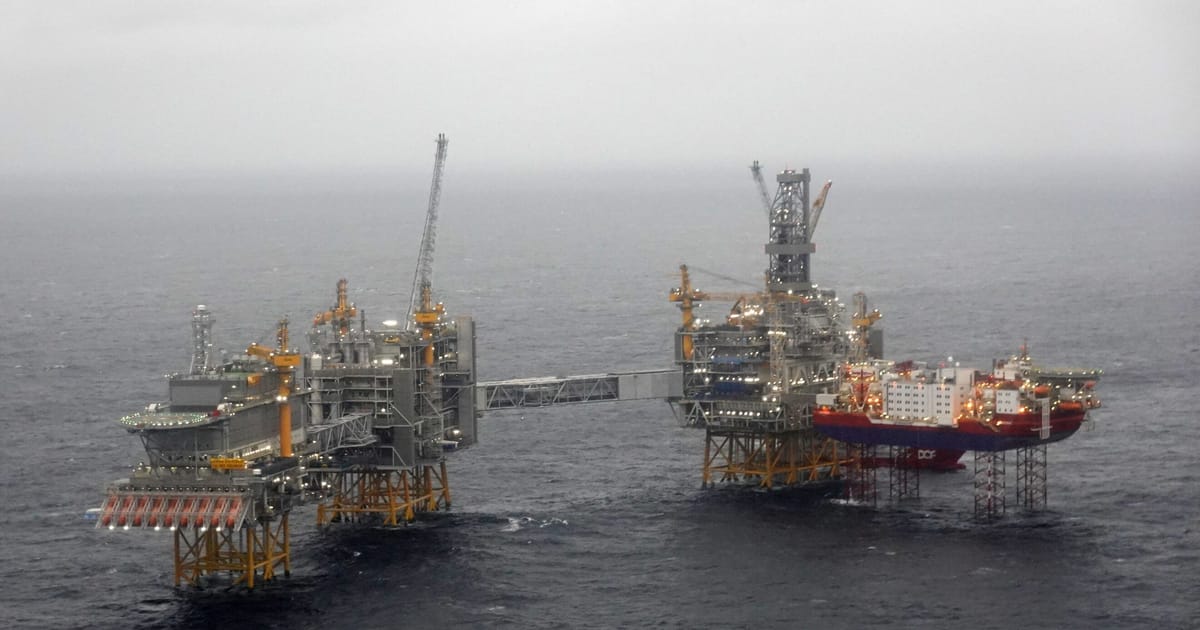
Roughly a quarter of all Norwegian gas production flows through Kårstø, the largest processing facility of its kind in Europe, a tangle of pipelines, distillation towers and flare stacks on the Norwegian coast. Gas processed there feeds pipelines to Belgium, France and Germany. Last year Norway supplied nearly a third of the EU's gas and 14 per cent of its crude oil. For a country outside the bloc that runs its domestic economy almost entirely on hydropower and electric vehicles, Norway has become the supplier Europe turns to when transition rhetoric meets demand reality.
Oil and gas still account for more than half of Europe's final energy consumption, despite two decades of renewable subsidies, electric vehicle mandates and heat pump programmes. The gap between what European leaders declare at climate summits and what their utilities actually purchase has become a straightforward business opportunity for Norway.
Equinor's strategic reversal
Equinor's pivot captures the mood. In 2020, amid peak political pressure on climate, the company announced ambitious plans for renewable investment. By 2026, those ambitions have been trimmed. Opedal framed the shift as simple pragmatism: all his European customers have transition strategies and are investing in renewables, but they are also securing long-term contracts for gas. The Uniper deal, he said, would contribute to energy security for Europe while providing demand security for Equinor, allowing continued investment in the Norwegian continental shelf.
Equinor executives were careful to note the company's substantial investments in the US oil and gas sector, as well as its offshore wind development for European markets. Opedal insisted the strategy is to provide reliable energy in a world in transition, with the majority continuing to be oil and gas. The message is calibrated: enough green investment to satisfy Brussels, enough hydrocarbon output to satisfy investors and European buyers.
A production cliff on the horizon
The difficulty is geology. Norwegian oil and gas production has been declining over the past decade. The Norwegian Offshore Directorate, which regulates the continental shelf, expects output to fall by at least a third by 2050 under its best-case scenario. Its baseline projection is worse: a decline of more than half.
Industry executives and politicians in Oslo argue that fresh investment and new technology can slow this decline, what the trade calls flattening the curve. At the ONS conference, which drew nearly 70,000 visitors to Stavanger, the exhibition halls were filled with subsea drones, AI mapping systems and drilling equipment promising to squeeze more from ageing fields. But the serious hope of arresting decline lies in frontier exploration, particularly in the Barents Sea in Norway's far north. That demands capital, risk appetite and people willing to live in remote Arctic communities.
Not everyone in the industry is confident about the pace. Johnny Hersvik, chief executive of the Norwegian fossil fuel company Aker, used a conference panel to lobby Aasland directly for faster regulatory approval of experimental production technology. The minister promised only to listen. Hersvik was blunter afterwards: he does not think there is a sense of urgency.
Norway's political consensus and its fractures
Norway's sovereign wealth fund, now valued above $2 trillion, was built on oil and gas revenues that fund roughly a fifth of the federal budget. The industry's political grip is unmistakable. Stavanger's professional ice hockey team is called the Oilers. The city has a museum celebrating the local oil industry. Equinor advertisements cover bus stops.
The governing coalition, led by the Labour Party, is a reliable backer of the sector. Energy minister Terje Aasland was blunt: Norway's strategy is to be a long-term provider of oil and gas to the European market, with the target being as high production as possible.
Yet the consensus has hairline cracks. The Green Party joined the governing coalition last year and has pushed for a commission to explore a future without oil. Green Party MP Frøya Skjold Sjursæther, surveying the oil majors' sprawling booths at ONS, described the industry's hold on politics as really sad. Outside the conference, Extinction Rebellion activists staged a protest on the opening day, drinking oil in a deliberately grotesque gesture.
Balancing Washington and Brussels
Norway must also manage its relationships with two powerful partners pulling in different directions. The White House under Trump has urged European allies to buy American liquefied natural gas. White House spokesperson Taylor Rogers declared that the United States, thanks to Trump's energy dominance agenda, is the world's largest producer and exporter of oil and natural gas with an abundant and reliable supply for allies.
Asked whether Norway competes with American LNG, Aasland was diplomatic: US LNG is important for Europe's energy security. It is a careful formulation. Eurostat figures on EU energy imports show Norway already supplies more gas to the bloc than any other source, but Norwegian officials have no interest in provoking Washington while they court Brussels.
The gap between Europe's words and actions
Ann Mettler, a former adviser to European Commission president Jean-Claude Juncker who now runs the think tank Catalyse Europe, articulated the contradiction plainly. Europeans moralise in public about clean energy, she said, but in practice they are buying large volumes of LNG. The business case for clean energy has not been delivered in many instances, which is why European oil and gas companies are returning to their roots.
The scene at Kårstø makes the point physically. Wind turbines turn on a hillside above the plant. Deer and cattle graze in fields beside it. Yet two bright orange flares send black smoke into the sky, burning off excess gas ahead of maintenance. The EU has campaigned to eliminate flaring as wasteful and polluting. The flares at Kårstø burned on regardless.
People mentioned
-
Ann Mettler
-
Johnny Hersvik
-
Frøya Skjold Sjursæther
Organisations
Equinor ASA · Uniper SE · Aker ASA · Norwegian Offshore Directorate · Catalyse Europe