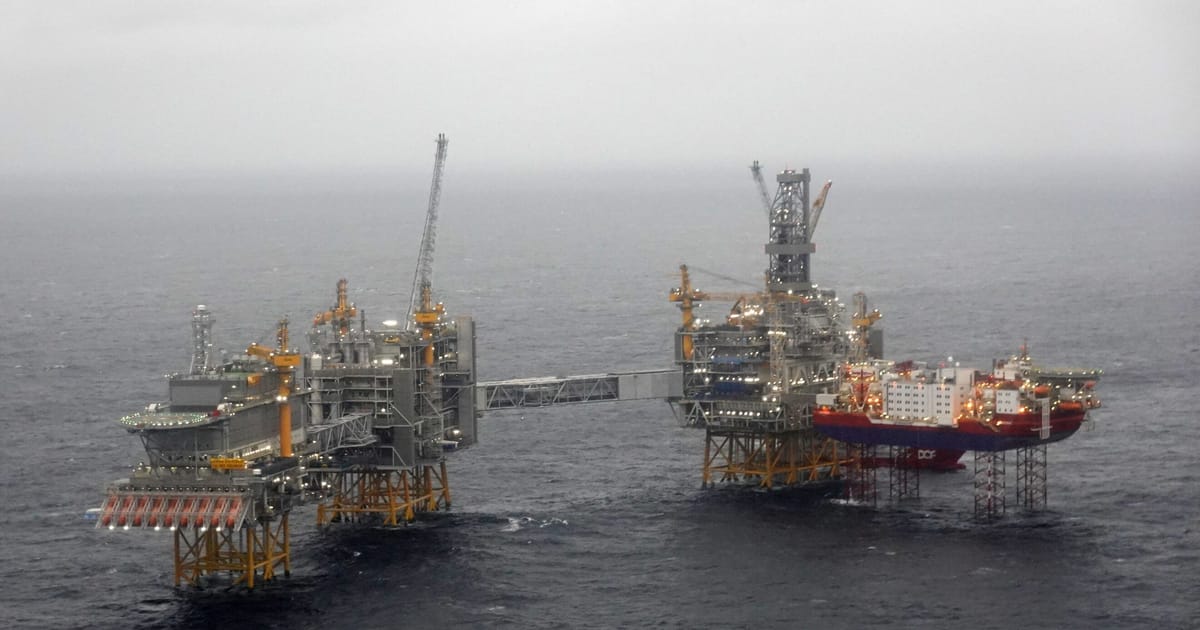
Norway has told the European Union, in terms barely short of blunt, that it will drill for oil and gas in Arctic waters whether Brussels approves or not. Energy Minister Terje Aasland, speaking at the ONS conference in Stavanger on 24 August 2026, said Norway would develop Barents Sea reserves even if the EU maintained its support for a moratorium on Arctic hydrocarbon supplies.
The statement sharpens a shift already under way in Oslo. Since Russia's full-scale invasion of Ukraine in 2022, Norway has become the single largest supplier of natural gas to the EU and Britain, covering roughly 30% of their combined gas demand. That leverage now underpins a more assertive posture.
Equinor's market signal
Anders Opedal, chief executive of Equinor, reinforced the government's position at the same event. Oil and liquefied natural gas from the Barents Sea can be shipped to global markets if the EU refuses to buy, he told Reuters. "The only thing that will suffer from this is actually European security," Opedal said. The message to Brussels is straightforward: Norwegian hydrocarbons do not depend on European buyers.
This recasts a relationship long presented as one of mutual obligation. For years, Norway framed itself as a reliable partner supplying energy to European allies. The new framing is market logic. If the EU chooses not to purchase Arctic oil and gas, those volumes will find buyers in Asia or elsewhere. Gas can be exported as LNG from Equinor's Melkøya plant near Hammerfest; oil flows to whichever market pays.
Sustaining output past 2035
Aasland said Norway intends to maintain petroleum production and exports at approximately current levels until at least 2035. The Barents Sea, above the Arctic Circle, is central to that ambition. Existing North Sea fields are in gradual decline, and without new Arctic acreage Norway cannot sustain today's volumes.
In discussions with EU officials, Oslo has argued that the parts of the Barents Sea opened to petroleum activity are ice-free, much like the North Sea, making them less prone to oil spills and other environmental damage. Development also supports employment and settlement in Norway's northern regions, which border Russia.
Aasland said he believed Norway's arguments were being heard in Brussels. But he left no doubt about what would happen if they were not. "We would develop these areas, and then it will be up to the EU whether they should have a moratorium on buying that gas or oil," he said.
The IEA weighs in
The International Energy Agency has added its own voice to the debate. Fatih Birol, the IEA's executive director, has urged the EU to reconsider its opposition to new Arctic oil and gas projects, arguing that future supplies will be needed for energy security. Critics counter that new Arctic developments take many years to come online and would do little for Europe's near-term energy challenges.
The tension between those positions is unlikely to resolve soon. New fields in the Barents Sea would not produce for a decade or more, by which point the EU's own energy mix may have shifted further toward renewables. But Norway's argument is about long-term optionality: if Europe wants gas available in the 2030s, investment decisions need to be taken now.
The 'green battery' discarded
Norway's energy relationship with Europe extends beyond hydrocarbons. The country produces a surplus of renewable electricity most years, thanks to an extensive network of reservoirs and waterways feeding hydroelectric plants. Power cables connecting Norway to Britain and Germany were built on the premise that Norway could act as a "green battery" for the continent, storing energy when supply exceeded demand and releasing it when needed.
Aasland called that concept "a flawed idea." Norway alone cannot balance the European power market, he said, and deeper integration with the continental grid has left the country exposed to price swings driven by events far beyond its borders.
The backlash has been building for months. Norwegian consumers and politicians have grown frustrated as European electricity prices have risen and dragged domestic prices higher through the interconnectors. Aasland confirmed that Norway will not build new power links to the continent, though it remains committed to cooperation within existing infrastructure.
A message to continental capitals
Aasland's broader point was that European countries need to strengthen their own stable power supply. Coal and nuclear plant closures, combined with insufficient investment in new gas-fired generation, have weakened the continent's base-load capacity. That drives up prices and makes reciprocity in power flows harder to achieve.
"The future lies in having a very strong and integrated system," Aasland said. But integration, in his telling, requires continental partners to invest in the generation that keeps grids stable, not simply to draw on Norwegian reservoirs when the wind drops.
People mentioned
-
Fatih Birol
Organisations
Equinor · International Energy Agency · European Union