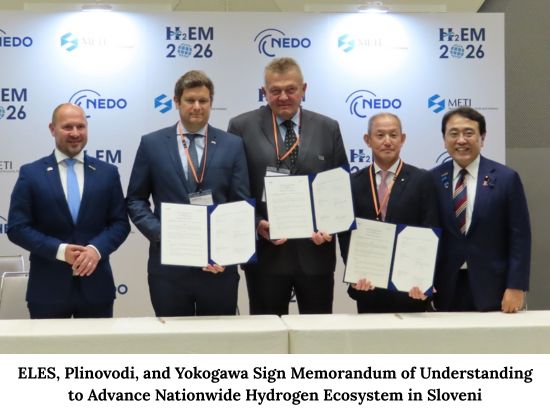
Slovenia's two main energy network operators and a Japanese industrial automation group have signed an agreement to plan a national hydrogen ecosystem, a move that could turn the small central European country into a working example of how electricity, gas and hydrogen infrastructure can be run as an integrated system.
The memorandum of understanding between ELES, Plinovodi and Yokogawa Electric Corporation was concluded during ministerial meetings in Japan and witnessed by government representatives from both countries. It covers a demonstration hydrogen plant, digital coordination between grids, green hydrogen vehicles for maintaining energy infrastructure, and mobile backup power units that could also serve as fast chargers.
Sector coupling on a national scale
European energy policy has talked about sector coupling, the idea of linking electricity, gas, heating and transport so they reinforce each other rather than operating in isolation, for the better part of a decade. Turning that concept into operating infrastructure has proved harder than drafting the white papers. Slovenia now has a chance to try it at the scale of an entire country, precisely because its energy system is compact enough to manage.
Matija Bitenc, Plinovodi's chief executive, said the collaboration would demonstrate how hydrogen can bridge electricity and gas networks, creating greater flexibility and making better use of existing assets. He described Slovenia as a potential European demonstration case for sector coupling.
That claim rests on something real. Slovenia has a single electricity transmission operator and a single gas transmission operator. In Germany or Italy, coordinating hydrogen infrastructure means aligning the interests of multiple grid managers, regional governments and regulators. In Slovenia, two organisations cover the entire country. That simplifies decision-making considerably.
What each party brings
ELES operates Slovenia's electricity transmission system and had already formed a consortium to develop low-carbon hydrogen on the power side. Plinovodi runs the gas transmission network and has been preparing it for renewable and carbon-neutral gases, including work on a national hydrogen backbone. Yokogawa contributes industrial automation and digital systems expertise, plus experience from other hydrogen projects internationally.
Yokogawa Europe will coordinate the work. The first step is a feasibility study examining whether the technical and commercial case for integrating hydrogen into Slovenia's energy infrastructure holds up. No deadline for completing that study has been disclosed.
Connecting to Europe's hydrogen plans
Plinovodi's work on a hydrogen backbone is not happening in isolation. The company is developing plans to integrate Slovenia's future hydrogen network into the European Hydrogen Backbone initiative, a collaboration among dozens of European gas infrastructure operators that envisages repurposing existing natural gas pipelines to carry hydrogen across the continent.
Slovenia sits between Austria, Italy, Hungary and Croatia. A hydrogen corridor through Slovenian territory could connect production sites in the south and east of Europe with demand centres further west. That geographic position gives the country's hydrogen infrastructure plans a relevance well beyond its domestic energy needs, provided the infrastructure actually gets built. The European Commission's hydrogen strategy identifies such corridors as essential to meeting the EU's decarbonisation targets.
The Japanese angle
Yokogawa's involvement brings Japanese industrial capability into a European hydrogen project at a moment when both Japan and the EU are trying to secure hydrogen supply chains. Japan has positioned hydrogen as central to reducing its dependence on imported fossil fuels, and finding European demonstration partners serves both commercial and diplomatic objectives.
The MoU was signed alongside ministerial meetings, a signal that both governments see the arrangement as more than a private-sector convenience. Koji Nakaoka, Yokogawa's executive vice president heading its Energy and Sustainability Business Headquarters, said hydrogen would have an important role in the energy transition and that the company would support building a resilient hydrogen ecosystem in Slovenia.
From agreement to investment
Memoranda of understanding signal intent. They do not generate hydrogen, build plants or lay pipelines. The feasibility study that Yokogawa Europe will lead needs to answer several questions before anything concrete follows. Where will the renewable electricity come from? What are the offtake arrangements for the hydrogen produced? Can existing gas infrastructure be repurposed, or will new build be required? How will a Slovenian project compete for EU funding against larger and more advanced proposals in Germany, the Netherlands or Spain?
Aleksander Mervar, ELES's chief executive, said the initiative could establish a foundation for wider deployment of hydrogen technologies in industry and transport, and that the operational experience could be replicated across Europe. Those are reasonable claims about potential. Whether they become reality depends on what the study concludes and who is willing to fund the next stage.
Green hydrogen produced by electrolysis remains substantially more expensive than fossil alternatives. The International Energy Agency has repeatedly noted that the infrastructure to transport and store it only attracts investment when demand is certain. Slovenia's compact energy system gives it an advantage in coordination. Its disadvantage is that neighbouring countries are moving faster and committing larger sums.
People mentioned
-
Aleksander Mervar
-
Matija Bitenc
-
Koji Nakaoka
Organisations
ELES · Plinovodi · Yokogawa Electric Corporation