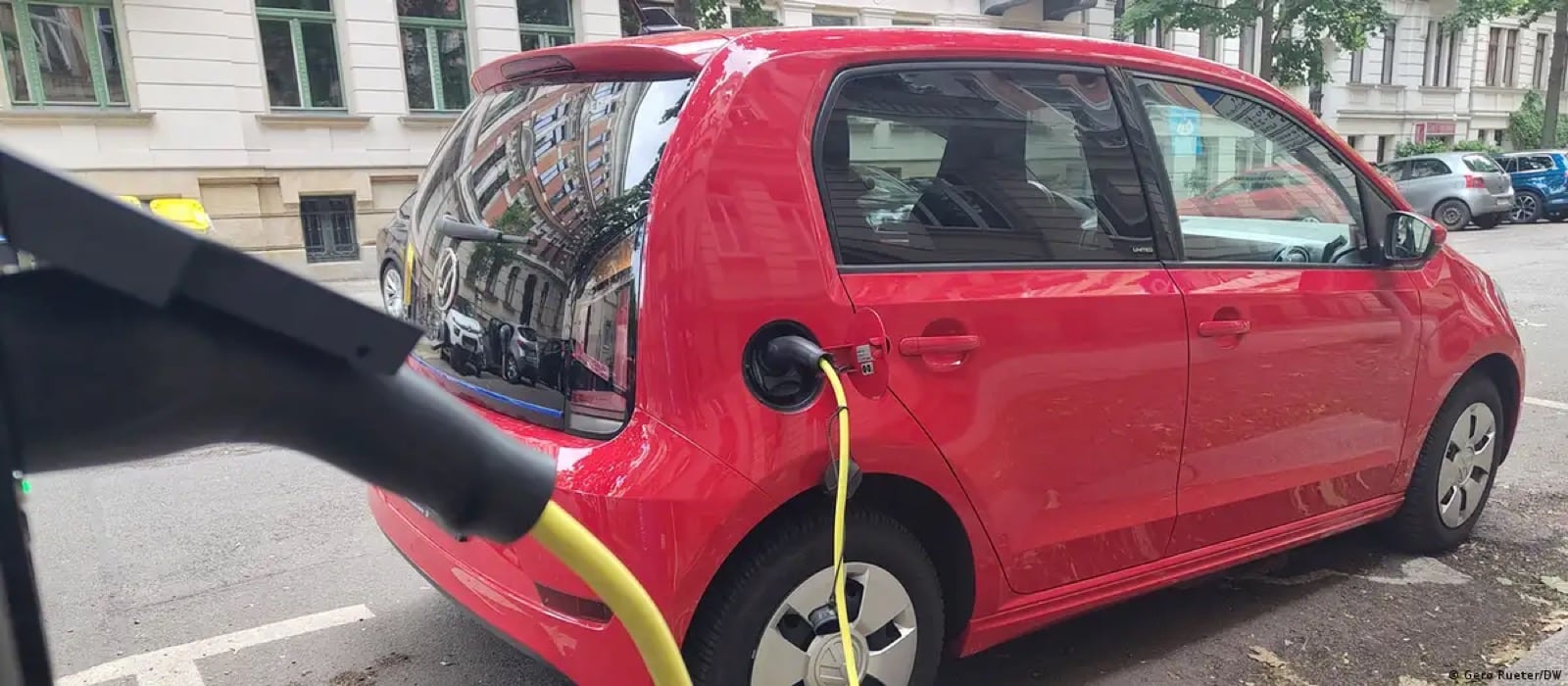
Bavaria's conservative premier Markus Söder has seized on a university report to demand the European Union abandon its 2035 combustion engine phaseout, declaring that science now backs his position. Germany's Bild tabloid went further, branding the EU's treatment of electric vehicles as carbon neutral "the EU's car lie".
What the Munich report claims
The report from the Technical University of Munich (TUM) argues that the EU's vehicle emissions regulation is fundamentally flawed because it counts only tailpipe emissions. Battery-electric vehicles are treated as climate-neutral under those rules, a classification TUM says ignores emissions from manufacturing and from the electricity used to charge vehicles.
TUM's central finding: battery-electric vehicles reduce carbon emissions by an average of just 41% compared with combustion engine cars. The report calls for lifecycle assessment, counting emissions from raw material extraction through to end-of-life recycling, and suggests credit mechanisms for things like green steel and battery recycling.
The argument has obvious appeal for Germany's car industry. BMW, Audi and Volkswagen all support the lifecycle approach. All three are also major institutional donors to TUM, a connection the report does not dwell on.
Why independent analysts disagree
Georg Bieker, a researcher at the International Council on Clean Transportation (ICCT), a US-based think tank, says the TUM analysis does not offer any new insights. The importance of lifecycle assessment is already well understood among climate and mobility specialists. The disagreement is about what the numbers actually show.
A 2025 study Bieker co-authored, which examined the global warming potential of passenger cars sold in the EU across their full lifecycle, found that battery-electric vehicle emissions are on average 73% lower than those of gasoline cars. When charged exclusively with renewable electricity, that figure rises to 78%. Research from the European Environment Agency, the International Energy Agency and the German Environment Ministry has produced similar results, with reductions ranging from 60% to 80%.
One reason for the gap between TUM's 41% and the ICCT's 73% is that production emissions for internal combustion vehicles account for only about 13% of their total climate impact. The vast majority comes from the tailpipe, a source battery-electric vehicles simply do not have. As the electricity grid decarbonises further, the EV advantage grows.
The battery production question
Batteries remain the most significant environmental challenge for electric vehicles. Mining cobalt and lithium has been linked to habitat destruction and water depletion: extracting a single ton of lithium, enough for roughly 125 vehicles, requires approximately 2 million litres of water.
The ICCT study found that battery-electric vehicles carry roughly 40% higher production emissions than gasoline equivalents, principally because of battery manufacturing. But those additional emissions are offset after about 17,000 kilometres, typically one or two years of driving. After that point, the electric vehicle is cumulatively cleaner. Unlike petrol, batteries can eventually be recycled.
Technology is shifting the balance further. Lithium-iron phosphate (LFP) batteries, increasingly the industry's preferred chemistry, generate fewer production emissions than the nickel manganese cobalt alternative. LFP cells are safer, last longer and cost less. Production is also moving closer to home. The European Commission has committed €1.5 billion in interest-free loans to build up European battery cell capacity, reducing the emissions associated with importing cells from China.
Electricity mix and the grid
The other variable is how the charging electricity is generated. A battery-electric vehicle charged on a coal-heavy grid produces more indirect emissions than one running on wind or solar. But the European grid is moving fast.
Gabrielle Clark, a policy officer at Eurelectric, the European electricity trade federation, said Europe's grid is currently more than 70% decarbonised and expected to be almost fully decarbonised by 2040. As green steel production and battery recycling capacity scale up, she argued, the case for electric vehicles strengthens further.
Clark said replacing the current tailpipe regulation with more complex lifecycle rules was unnecessary. "Whether assessed through lifecycle assessment or tailpipe emissions, battery-electric vehicles are always the preferred technology for carbon emission reductions in the road transport sector," she said. "Their replacement of internal combustion engine vehicles must be accelerated, not delayed."
Who benefits from the 41% figure
The TUM report has arrived at a convenient moment for German automakers with deep investments in combustion engine platforms and for the politicians who represent them. Söder's demand to scrap the 2035 phaseout is not new, but the claim that science now supports it gives political cover to what has always been an industrial argument.
The risk for European carmakers is that slowing electrification at home does not slow it elsewhere. Global electric vehicle sales are growing rapidly, particularly in China and Southeast Asia. In Germany itself, a survey by SBD Automotive and Here Technologies found that 54% of respondents were now more likely to consider an electric car as their next purchase, citing technology advances, rising fuel prices and environmental concerns.
People mentioned
-
Georg Bieker
-
Gabrielle Clark
Organisations
Technical University of Munich · International Council on Clean Transportation · Eurelectric · European Commission