Britain will transfer technical drawings for British-made components of the Scalp cruise missile, allowing Ukraine to set up assembly lines for the long-range weapon on its own territory. The decision, confirmed during Prime Minister Burnham's visit to Kyiv on Monday, represents a notable step beyond previous Western support: rather than simply shipping finished munitions, London is sharing the means to manufacture them inside a country under bombardment.
The Scalp is the French variant of the Storm Shadow, with a range exceeding 250 kilometres. Both versions have already been supplied to Kyiv and used against targets inside Russia. Until now, Ukraine has depended entirely on deliveries from London and Paris. Domestic production would give Kyiv a measure of self-sufficiency, though it also creates a clear vulnerability: any factory on Ukrainian soil is within range of Russian missiles.
Moscow's warning on production sites
The Kremlin did not wait long to make that point. Spokesman Dmitry Peskov told reporters on Monday that Russian forces were already collecting intelligence to locate and destroy any manufacturing facilities. He accused Britain of methodically adding fuel to the fire and said the blueprint transfer prevented even minimal progress towards peace.
Burnham's reply was characteristically direct. Asked about the Russian criticism, he said: "Who started the fire? That's the question, isn't it?" He has maintained that Britain is providing support so Ukraine can defend itself, a position he said had been consistent across previous prime ministers and remained his own.
Andrei Fedorov, a former Russian deputy foreign minister, went further, warning that Britain could face a "semi-military" response from "unknown sources". He suggested enterprises or factories producing drones for Ukraine could be targeted, though he conceded that such escalation risked pushing the conflict beyond Ukraine's borders. Whether that constitutes a veiled threat of sabotage against British defence facilities is open to interpretation.
Air defence as urgent priority
Burnham used his Kyiv visit to chair the first meeting of the coalition of the willing, a grouping of 34 countries established by Britain and France under his predecessor, Keir Starmer. French President Emmanuel Macron and German Chancellor Friedrich Merz co-chaired. The session, held partly in Kyiv and partly by video, focused on interceptors.
A joint statement from the three leaders described strengthening Kyiv's air defences as a matter of urgent priority. They also pledged to constrain Russia's capacity to fund the war through sanctions and actions against the shadow fleet of tankers Moscow uses to move oil, and condemned what they called Russia's systemic and escalating strikes on Ukrainian cities, infrastructure and civilians.
The urgency is grounded in recent events. A Russian strike on a shopping centre on Friday killed at least 16 people. Three more died in an attack on Kharkiv, according to regional governor Oleh Syniehubov. Burnham said allies were doing everything they could to dig into their own stocks and help others do the same, but the gap between need and supply remains wide. Patriot interceptor missiles, supplied by the United States, are running low; the source attributes the shortage partly to the conflict in Iran drawing on American stockpiles.
The EU financial pipeline
Separately, the European Union has released €6.1 billion in military aid for Ukraine, part of a wider €90 billion loan package from the EU. The funds are directed primarily at air defence, reflecting the immediate strain on Ukraine's ability to shield its cities and critical infrastructure from Russian missile and drone attacks.
An AI data-sharing arrangement
Alongside the missile agreement, Britain and Ukraine announced a military technology partnership. British experts will gain access to Kyiv's Avengers AI Labs database, which aggregates battlefield data collected by Ukrainian sensors and cameras. Downing Street says the information can be used to train artificial intelligence models to address national security challenges shared by both countries.
The arrangement gives the UK access to real-world combat data that no peacetime exercise can replicate. For Ukraine, it ensures continued technological collaboration with a NATO member that has advanced signals intelligence and AI research capabilities. The partnership also raises questions about how battlefield-derived AI models might be governed, and whether data collected under fire can be reliably validated, but those details have not been made public.
Diplomatic retrenchment
Russia's ambassador to the United Kingdom, Andrei Kelin, has left London in recent weeks. The Russian embassy told the BBC the departure did not signal an intention to downgrade diplomatic relations, but the Kremlin has yet to name a successor. The timing, as Britain deepens its military involvement in Ukraine, is difficult to read as coincidental.
The Russian embassy in London accused Britain of deliberately escalating the crisis and warned that the deeper its involvement, the higher the price it would pay. Burnham dismissed the threat last week, saying: "We are not fair-weather friends, we will be there in Ukraine's hour of need and that won't change."
Strikes in both directions
The diplomatic manoeuvring comes amid intensifying military exchanges. Ukraine has escalated long-range attacks on Russian territory, targeting oil refineries and warehouses belonging to major retailers. The online company Ozon confirmed that logistics centres in Samara and Orenburg were struck on consecutive days. A third night of attacks set fire to another Ozon warehouse. Ukraine has said it considers the company a legitimate target because it sells dual-use items with potential military applications.
On the Russian side, local authorities reported that debris from a Ukrainian drone struck a private children's centre, killing two children and injuring seven. The claim could not be independently verified.
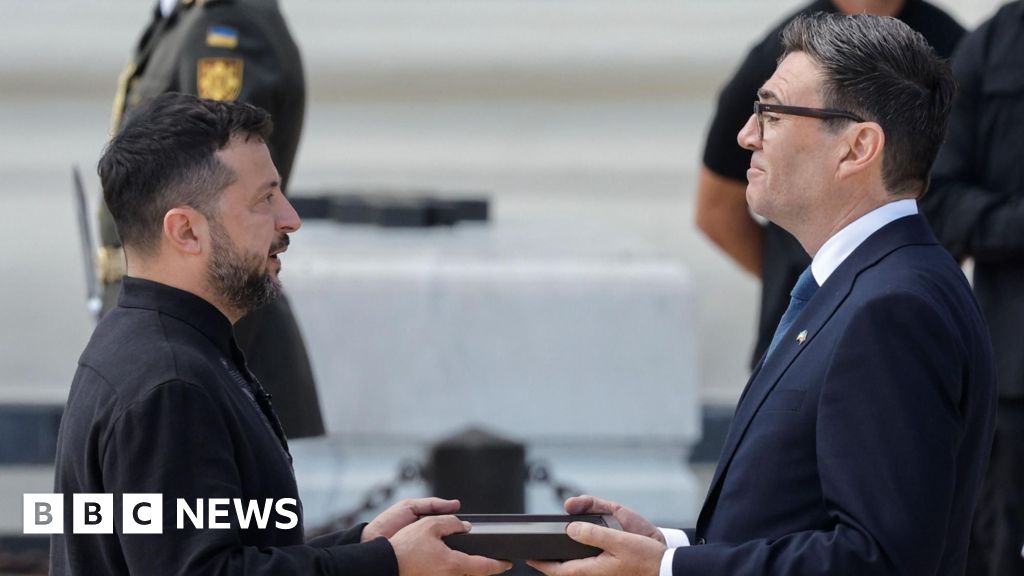
Burnham, laying flowers at Ukraine's National Military Memorial Cemetery and accepting an award from Zelensky on behalf of the British people, framed the conflict in historical terms. "My nation kept the flame of European freedom alive in the 20th century," he said. "You hold that flame in the 21st."
People mentioned
-
Burnham
-
Andrei Kelin
Organisations
MBDA · Coalition of the Willing · European Union · Avengers AI Labs