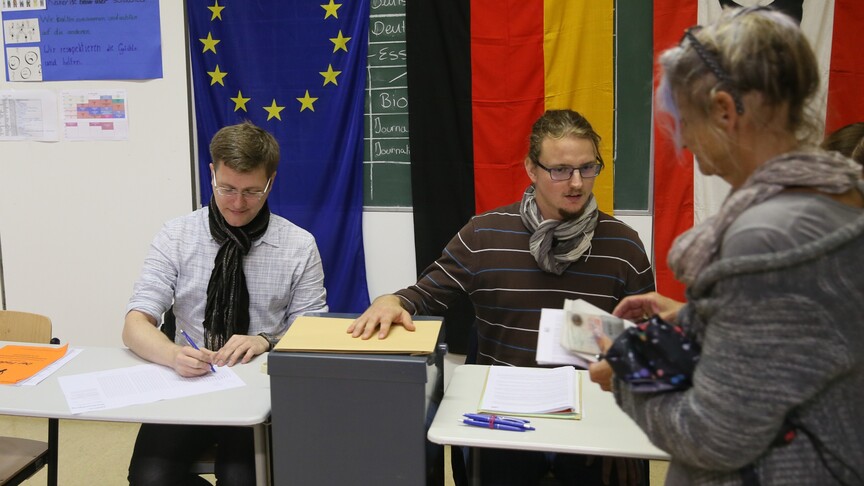
A state with fewer than 2.2 million residents, home to less than 3% of Germany's electorate, is about to deliver a result that could reshape national politics. On Sunday, voters in Saxony-Anhalt will decide whether the Alternative for Germany (AfD) takes control of a state government for the first time since the Federal Republic was founded in 1949.
A surge that doubled in five years
The AfD won 20.8% in Saxony-Anhalt's 2021 state election. Five years later, multiple polling institutes put the party at 40% to 43%. That trajectory reflects both national discontent with immigration policy and local frustration with economic stagnation in a region that has long lagged western Germany. The party's rise has been steep enough that its lead candidate, 35-year-old Ulrich Siegmund, has already published a full government programme and a 100-day action plan.
Siegmund's pitch centres on immigration. He promises to begin expelling people without legal status immediately, to expand detention capacity for deportations from dozens of places to hundreds, and to require asylum seekers to work or lose their benefits. Germany's federal statistics office records show Saxony-Anhalt consistently among the states with the lowest net migration and the weakest economic output per capita, a discrepancy Siegmund exploits by arguing that scarce resources are being diverted from local needs.
Der Spiegel put Siegmund on its cover as "Germany's most dangerous man." He embraced the label, signing copies for cameras. Critics argue his presentable manner conceals harder-line networks around him, and the Federal Office for the Protection of the Constitution has classified the AfD's Saxony-Anhalt branch as a confirmed right-wing extremist organisation, citing anti-democratic objectives and links to far-right groups.
The incumbent fighting on two fronts
Siegmund's closest rival is Sven Schulze, the 47-year-old CDU premier who took office only in January after Reiner Haseloff stepped down following nearly 15 years in power. Schulze has had months rather than years to build name recognition, and the CDU's vote share has collapsed from 37.1% in 2021 to roughly 22% to 23% now.
Schulze's central argument against the AfD is economic. Saxony-Anhalt depends heavily on the European single market, and the AfD wants to take Germany out of both the euro and the Schengen visa-free zone. "The AfD has no contacts whatsoever to make things better in Europe. It only wants out of the EU. That would be an economic catastrophe," Schulze said in a recent interview. He has positioned himself as the only candidate capable of keeping the AfD from power.
The arithmetic that decides everything
Winning the largest share of the vote does not guarantee governing power. Seats in the 83-seat Landtag are distributed only among parties that clear the 5% threshold, and how many parties survive that cut determines whether the AfD can translate its poll lead into a governing majority.
If the Greens fall below 5%, and if the Free Democrats and the Sahra Wagenknecht Alliance also fail to clear the bar, the share of votes that counts for seat allocation shrinks, and the AfD's percentage translates into a larger share of seats. Estimates suggest Siegmund needs 45% to 48% of the vote to secure the 42 seats required for an outright majority. He is running to govern alone, not seeking a coalition partner.
If the AfD falls short of a majority, the options narrow quickly. All mainstream parties, including the CDU, have ruled out any coalition or cooperation with the AfD, citing the intelligence service's extremism designation. Schulze has said he will not make himself dependent on the Left Party. Wagenknecht, founder of the BSW, has insisted her alliance will not serve as a majority-maker keeping the CDU in office and has called for a non-partisan premier. The most discussed fallback is a CDU-led minority government with the SPD and possibly the Greens, surviving vote by vote.
Pressure reaching Berlin
The consequences will not stay in Magdeburg. Chancellor Friedrich Merz heads a coalition between his Christian Democrats and the Social Democrats that has been strained by economic weakness and internal disagreements. An ARD poll puts satisfaction with Merz at 13%, with 83% of eligible voters saying they are dissatisfied, the worst figure the survey has recorded for a sitting chancellor.
A heavy CDU defeat in Saxony-Anhalt would reopen debate within the conservative party over whether Merz should remain chancellor. A leadership challenge would not automatically bring down the government: parliament can elect a new chancellor without dissolving the Bundestag. But the mere prospect of that fight would consume political oxygen and weaken Berlin's ability to act on economic reform or European policy at a moment when both demand attention.
The firewall under test
The AfD's national co-leader, Alice Weidel, has framed Sunday's vote in expansive terms. "We will form the government in Saxony-Anhalt," she said. "We will also govern at the federal level." That ambition depends on whether the party can breach what German commentators call the firewall, the collective refusal of all other parties to share power with it. The firewall has held at every level of government since the AfD's founding in 2013. Sunday is the first time it faces a realistic chance of being rendered irrelevant by a single-party majority.
People mentioned
Organisations
Alternative for Germany (AfD) · Christian Democratic Union (CDU) · Social Democratic Party (SPD) · Federal Office for the Protection of the Constitution