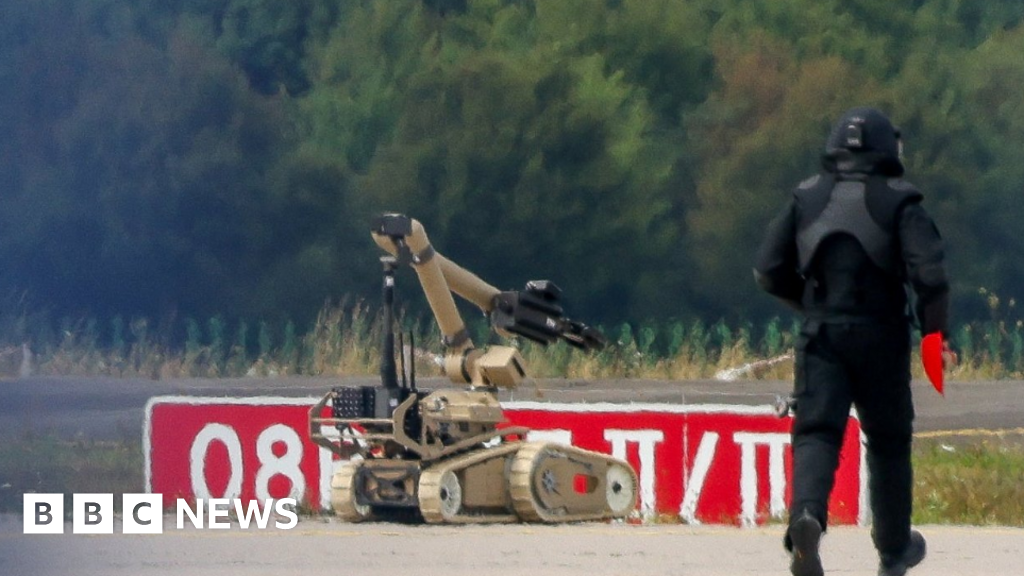
A drone carrying an explosive device was discovered at Leipzig/Halle Airport on 4 August 2026, sitting close to Ukrainian cargo aircraft operated by Antonov Airlines. The device failed to detonate because its detonator was apparently faulty, according to German security officials. Police defused the explosives and believe a second drone may have collided with a cargo aircraft nearby. In the weeks since, investigators have located a third drone in the vicinity and detected traces of hexogen, a military-grade explosive, in the surrounding area.
A logistics artery for NATO and Ukraine
Leipzig/Halle Airport is not a conventional commercial hub. It functions as a primary logistics node for the German military and NATO allies, handling the transport of military equipment and supplies. Since Russia's full-scale invasion of Ukraine in February 2022, the airport has also become the main European base for Antonov Airlines, Ukraine's state-owned cargo carrier, which operates the world's largest fleet of heavy-lift aircraft. The airline moves the bulk of Ukraine's aerial cargo, including humanitarian aid and military materiel shipped by Western partners. The airport is simultaneously a major hub for DHL, the German logistics giant, integrating civilian and military supply chains on a single airfield.
The convergence of NATO logistics, Ukrainian heavy-lift operations and global freight traffic makes Leipzig/Halle a target of strategic significance. Disruption here would reverberate across European defence supply lines and Ukraine's ability to sustain its airbridge. German authorities have not publicly identified the perpetrators, but security experts cited in domestic reporting have pointed toward Russian involvement. Moscow has denied any role.
Merz signals a shift toward active defence
Speaking on 25 August at a government coalition retreat in Neuhardenberg, Chancellor Friedrich Merz described the incident as evidence that Germany faces a "very real threat" and is "increasingly becoming a target." He vowed that attackers would "pay a price" and outlined a package of measures designed to move German security posture from passive protection toward active disruption of hostile operations.
"We have problems, some of which stem from outside the country, and which we must not ignore," Merz said. "Attackers are increasingly ruthless, accepting even severe property damage, and even injuries and fatalities." The Chancellor said the government was working closely with security authorities and would release further details on the investigation shortly.
The proposed measures include stronger drone defences at critical infrastructure sites and, more significantly, new legal authorities allowing German security services to strike back against attackers both at home and abroad. Merz cited the example of hacking the computer servers of hostile actors as one such offensive capability. This marks a notable departure for a country whose post-war legal framework has traditionally constrained intelligence and security agencies to defensive operations within national borders.
A pattern of overflights across sensitive sites
The Leipzig incident did not occur in isolation. German police have recorded a series of unauthorised drone flights in recent months over military bases, airports, energy terminals, seaports and logistics companies across the country. Authorities have warned that these overflights could have been organised by Russian agents, potentially conducting reconnaissance or testing defences ahead of more destructive action. The pattern suggests a sustained campaign rather than a one-off event.
The discovery of hexogen traces near Leipzig/Halle adds a forensic dimension to the intelligence picture. Hexogen, also known as RDX or cyclotrimethylenetrinitramine, is a high explosive used in military applications including plastic explosives such as C-4. Its presence indicates a device built to military specifications rather than an improvised construction, reinforcing the assessment that a state actor or sophisticated proxy was responsible.
Ukraine support framed as a path to peace talks
Merz used the occasion to reiterate Germany's commitment to Ukraine, framing continued military support not as an open-ended escalation but as leverage to force negotiations. "The government is continuing its support for Ukraine with steadfast resolve," he said. "Today, we are its strongest supporter, not to prolong the war, but to force peace talks." Germany has become the second-largest national provider of military aid to Ukraine after the United States, supplying air defence systems, artillery, armoured vehicles and training.
The Antonov Airlines connection is central to this supply effort. The airline's An-124 and An-225 aircraft (the latter destroyed in the early days of the war) have been irreplaceable for moving outsized cargo, turbine components, radar systems, bridge sections, that no other aircraft can carry. Leipzig/Halle's role as the airline's European base means that any sustained disruption to the airport would directly degrade Ukraine's logistical capacity.
Attribution remains officially unspoken
Despite the technical indicators and the pattern of overflights, the German government has stopped short of a formal attribution to Russia. This restraint reflects both the evidentiary standards required for state-on-state accusations and the diplomatic calculus of managing relations with a nuclear-armed neighbour that remains Germany's largest historical energy supplier. The Kremlin's denial follows a familiar template: categorical rejection accompanied by accusations of anti-Russian hysteria in Western capitals.
German intelligence agencies, including the Bundesamt für Verfassungsschutz (domestic intelligence) and the Bundesnachrichtendienst (foreign intelligence), are understood to be leading the technical investigation. Their findings will determine whether Berlin moves from implicit suspicion to explicit accusation, a step that would likely trigger coordinated responses from NATO allies and potentially new EU sanctions packages.
Legal and operational hurdles for offensive cyber powers
Merz's proposal to empower security services to "strike back" against attackers abroad, including through hacking, faces significant legal obstacles. Germany's Basic Law and the G10 Act governing intelligence activities tightly circumscribe extraterritorial operations. Any expansion would require legislative amendments, likely needing a two-thirds majority in the Bundestag for constitutional changes, and would be subject to scrutiny by the Federal Constitutional Court in Karlsruhe.
Operationally, attribution in cyberspace remains notoriously difficult. False-flag operations, proxy infrastructure and the use of compromised third-party servers complicate the chain of evidence required for both legal authorisation and political justification. European partners, including France and the Netherlands, have developed their own offensive cyber doctrines in recent years, but Germany has lagged, constrained by a political culture wary of intelligence overreach given its historical experience.
People mentioned
Organisations
German Federal Government · NATO · Antonov Airlines · DHL