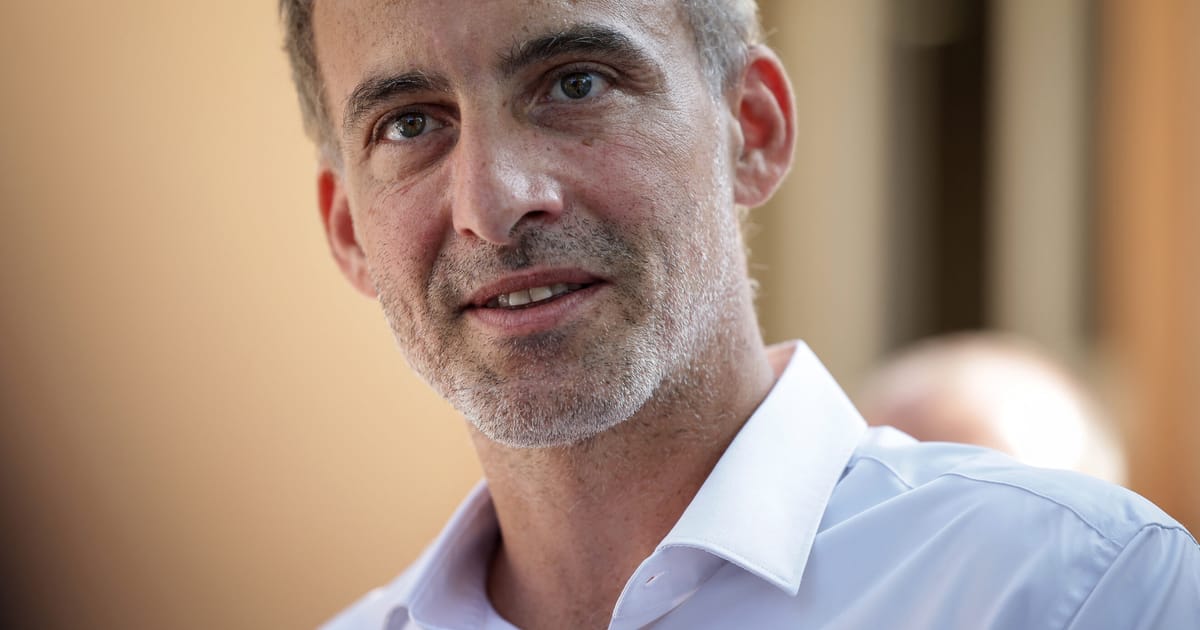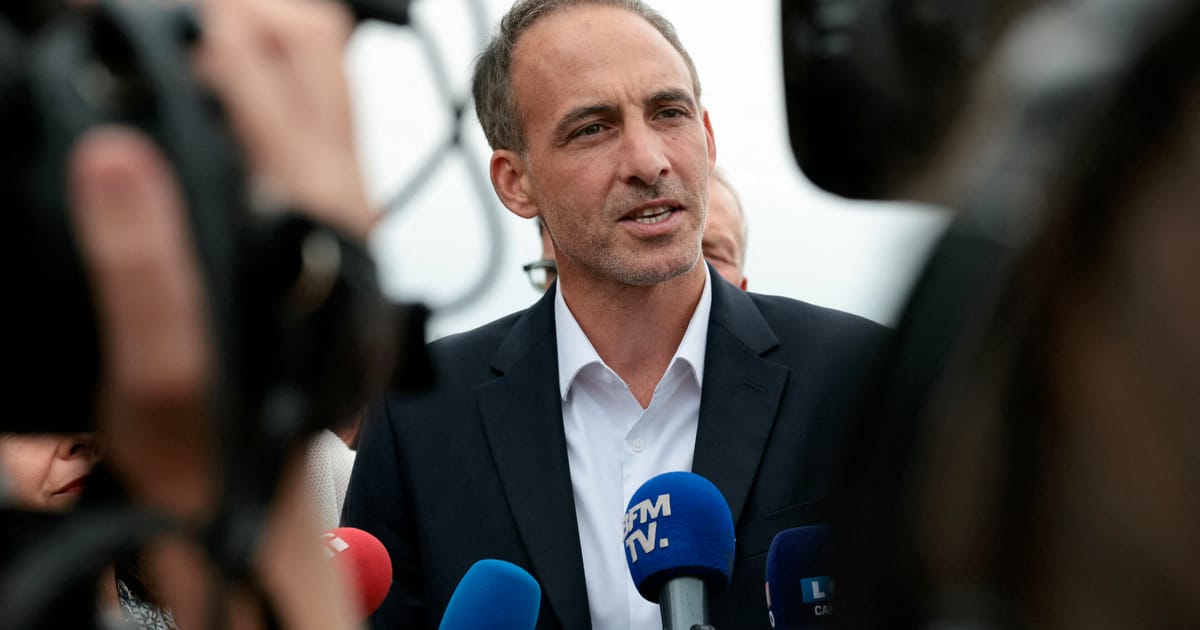
Raphaël Glucksmann's path to the Elysée just got considerably more complicated. The 46-year-old member of the European Parliament, who has built his political profile as a sharp critic of authoritarianism and a voice for a reinvigorated European left, agreed earlier this year to enter the Socialist Party's primary despite never holding a party membership card. The calculation was straightforward: accept the contest, win the endorsement, and secure the party's organisational machinery and campaign financing for a presidential bid in spring 2027. What looked like a formality is now a genuine fight.
Faure's late entry reshapes the race
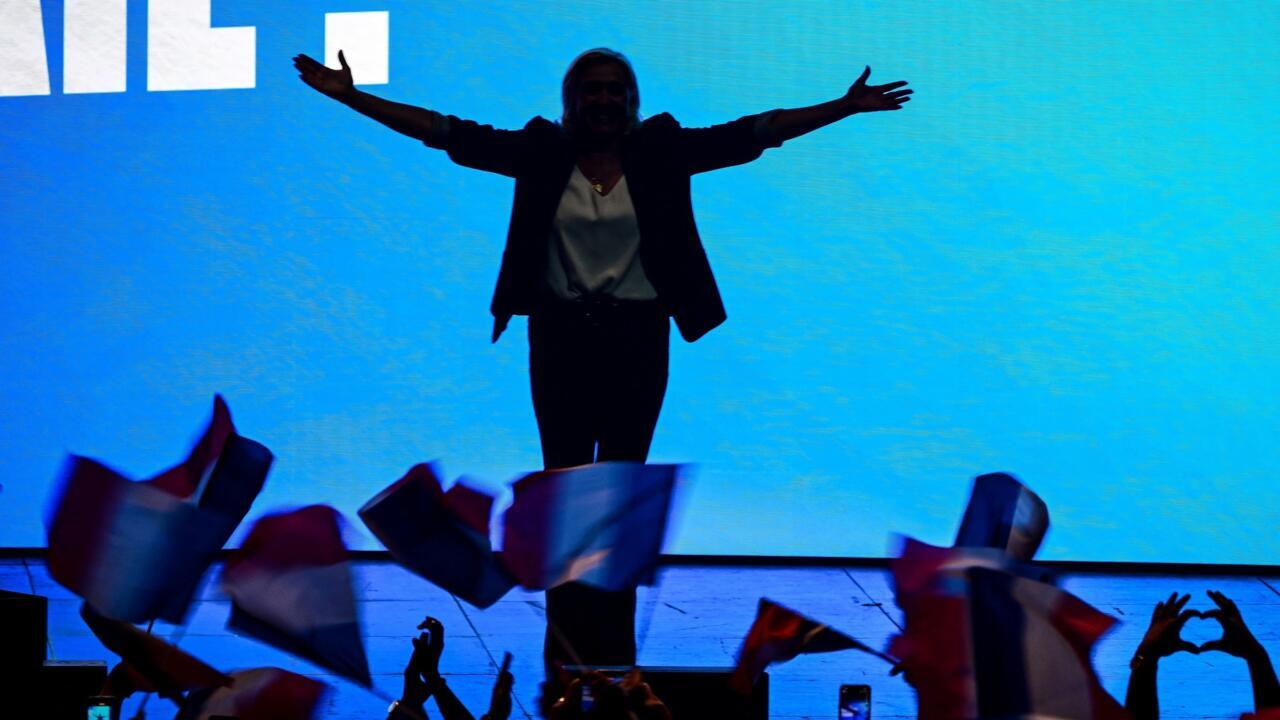
Olivier Faure, who has led the Socialist Party for more than eight years, announced on Sunday that he would stand in the primary himself. The decision upends what had been widely expected to be a comfortable Glucksmann victory. Before Faure entered, the field consisted of three MPs with relatively modest national profiles, Ségolène Royal, the party's 2007 presidential candidate whose political relevance has faded considerably since her defeat to Nicolas Sarkozy, and the possibility of Mathieu Pigasse, the businessman and media mogul who was once tapped by the United States to restructure Venezuela's debt. None of these figures looked likely to mount a serious challenge to Glucksmann, whose polling numbers have consistently shown him as the centre-left's strongest contender against Marine Le Pen, the far-right front-runner.
Faure changes that calculation entirely. He is not a household name across France, but inside the party apparatus he commands real influence. Eight years at the helm of an organisation that has weathered catastrophic electoral decline, the near-death experience of the 2017 and 2022 presidential contests, and the messy alliances and ruptures with Jean-Luc Mélenchon's La France Insoumise have given Faure a durable network of loyalists. One Socialist MP described Faure as seemingly immortal, comparing him to a Highlander. Another acknowledged that the contest would now be close.
Why Glucksmann needs the Socialists
Glucksmann's decision to submit himself to a primary run by a party he never joined reflects a cold electoral reality. France's presidential system rewards candidates who can assemble a broad coalition, and the Socialist Party, despite its electoral battering over the past decade, still controls local party structures, holds residual name recognition among older voters, and can provide the financing and ballot-access infrastructure that an independent candidacy would lack. France's National Institute of Statistics and Economic Studies has documented the country's shifting electoral geography, but the mechanics of running a credible presidential campaign remain deeply tied to established party structures.
The trade-off is that Glucksmann must now persuade Socialist Party members and primary voters, people who have stayed loyal through years of electoral humiliation, that an outsider who has never held a Socialist membership card deserves their nomination. That is a harder sell when the party's own secretary-general is standing against him.
Glucksmann's political identity has always sat at an awkward angle to the Socialist Party. He rose to prominence through the Place Publique movement, a centre-left platform that positioned itself as more pro-European and more willing to confront the far right on cultural questions than the traditional left. His voting record in the European Parliament has reflected that orientation, focusing on foreign interference, democratic backsliding in Hungary and elsewhere, and supply-chain ethics. He is, in the language of French political commentary, a social liberal rather than a socialist, and that distinction matters to party members who feel their ideological identity has been diluted enough already.
The elitist charge gains traction
Glucksmann's opponents have wasted no time exploiting the vulnerabilities in his biography. In an interview on Monday, Ségolène Royal dismissed him as "the media's darling child," a formulation that stings in a country where anti-media sentiment runs deep among left-wing voters. Philippe Brun, an MP who is himself running in the primary, went further, calling Glucksmann the French equivalent of a coastal elite, a direct import of American political vocabulary that nonetheless lands in a country sensitive to questions of class and cultural capital.
The attacks are not baseless. Glucksmann is the son of the philosopher André Glucksmann, a prominent public intellectual. His partner is a well-known French television anchor. His political career was forged in European institutions rather than local party branches. He speaks the language of Brussels with a fluency that plays well in Strasbourg but can sound alien in the post-industrial towns where the left has lost the most ground to Le Pen's National Rally. For Socialist Party members who have spent years watching their working-class base erode, the prospect of a candidate who appears to embody the Parisian establishment carries a particular kind of risk.
Faure, by contrast, presents himself as a party man. His pitch, implicit though it is at this stage, is that the Socialists should be led by someone who has actually rebuilt the organisation, not someone who arrived when the rebuilding was mostly done. Whether that argument carries enough weight with primary voters, who may care more about electability than party loyalty, is an open question.
Hollande's patient calculation
Looming over the entire primary is the figure of François Hollande, president from 2012 to 2017, whose tenure ended with approval ratings so low that he chose not to seek re-election. Hollande has a book coming out in September, the traditional vehicle for French politicians signalling ambition without committing to anything. He has said he will wait until December to announce whether he intends to run again.
Hollande's calculation, according to people familiar with his thinking, is that whoever emerges from the Socialist primary will be weakened by the experience and may well collapse as a candidate by the end of the year. At that point, the party would need a rescuer, and Hollande would position himself as the only figure with the national stature and governing experience to step in. It is a strategy that depends on the primary producing a damaged winner rather than a galvanised one.
Speaking over the weekend, Hollande acknowledged the dynamics at play. "I know primaries can have a galvanising effect," he said. "That's probably what the participants are hoping for. But they can also fuel divisions." It was a characteristically measured observation from a politician whose entire career has been built on waiting for others to make mistakes.
What a contested primary costs the left
The immediate consequence of Faure's entry is that Glucksmann must now spend the coming months fighting for the Socialist nomination rather than building a national campaign against Le Pen. Every week devoted to internal party debates about ideological purity and candidate authenticity is a week not spent reaching the voters who have drifted towards the far right. The French left has a long and painful history of this kind of self-destructive internal warfare. The 2017 presidential election saw the Socialist candidate, Benoît Hamon, win a bruising primary only to receive 6.4 per cent of the vote in the first round, a result that effectively destroyed the party as a credible presidential force.
There is a more optimistic reading. A contested primary could generate media attention and voter engagement that a coronation would not. Glucksmann, if he wins, would have a mandate from the party's members rather than a merely procedural endorsement, which could strengthen his legitimacy in the broader campaign. The risk is that a loss, even a narrow one, would destroy his candidacy entirely, leaving the left with a candidate who polls consistently worse against Le Pen.
The Pigasse variable
Mathieu Pigasse's potential candidacy adds another layer of uncertainty. Pigasse is not a conventional politician. He made his name in finance, leading the restructuring of Venezuela's sovereign debt at the request of the United States, and controls significant media holdings in France. A primary run by Pigasse would introduce a figure with personal wealth, media access, and a reputation for disruption into a contest that was already more volatile than expected. Whether he actually declares remains unclear, but the fact that his name is being taken seriously within Socialist circles speaks to how open the race has become.
Pigasse's presence would also sharpen the ideological tensions within the primary. His background in investment banking and sovereign debt restructuring sits uneasily alongside a party that has moved leftward on economic questions in recent years. Glucksmann, for all the criticism he receives from the party's left flank, at least built his career outside the financial sector. A Pigasse candidacy would force the party to decide whether electability, measured in media visibility and personal resources, matters more than ideological consistency.
People mentioned
-
Philippe Brun
-
Mathieu Pigasse
Organisations
Socialist Party · European Parliament