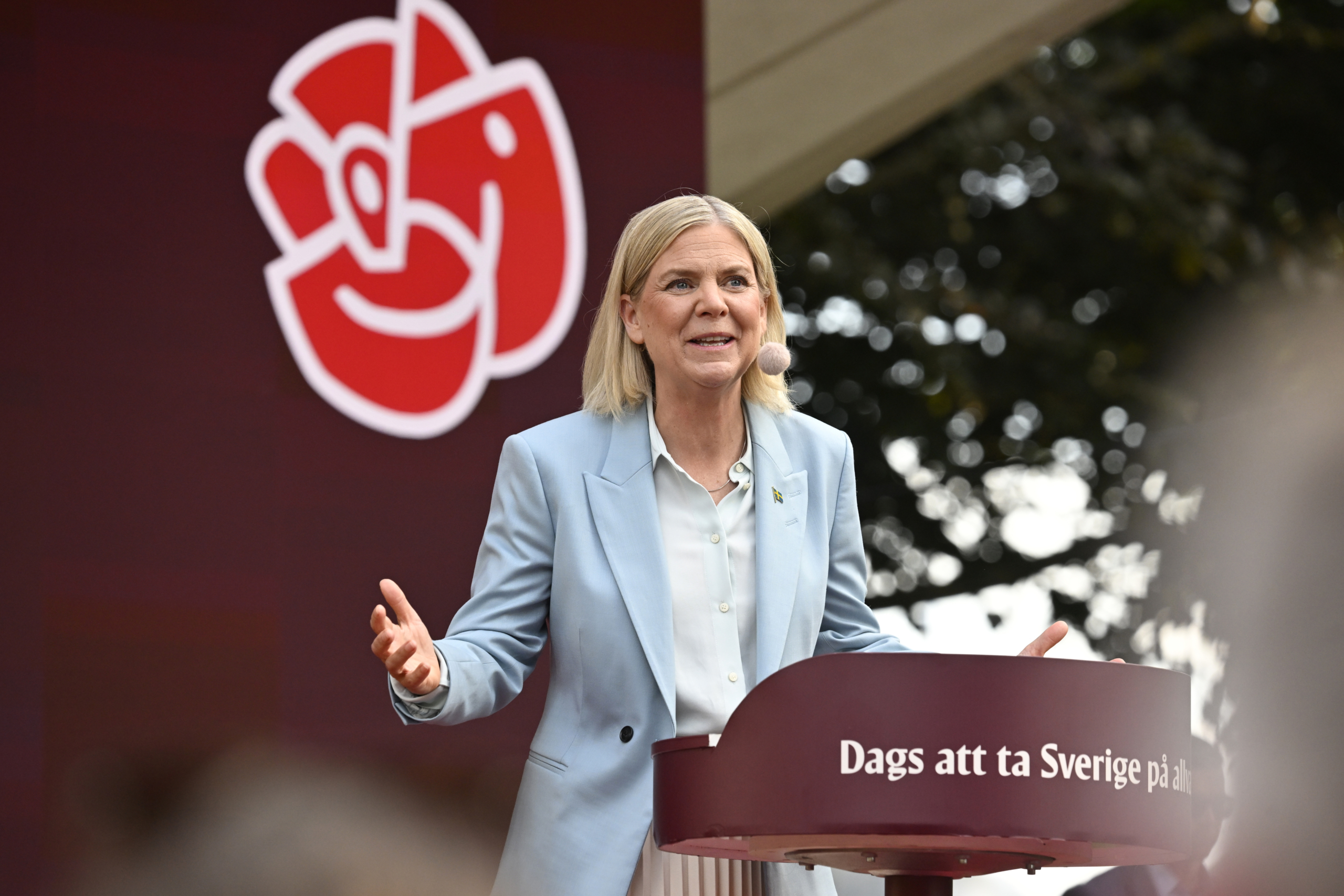
Sweden votes on 13 September, and the arithmetic favours a change of government. Four years of centre-right rule propped up by the far-right Sweden Democrats have left the governing bloc trailing in the polls. The Liberal Party, a junior coalition member, is polling below the 4% threshold needed to enter the Riksdag at all. Magdalena Andersson, who led the Social Democrats during Sweden's historic NATO accession, is the clear favourite to return as prime minister. What Europe should watch is not whether Sweden pivots, but how far that pivot extends, and where it stops.
The Tidö agreement's mounting cost
Ulf Kristersson took office in 2022 through a deal struck at Tidö castle, giving the Sweden Democrats formal influence over government policy in exchange for supporting a minority administration. It was the first time the far-right party, founded in 1988 with roots in white nationalism, had structured policy input. The bargain delivered tighter migration and criminal justice rules, which satisfied the Sweden Democrats' base. It also cost the coalition partners their own voters. The Liberals, in particular, have haemorrhaged support to the point of electoral irrelevance. Kristersson's own Moderates have not escaped the damage either.
The Tidö framework also shaped foreign policy in ways that drew less attention. Sweden Democrats' influence extended to a harder line on immigration from outside Europe, a more sceptical posture towards certain international institutions, and a reluctance to increase development assistance. Those positions would sharpen considerably if the party advances from external support to full cabinet membership, as Kristersson has promised should the right win again.
Coalition arithmetic that could take months
Andersson's path to the prime minister's office is clear. Her path to a stable majority is not. The most probable configuration is a red-green coalition bringing together the Social Democrats, the Green Party and the Left Party. That sounds straightforward. It is not.
The Left Party, which traces its origins to the former Swedish communist movement, remains formally committed to withdrawing from NATO. The Greens are divided about whether to enter government at all, with senior figures reporting sharp internal disagreements. Both parties want looser migration rules than the Social Democrats accepted when they last governed, and the Social Democrats themselves tightened asylum policy during that period. Meanwhile, the Centre Party, market-liberal and pro-business, would demand deregulation that angers trade unions and clashes with green industrial policy. Assembling a working majority from these ingredients will require concessions on multiple fronts, and the negotiations could stretch well beyond election day.
One option discussed in Stockholm is a grand coalition between the Social Democrats and the Moderates, but that would require a serious external crisis and a significant internal shift within the Moderate Party. Short of that, Andersson's most plausible route mirrors what Mette Frederiksen has done in Denmark: govern from the centre-left while buying off the Left Party's opposition on sensitive security questions with social policy concessions, keeping them outside the cabinet.
What stays the same: NATO, Ukraine, trade
On the fundamentals of security policy, the election will change remarkably little. Sweden's all-party Defence Commission reported this summer with a unanimous assessment of the threat from Russia. Support for Ukraine runs deep across the Riksdag. NATO membership, which the Social Democrats themselves delivered, will not be reopened. The Left Party's formal opposition to the alliance is understood by everyone involved, including the Left Party itself, as a position that cannot be acted upon. Public support for NATO is strong, and the security environment makes withdrawal unthinkable.
The same applies to the euro. Sweden rejected the common currency in a 2003 referendum, and no party is prepared to revisit that decision in the next parliamentary term unless a deep economic crisis forces the question. The Centre Party may push for a review, but that is a long way from a new vote. Trade policy will remain firmly liberal: Sweden's export-dependent economy leaves every party committed to open markets, and Andersson's government would be one of the more frugal voices in the next round of Multiannual Financial Framework negotiations.
Defence spending will keep rising. Both blocs agree on rapid increases to military budgets, and the Social Democrats have additionally pushed for greater investment in civil defence. Peter Hultqvist, who served as defence minister during the NATO accession period, is expected to return to that post. The consensus on Russia is genuine and deep.
Where policy would shift
The real differences emerge on questions where the Tidö agreement pulled Sweden rightwards. A centre-left government would redirect development spending towards the global south and gradually rebuild aid budgets that the current coalition cut. The Social Democrats have deep ties with South Africa and Brazil, cultivated during their years in opposition. If Lula da Silva wins re-election, Andersson would be well positioned to push for stronger EU-Brazil engagement. She has also built a rapport with Mark Carney in Canada, a relationship that could prove useful in coordinating climate and trade policy across the OECD.
Climate policy would become more ambitious, at home and at EU level. For the Social Democrats, green industrial policy is not an environmental project alone: it is the mechanism for keeping industrial workers on side during a transition that threatens their livelihoods. Trade unions and many manufacturing leaders share this analysis, which gives it more political weight than a purely environmental pitch would carry. The Green Party would likely reclaim the development and environment portfolios, though they would face competition from the Centre Party for climate and energy briefs if the coalition widens.
Middle East policy would move noticeably. The Social Democratic government in 2014 became the first in Western Europe to recognise Palestine, over the protests of the centre-right opposition. Andersson's government would criticise Israeli military actions more directly than Kristersson's has done, while also condemning terrorism. The complication is Ebba Busch: her Christian Democrats are strongly pro-Israel, and if they enter the coalition, the resulting position would be harder to hold together.
Andersson would also revive the feminist foreign policy framework launched by Margot Wallström and continued by Ann Linde during the Social Democrats' last period in government. That approach, which placed gender equality and women's rights at the centre of diplomatic priorities, was scrapped by the current administration.
The constraints on a social democratic Europe
Andersson would arrive in Brussels at a moment when the European People's Party dominates the institutions. The Nordic and Baltic states form her natural bloc, but beyond that, the Party of European Socialists has few large member states. Pedro Sánchez in Spain is the obvious potential ally, but his hold on power is uncertain. Leading Swedish Social Democrats are keen to avoid being compared with either Sánchez or Frederiksen in Denmark, insisting that Andersson will chart her own course.
The constraints extend to security policy in practice, even where the rhetoric might shift. The Social Democrats accept nuclear weapons as part of NATO's deterrent strategy, but they press harder than the Moderates on global non-proliferation. A red-green coalition could face internal friction over the planned rotation of French nuclear-capable aircraft through Swedish bases, or over intelligence cooperation with Turkey, both of which the Left Party would resist. The likely solution is side payments: policy concessions on domestic social questions in exchange for silence on security matters.
On the United States, there is a gap between private sentiment and public posture. Senior Social Democrats are sharply critical of Donald Trump in private, and Andersson expressed solidarity with Denmark when he threatened Greenland. But the party will not pick a public fight. Sweden's reliance on American aircraft, interceptors and satellite intelligence in the Baltic Sea region leaves far less room for diplomatic distance than southern European governments enjoy. Even in background conversations, Social Democratic figures decline to discuss alternatives to American command of major NATO operations.
The alternative: Sweden Democrats in cabinet
The election is not settled. European electorates have become volatile, and a late swing could return Kristersson to office. If it does, the Sweden Democrats would not remain outside the cabinet this time. The Moderates have promised them ministerial posts, and given the party's size, those would include influential portfolios: EU negotiations on migration and home affairs, possibly finance and competitiveness, mirroring the role the Finns Party holds in Helsinki.
The security implications would be real. In Sweden, ministers make government decisions collectively and receive sensitive intelligence briefings at cabinet meetings. The Sweden Democrats have been vocal in criticising Vladimir Putin since their own past links to Moscow were exposed, but the opposition continues to regard them as a security risk. A party that spent years cultivating ties with the Kremlin would suddenly sit inside the room where intelligence assessments are discussed and foreign policy positions are set.
A tilt, not a turn
The broad picture is one of continuity on security and trade, with meaningful adjustments on climate ambition, development spending, Middle East diplomacy and the global south. Andersson's Sweden would champion a stronger United Nations, rebuild aid budgets and push harder on green industrial policy within the EU. It would not reopen NATO membership, challenge American leadership of the alliance's military structures, or abandon support for Kyiv.
The sharper question is what happens if the polls are wrong and Kristersson survives. A second Kristersson term with Sweden Democrats inside the cabinet would give a far-right party real executive authority over foreign policy, intelligence briefings and EU negotiations for the first time. That prospect matters beyond Stockholm. In a European landscape where far-right parties could lead governments in France, Italy and Poland, the Swedish precedent of moving them from external support into ministerial office would resonate.
People mentioned
-
Magdalena Andersson
-
Peter Hultqvist
-
Ebba Busch
Organisations
Swedish Social Democratic Party · Sweden Democrats · Moderate Party · Left Party · Green Party · Centre Party