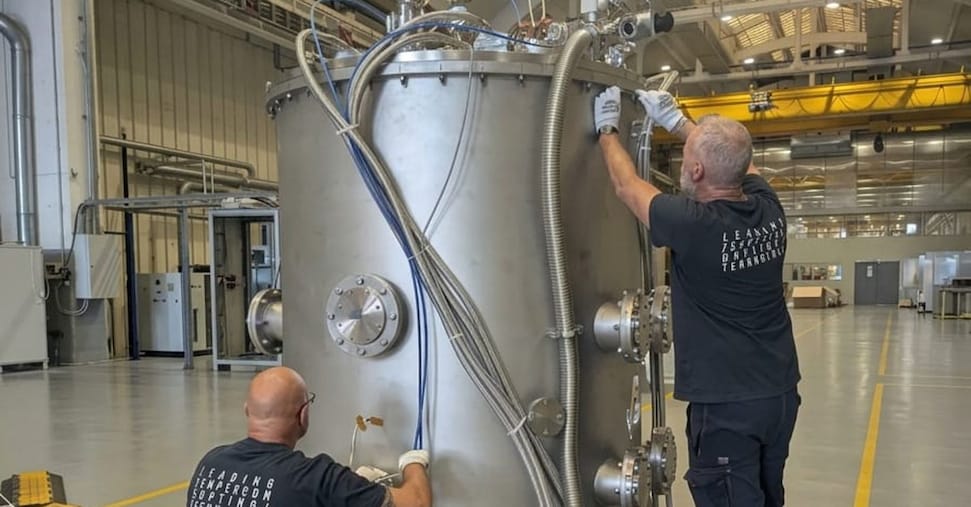
An Italian-made high-temperature superconducting magnet, generating over 5 tesla and 1 megajoule of stored energy, was presented this week at the Applied Superconductivity Conference in Pittsburgh. Its developers call it the most powerful device of its kind in Europe built entirely from high-temperature superconducting materials, and its arrival signals an effort by European researchers to claw back ground lost to Asian and American competitors.
The magnet was constructed at ASG Superconductors' factory in Genoa through a collaboration between the company and the National Institute of Nuclear Physics (INFN), funded under a contract from Italy's Piano Nazionale di Ripresa e Resilienza, the country's EU-backed recovery plan.
Why temperature matters
Conventional superconducting magnets, the kind that power MRI scanners and particle accelerators, operate at between 2 and 4 Kelvin, just above absolute zero. Reaching and maintaining those temperatures demands elaborate cryogenic systems that consume large amounts of energy and confine the technology mostly to well-funded laboratories.
High-temperature superconductors, by contrast, function at between 20 and 30 Kelvin. The term is relative: minus 250 degrees Celsius is not warm by any ordinary standard. But that temperature range is far easier to achieve and maintain than the near-absolute-zero conditions older magnets require. Cooling systems become simpler. Energy consumption drops, and operating costs fall by what the project describes as several orders of magnitude.
For nuclear fusion reactors, which need enormous magnetic fields to confine plasma at stellar temperatures, that efficiency gain could determine whether a power plant produces more energy than it consumes. For existing medical and research applications, the same physics translates directly into lower running costs.
Europe's competitive gap
The catch is that high-temperature superconducting materials are far harder to work with than the niobium-tin and niobium-titanium alloys used in conventional magnets. REBCO, the compound at the heart of the Italian device, combines copper, barium and rare-earth oxides. Processing it demands precision and care well beyond what established manufacturing techniques can deliver.
Japan and China have channelled substantial state resources into mastering these processes. The United States has done the same, and a wave of private capital has followed: nuclear fusion start-ups, predominantly American, have raised more than $7 billion from private investors in the past three years alone. Europe, which once held a leading position in superconductor research, has been overtaken.
The Italian project is an explicit attempt to narrow that gap. Funded through the PNRR, the same mechanism that has directed billions of euros of EU recovery money toward national priorities, it ties research infrastructure to an industrial supply chain in Genoa.
The Genoa factory's track record
ASG Superconductors, owned by the Malacalza family and based in Liguria, is not a newcomer. Its Genoa plant has produced magnets for CERN's Large Hadron Collider in Geneva, for the ITER and JT60 nuclear fusion projects, for Fermilab in the United States, and for Germany's GSI heavy-ion research centre. The company's competence in conventional superconductors is well established. The challenge was extending that expertise into materials where manufacturing tolerances are tighter and failure modes less forgiving.
What the numbers convey
Five tesla is a strong magnetic field. A typical hospital MRI scanner operates at 1.5 to 3 tesla. The Large Hadron Collider's dipole magnets run at 8.3 tesla, but those are conventional superconductors cooled to 1.9 Kelvin. Achieving 5 tesla with a high-temperature superconductor, at a temperature an order of magnitude higher, demonstrates that the technology can reach the field strengths demanded by accelerators and fusion devices without the energy penalty of extreme cryogenics.
The 1 megajoule stored-energy figure measures how much magnetic energy the device can contain, relevant for fusion applications where magnets must sustain large fields over extended periods without degrading.
The Iris network
The magnet forms part of Iris, a network of laboratories and projects spread across Italy and supported by INFN and PNRR funding. Lucio Rossi, the project leader, presented the device at ASC 2026 alongside Marco Statera, also of INFN, framing it as evidence that Italian and European researchers can still compete at the highest level, provided investment continues.
Rossi described the magnet as "currently the most sophisticated and powerful in Europe amongst the full HTS magnets for accelerators," meaning one built entirely from high-temperature materials rather than a hybrid incorporating older technology. He added: "What now seems merely a matter of scientific innovation in the field of magnets may, in the future, have significant implications from an industrial perspective as well; this is precisely why we need to invest and press ahead, so as to enable European researchers and industry to prepare for competition on a global stage."
Commercial stakes ahead
The global market for superconducting magnets is already worth several billion dollars a year. Industry projections, cited at the Pittsburgh conference, put the figure at roughly 10 billion euros annually in the near future, driven by nuclear fusion and energy applications. Fusion start-ups that have attracted the bulk of recent private investment now face a demanding test: they must build working demonstrators to justify continued funding, and magnets are the core component those demonstrators require.
The suppliers who can deliver high-temperature superconducting magnets at scale and at controlled cost will hold significant commercial leverage. For ASG Superconductors and INFN, the Pittsburgh presentation was a signal to that market. The question now is whether a single demonstration magnet, however impressive, can be translated into the repeatable, cost-controlled manufacturing that fusion companies and research institutions will pay for.
People mentioned
-
Lucio Rossi
-
Antonio Zoccoli
-
Marco Statera
Organisations
National Institute of Nuclear Physics (INFN) · ASG Superconductors · European Organization for Nuclear Research (CERN) · ITER Organization