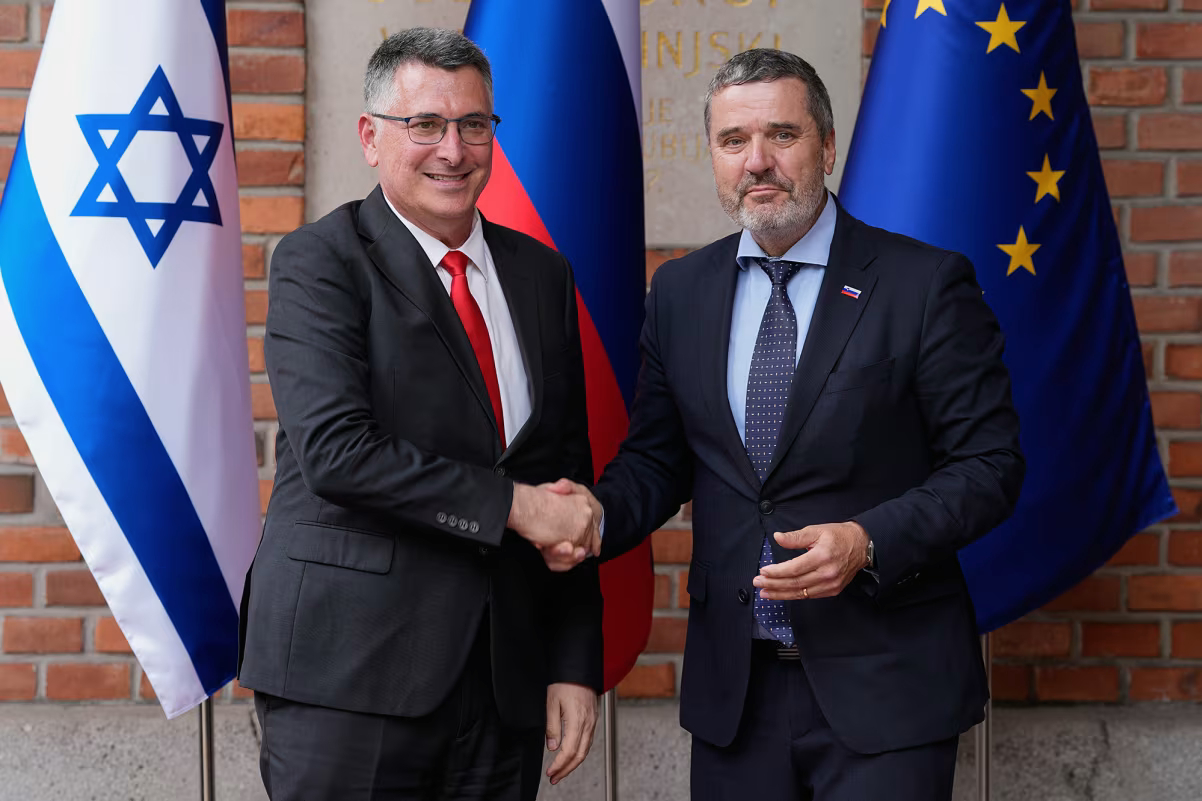
Gideon Saar smiled for the cameras as he cut a blue ribbon outside the new embassy of Nauru in Jerusalem, praising the Pacific island nation of 12,000 people as one of Israel's greatest friends. Two days later he repeated the ceremony in Ljubljana, welcoming Slovenia's centre-right government into what he called the circle of European supporters. There was no ribbon in London. Israel has been without an ambassador there for almost a year after the prime minister's chosen envoy, his chief of staff Tzachi Braverman, was prevented from leaving the country by a criminal investigation.
A ribbon-cutting in Jerusalem and a vacancy in London
The split screen captures a wider reorientation. As patience in Western European capitals frays over settlement expansion and rising violence in the occupied West Bank, the Israeli government is redirecting diplomatic energy toward smaller states and those it considers ideologically aligned. The contrast is deliberate. Nauru and Slovenia offer votes in international forums and, in Slovenia's case, a voice inside the European Council that can replace the blocking role once played by Viktor Orban's Hungary.
The British vacancy is not merely symbolic. When Ed Miliband stood in parliament on 9 September to announce coordinated sanctions and trade restrictions on settlements, joined by eleven other governments, he tied the measures explicitly to the E1 project. That plan, which would extend the Maale Adumim settlement toward Jerusalem, is widely seen as cutting the West Bank in two and ending the prospect of a contiguous Palestinian state. The sanctions follow a pattern established in September 2025, when Britain, Canada, France and more than a dozen other Western states recognised Palestinian statehood, and a June 2026 wave of targeted measures against individuals and networks accused of financing settler violence.
Western Europe's coordinated pressure campaign
The pressure has taken different forms across capitals. France barred Finance Minister Bezalel Smotrich from entry. Italy opened an investigation into National Security Minister Itamar Ben Gvir over the treatment of detained activists, including Italian nationals, after Israel intercepted an aid flotilla bound for Gaza. The Netherlands declared both ministers persona non grata and approved a national ban on imports of settlement goods. Not every proposal has succeeded. A French-Swedish push for an EU-wide settlement trade ban was stalled, as was an attempt to expel Israel from the Horizon research programme.
The stalling reflects a change in the EU's internal dynamics. For years Israel relied on Hungary to veto hostile initiatives. Since the leadership change in Budapest, Slovenia has effectively assumed that role, using its council position to water down or delay measures. Yet the shielding is incomplete. Rémi Daniel of the Institute for National Security Studies observes that Germany and Italy have so far refused to join the sanctions, limiting themselves to statements. "They are the most important EU member states because they have the power to block plans at the European level," he said, but added that "the swinging centre is going more against Israel."
Berlin and Rome hold the line at EU level
The German and Italian positions matter because both governments have historically treated the relationship with Israel as a strategic anchor, not a variable. Their reluctance to move beyond rhetoric reflects domestic coalition constraints, economic ties, and a calculation that EU unity on the Middle East is easier to preserve by avoiding votes that would expose deeper fractures. But the trend is unmistakable. Each national sanction regime, each recognition of Palestinian statehood, each investigation of a minister narrows the space for a collective European policy that Israel can live with.
Even as political relations cool, defence commerce provides a counterweight. In August Israel signed a $3.5 billion air-defence agreement with Greece, one of the largest arms deals in its history. Earlier in the year Israel Aerospace Industries finalised a $3.1 billion contract to expand Germany's Arrow missile interceptor supply. These programmes bind militaries and industrial bases across decades, creating constituencies that are less susceptible to diplomatic swings. They also illustrate the asymmetry: the same governments that condemn settlement policy continue to deepen security integration.
Arms deals keep some channels open
Israel's public response to the British measures was openly combative. Saar announced the closure of the British Consulate General in Jerusalem, the termination of UK training for Palestinian Authority security forces, and entry bans on a dozen British officials and lawmakers. His statement called the move "morally distorted" and a "blatant interference in the affairs of a sovereign state and its electoral process." Benjamin Netanyahu went further, labelling the United Kingdom the "Islamic Republic of Britain" on a podcast and accusing President Emmanuel Macron of fuelling antisemitism by recognising a Palestinian state.
Jerusalem strikes back at London
The rhetoric signals a government that no longer treats Western European criticism as a management problem but as an existential challenge to its legitimacy. That posture frees the foreign ministry to pursue alternatives without the constraint of preserving goodwill in Paris, Berlin or Rome. The pivot has a geographical logic. Saar declared 2026 the "Year of South America", touring Argentina, Ecuador, Paraguay and Colombia while restoring relations with Bolivia, Chile and Honduras. A communication channel with Venezuela opened for the first time since 2009, cemented by Israeli rescue teams deployed after an earthquake.
New embassies have appeared in Zambia, Estonia, Moldova, Fiji and Slovenia. The most striking step was the recognition of the self-declared Republic of Somaliland, making Israel the first state to do so. Somaliland reciprocated by opening an embassy in Jerusalem, joining fewer than ten countries with a diplomatic presence there. Argentina, Colombia, Costa Rica and the Democratic Republic of Congo have declared their intention to follow. The gains are real in diplomatic arithmetic: more votes in the General Assembly, more flags in Jerusalem, more partners who do not condition engagement on the two-state framework.
The southern hemisphere pivot
Daniel Shek, who served as Israel's ambassador to France, argues the calculus is flawed. "They are sacrificing the alliances with the most significant countries," he said. "If Saar thinks the Paraguayan economy can replace France as a partner for export and import, good for him." Shek stresses that the sanctioning governments are not ideologically hostile to Israel; they are frustrated with the policies of Netanyahu, Ben Gvir and Smotrich. The measures target settlements, not Israel proper, and their immediate economic bite is limited. But he warns that once imposed, sanctions create facts that cannot be reversed. "There are things that have been opened and cannot be put back in the bottle."
What the veterans warn
People mentioned
-
Rémi Daniel
-
Daniel Shek
Organisations
European Union · UK Foreign Commonwealth and Development Office · Institute for National Security Studies · Israeli Ministry of Foreign Affairs · European Council