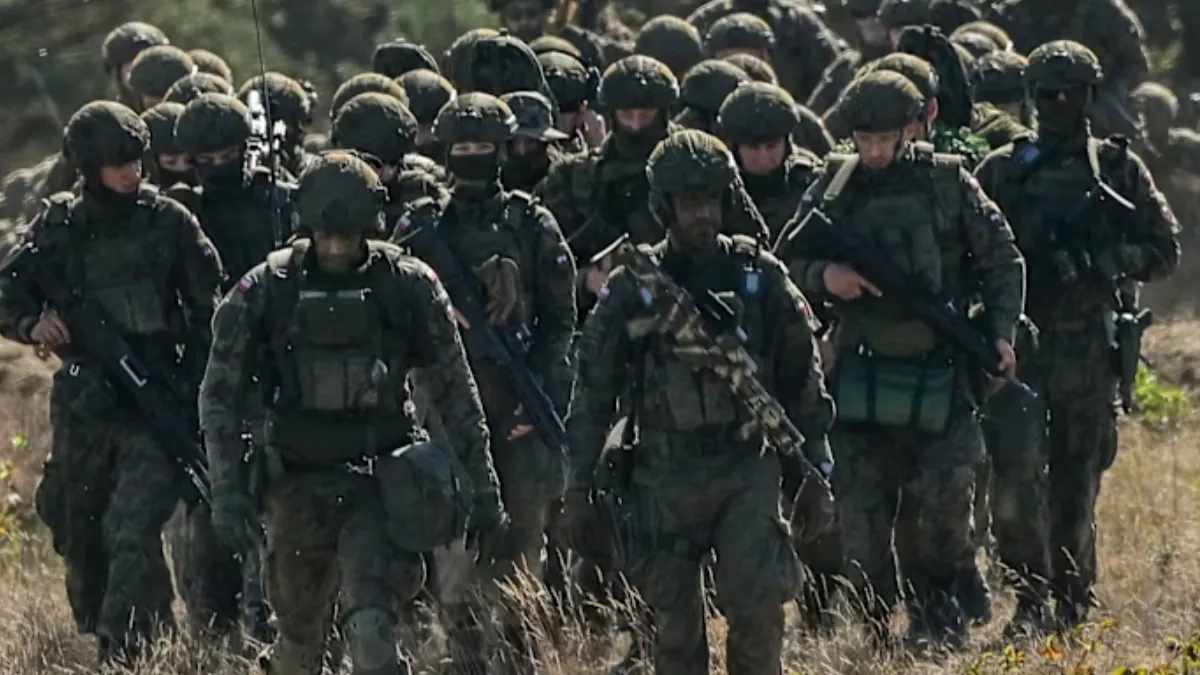
The Dutch Ministry of Defence has published an Energy Security Roadmap that frames uninterrupted access to liquid hydrocarbons as a condition of military credibility. The document, released this month, is a national strategy but its logic extends to every NATO member that relies on the alliance's single fuel policy. That policy standardises logistics around kerosene to guarantee that aircraft, ships and ground vehicles can be refuelled by any ally in any theatre. In the Dutch case, more than 95 percent of military platforms still burn fossil fuels.
A roadmap written for generals, not climate negotiators
The roadmap defines energy security as the continuous availability of reliable and affordable energy for both peacetime training and combat operations. It does not pretend that batteries or hydrogen can replace jet fuel in the near term. Instead it treats the NATO single fuel policy as an operational fact that will not be rewritten by EU directives. The contrast with the European Commission's Fit for 55 package, which aims to cut net greenhouse gas emissions by 55 percent by 2030, is immediate. One document plans for war; the other plans for a transition that the Dutch military says it cannot yet make.
Industrial electricity prices and the steel crisis
The security argument does not stop at the fuel depot. Armies need steel, chemicals, machinery and electronics. European industry has been paying roughly twice the US industrial electricity price and about 50 percent more than Chinese competitors, according to data tracked by Eurostat. Last year EU steel output fell to its lowest level since 1960. ThyssenKrupp announced 11,000 job cuts in its steel division, a reduction that removes capacity from the very supply chain that would produce armour plate, submarine hulls and artillery barrels.
The Dutch roadmap implicitly acknowledges this chain. Operational readiness begins with energy security, but energy security also means an industrial base that can turn that energy into materiel. If the factories close because power is too expensive, the fuel supply becomes a secondary problem.
Global energy mix unchanged after two decades of subsidy
The 2026 Statistical Review of World Energy, published by the Energy Institute, puts fossil fuels at 86 percent of global primary energy consumption. Wind and solar, after twenty years of aggressive deployment and subsidy across Europe, account for slightly more than three percent. China, frequently cited as a renewable leader, is simultaneously adding coal-fired capacity and locking down supply chains for the critical minerals that make both wind turbines and batteries possible. The United States has used its shale revolution to become a net energy exporter, giving it both an industrial cost advantage and a strategic reserve that Europe lacks.
The Clintel analysis and its author
The most detailed public reading of the Dutch document comes from Clintel, a Dutch foundation that describes itself as promoting a balanced debate on climate and energy. Its article is written by Samuel Furfari, an engineer with a PhD from the University of Brussels who spent 36 years as a senior official in the European Commission's Directorate-General for Energy. He now teaches energy geopolitics. His background gives him institutional knowledge of how Brussels energy policy is made, but Clintel's funding model, reliant on private donors and explicitly opposed to government money, also signals a partisan position in the Dutch climate debate. The roadmap itself is a government document; the interpretation is Clintel's.
NATO's logistics tail and the single fuel policy
NATO's single fuel policy dates to the Cold War. The idea was simple: if every allied tank, truck and helicopter runs on F-34 kerosene, a single supply line serves the whole force. The policy has survived the end of the Warsaw Pact, the Balkan wars and the Afghanistan campaign. NATO has studied alternatives, including synthetic fuels and electrification of light vehicles, but the alliance's 2023 energy security assessment concluded that liquid hydrocarbons will remain the dominant military energy carrier until at least 2040. The Dutch roadmap aligns with that timeline.
Where the EU and the alliance diverge
The European Commission has no direct competence over defence procurement, but its energy legislation shapes the market in which defence contractors operate. The Emissions Trading System, the Renewable Energy Directive and the taxonomy regulation all affect the price and availability of the hydrocarbons that NATO's logistics tail requires. The Dutch roadmap does not call for the EU to abandon its climate targets. It does argue that energy security must be treated as a strategic prerequisite, not an afterthought. That distinction is now being raised in the European Parliament's security and defence subcommittee, where several rapporteurs have asked the Commission to assess the impact of Fit for 55 on the European defence technological and industrial base.
People mentioned
-
Samuel Furfari
Organisations
Dutch Ministry of Defence · NATO · European Commission · ThyssenKrupp · Clintel