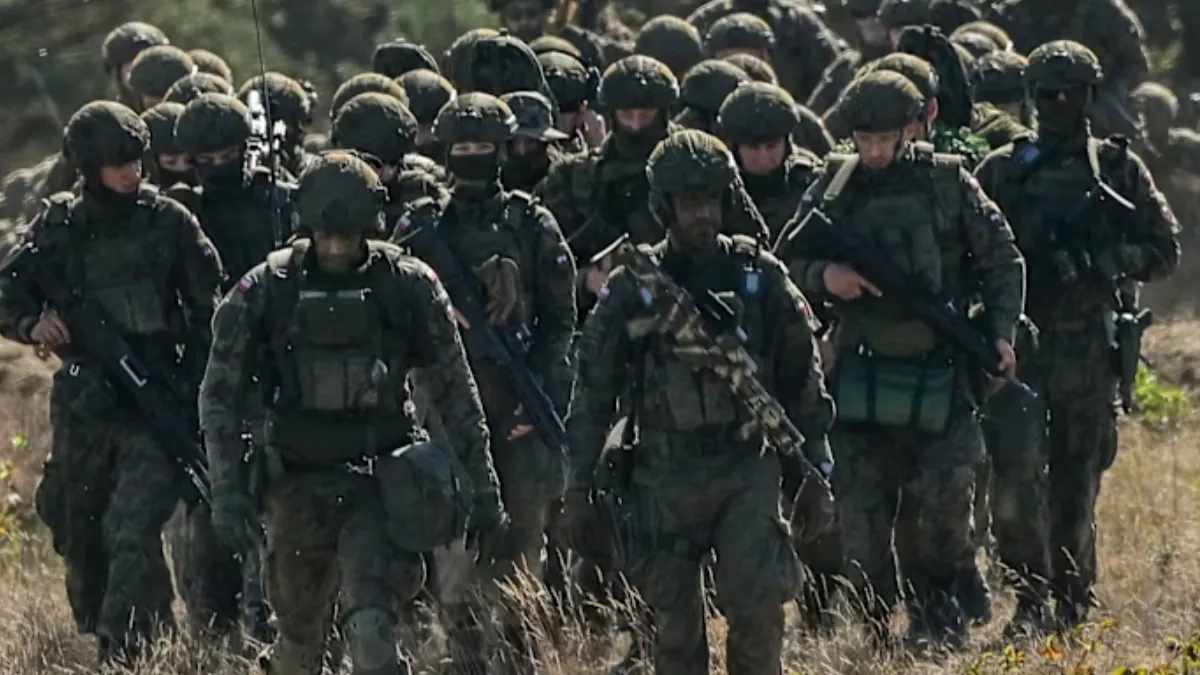
NATO deployed 10,000 soldiers with full equipment to its eastern flank in 8.5 days during the Steadfast Dart exercise, beating the alliance's own ten-day target for rapid reinforcement. The result received little coverage. Headlines warning of European vulnerability and Russian military superiority sell better, as the Estonian commentator Peeter Kaldre noted this week, but the underlying picture of alliance readiness tells a more complicated story.
The deployment that beat its target
Steadfast Dart, NATO's annual major rapid-deployment exercise, tested the alliance's ability to move forces into the Baltic states under a scenario in which Russia had attacked with large formations. The exercise scenario assumed the Baltic states would need to hold out alone for a period before allied reinforcement arrived. The ten-day target was met with a day and a half to spare, suggesting that NATO's logistics for moving personnel and heavy equipment eastward have improved since the exercise series began.
A two-part British documentary from 2025, Inside NATO: The Battle to Stop Putin, covered the exercise in detail. Broadcast on Estonian television, it made no attempt to sugar-coat the shortcomings. Military vehicles broke down during the advance and had to be repaired and towed. Field hospitals proved difficult to erect. Soldiers from southern European countries struggled with Baltic weather. The programme also stressed mental preparation, arguing that NATO personnel must be ready for the same kind of trench warfare and brutality that Russian forces have displayed in Ukraine.
Estonian diplomats working at NATO headquarters have said they see no loosening of the alliance's military posture, regardless of what politicians say about American commitment. Military planning continues on its established course.
Tripwire forces and what they signal
NATO has also pre-positioned allied contingents in the Baltic states. Estonia, for instance, hosts British, French and American personnel. The numbers are small, but the calculation behind them is deliberate: any Russian attack would kill allied soldiers from nuclear-armed states, turning what might otherwise be framed as a regional dispute into an attack on NATO itself. The presence of those forces raises the political cost of aggression before any shot is fired.
Lithuania is set to become an even stronger signal. Germany has committed to permanently stationing a brigade there, comprising more than 4,000 troops. If that deployment is carried through, it would represent a step-change in the alliance's forward presence on the eastern flank, moving from symbolic deterrence to something closer to operational defence.
An unannounced message near Kaliningrad
Beyond scheduled exercises, NATO has been signalling resolve in ways that attracted almost no media attention. On 18 August, an unannounced exercise took place near Kaliningrad, involving American and Norwegian fighter jets, Polish ground forces and AWACS reconnaissance aircraft. Military observers interpreted it as a direct signal to Moscow: do not test the alliance by launching ballistic missiles from Kaliningrad toward European targets, and do not attempt to seize the Suwałki corridor, the narrow strip of Polish and Lithuanian territory between Belarus and Kaliningrad that separates the Baltic states from the rest of NATO.
The Suwałki corridor has long been identified as one of the alliance's most vulnerable points. If Russian forces seized it, the Baltic states would be cut off from overland reinforcement. The August exercise made clear that NATO has the capability and the intent to contest that scenario before it begins.
Tomahawks in Trondheim
At the end of August, the United States deployed four Tomahawk cruise-missile launchers to Trondheim, Norway. The Tomahawk has a range exceeding 1,500 kilometres, meaning the missiles can reach a substantial portion of Russia's European territory from Norwegian soil. Moscow reacted furiously, which was precisely the point. The deployment shifts the deterrence calculus by giving NATO a conventional strike capability that can hold Russian military infrastructure at risk without resorting to nuclear weapons.
France takes the lead
The exercise Northern Viking, held near Iceland, practised anti-submarine warfare against Russia's submarine fleet. What made it symbolically significant was the participant list: for the first time, Americans were not present. France led the exercise.
The United States has long insisted that Europeans must take greater responsibility for their own security, a position articulated not only during Donald Trump's presidency but across administrations. Whether that insistence is entirely sincere is open to question. Analysts recall that in the late 1990s, when the European Union sought to create security cooperation outside NATO, US Secretary of State Madeleine Albright travelled to Europe and firmly discouraged the initiative, making clear that Washington would not welcome anything that rivalled NATO, and by extension, American leadership.
France's leadership of Northern Viking may indicate where the balance is shifting: not toward European independence from the alliance, but toward European credibility within it. If European nations can demonstrate that they can lead complex operations, American calls for burden-sharing become harder for Washington to dismiss as aspirational.
People mentioned
-
Peeter Kaldre
-
Madeleine Albright
Organisations
North Atlantic Treaty Organization · ERR