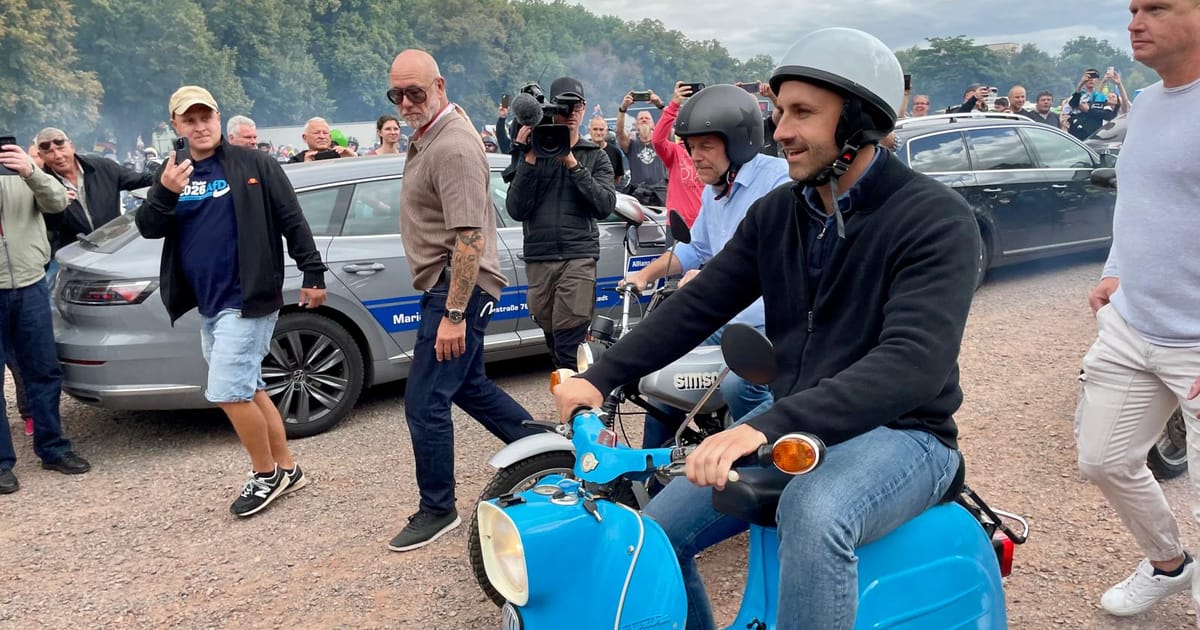
Several hundred riders on blue Simson mopeds rolled through the medieval streets of Quedlinburg last Sunday, German flags fluttering from handlebars, led by the Alternative for Germany's lead candidate in Saxony-Anhalt, Ulrich Siegmund. The convoy was not a vintage enthusiasts' club outing. It was a campaign event, staged six days before a state election in which the AfD holds a commanding poll lead and stands on the brink of its first taste of genuine governing power since the party's founding in 2013.
A campaign built on Ostalgie
The rally showcased the AfD's deliberate embrace of Ostalgie, the persistent nostalgia for aspects of life in the German Democratic Republic. Siegmund, born in 1990, a year after the Berlin Wall fell, stood on stage before the departure and acknowledged the dictatorship's crimes before pivoting to the party's core message: "This Simson culture stands for individual freedom of movement. It stands for a time when we stuck together in this country. And that is exactly the time I want back."
The strategy targets a specific electorate. Saxony-Anhalt, a largely rural state of two million people, has seen its population shrink by 16 percent since reunification while western Germany grew by 10 percent, according to Federal Statistical Office data. The east is older, poorer and more sceptical of the federal government. A YouGov poll conducted last year found 43 percent of eastern Germans see more differences than similarities with their western compatriots, up nine percentage points from 2019. Only 11 percent said similarities outweigh differences.
The Simson paradox
The mopeds themselves carry a history the AfD prefers not to emphasise. The Simson company was founded in 1856 in Suhl, Thuringia, by a German Jewish family. Their descendant Minna Simson fled Nazi Germany in 1936; the regime expropriated the factory. After the war, the East German state nationalised it and produced the mopeds that became ubiquitous because they were affordable and, uniquely, could legally reach 60 km/h, 15 km/h faster than standard mopeds under a GDR-era exemption that still applies.
That history has become a point of contention. Dennis Baum, Minna Simson's American grandson, travelled to Germany in July to protest at the AfD's party conference in Thuringia, held exactly a century after the Nazis staged a major rally in the same region. "History is not repeating itself, but it rhymes," Baum said, quoting Mark Twain. "It is the intolerance of the far right and the AfD that has forced me and my family to take a stand. And that is why I demand: Keep the name Simson out of politics."
Dismissing criticism as foreign interference
Siegmund brushed off Baum's intervention at the Quedlinburg rally. "Why should I care if someone who's been living across the pond for decades, not even here in Europe, not even in Germany, and certainly not in Saxony-Anhalt, wants to pass judgment on how we have to live here?" The crowd cheered. "You're the people who represent us here, not Americans who want to dictate how we should live!"
The exchange encapsulates the AfD's framing: external critics, whether Jewish descendants, federal politicians or European partners, are portrayed as illegitimate meddlers in eastern German affairs. Michael Friedrich, a 67-year-old roofer riding a red Simson, expressed sympathy for the party's tactics. "Of course, this is used as a way to stir up a little Ostalgie and bring people together. But that's okay. When mobilising, anything goes."
From far-left tool to far-right weapon
Historian Stefan Wolle, who has studied the GDR for decades, traces a striking trajectory. Ostalgie was long a hallmark of the far left, which romanticised the GDR's social protections and anti-fascist founding myth. In recent years, the AfD has mimicked the playbook, but with a contradictory twist. On one hand, AfD leaders compare the mainstream parties' "firewall" against cooperation with the AfD to the SED's suppression of dissent. On the other, they co-opt GDR symbols to stoke hostility toward the west and translate a distinct eastern identity into votes.
"East Germany serves as a negative foil," Wolle said. "At the same time, the AfD increasingly attempts to co-opt memories of East Germany for their own agenda and to stoke a certain hostility toward the West. And this certain eastern mentality or this new pride in being from the East is supposed to be translated into political votes."
Electoral arithmetic and the firewall
The numbers explain the urgency. In Saxony-Anhalt, the AfD polls above 30 percent, well ahead of the CDU and the governing SPD-Green-FDP coalition parties. In Mecklenburg-Western Pomerania, which votes on 20 September, the party also leads. A victory in either state would shatter the taboo that has kept the AfD out of government at every level since its formation. The party's Saxony-Anhalt branch has already been designated a "proven extremist" organisation by the state's Office for the Protection of the Constitution, a classification that normally triggers political isolation. Yet the firewall shows cracks: the CDU in several eastern states has softened its refusal to cooperate on specific issues.
A national project launched from the east
Siegmund makes no secret of the broader ambition. At a July event in Magdeburg, he declared: "We're taking the first step. But the sun won't just rise in the East, it will shine over all of Germany." The rhetoric mirrors the party's national leadership under Alice Weidel, who has sought to reposition the AfD as a mainstream conservative force while its eastern branches pursue a more radical line. The Simson rallies, with their blend of cultural nostalgia and anti-establishment grievance, are the visible edge of that project.
People mentioned
-
Stefan Wolle
-
Dennis Baum
Organisations
Alternative for Germany · Landesamt für Verfassungsschutz Sachsen-Anhalt · YouGov · Statistisches Bundesamt