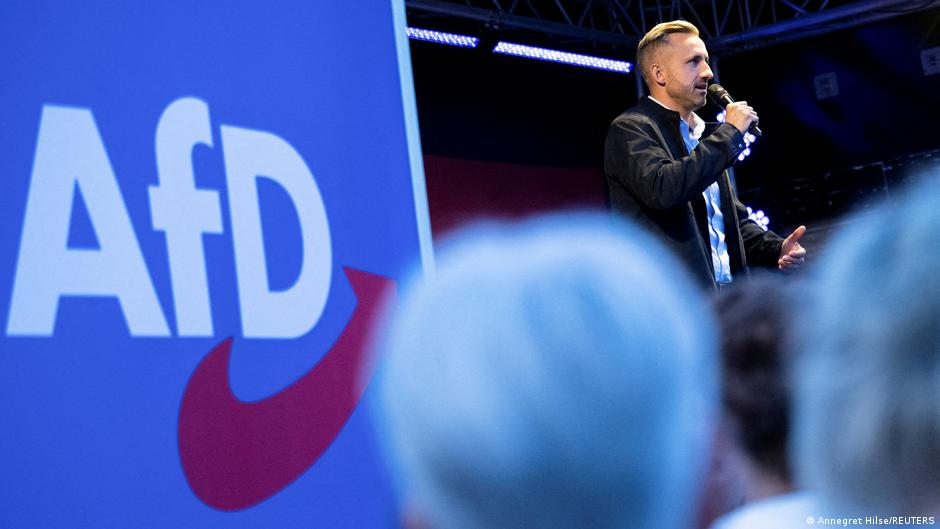
The Alternative for Germany (AfD) enters the Saxony-Anhalt election campaign with a commanding lead in opinion polls and a draft government programme that would reshape the state's migration, security and cultural policies in ways that test the limits of state authority under the German Basic Law. The party's lead candidate, Ulrich Siegmund, is campaigning to become the first AfD minister-president of a German state, heading what the party hopes will be a single-party government.
A programme that tests constitutional boundaries
The AfD's election platform promises "deportation from minute one" and sets a goal of removing as many people without residency permits as possible. To achieve this, the party proposes expanding detention pending deportation, introducing mandatory work for asylum-seekers, and cutting all state funding for integration programmes, which it labels an "asylum industry." Children and adolescents without permanent residency would be excluded from regular schools. A "Remigration Task Force" inside the state government would coordinate asylum policy.
How much of this a state government can deliver is contested. The power to order deportations rests with the federal government, not the Länder. Creating separate classes for refugee children likely breaches the UN Convention on the Rights of the Child and EU directives on education access. The Saxony-Anhalt chapter of the AfD is already classified by the Bundesamt für Verfassungsschutz as "confirmed far-right," a designation that gives domestic intelligence agencies expanded surveillance powers over the party's state association.
Demographic collapse and the skilled worker gap
Saxony-Anhalt has shrunk more than any other German state since reunification. The population has fallen from roughly 2.9 million in 1990 to 2.1 million today, a decline of 27.6%. The exodus has left gaping holes in the labour market, especially in nursing and elderly care. The AfD's answer is a "return programme" aimed at Germans living abroad, complete with a "return bonus" for housing and childcare. The programme lacks costings or targets for how many returnees it expects to attract.
Reint Gropp, president of the Halle Institute for Economic Research, told Die Welt that the platform would backfire. "Highly qualified professionals, in particular, have options. If they feel they are unwelcome or can expect hostility, they will choose other regions." His warning underscores a paradox: a state desperate for workers is flirting with a government that signals hostility to the very people it needs to recruit.
Federal leverage through the Bundesrat
State governments have no formal say in foreign or defence policy, but they sit in the Bundesrat, the chamber that represents the Länder in federal legislation. An AfD minister-president could use that platform to shift the national debate. The party's programme calls for a rapprochement with Russia, an end to sanctions imposed after the 2022 invasion of Ukraine, and expanded Russian-language teaching in schools with native-speaker recruitment. It also demands a "return offensive" for Ukrainian refugees, again, a federal competence.
These positions are largely symbolic at state level, but they would give the AfD a permanent voice in the Bundesrat's committees, where the party could delay or complicate federal legislation requiring state consent. The practical effect would depend on whether other states tolerate an AfD representative in those bodies or isolate them through procedural means.
Citizen patrols and the monopoly on force
Among the most controversial proposals is a "voluntary citizen patrol" described as a third pillar of local security alongside the police and municipal order offices. The AfD argues that regular police are "overwhelmed." Thomas Feltes, a criminologist at Ruhr University Bochum, dismissed the idea in a column for Legal Tribune Online. "It is the police's duty to ward off dangers and ensure the protection of the public. Only the police are authorized to use force in doing so," he wrote. A citizen patrol, he argued, would function as a vigilante group and increase fear of crime among the wider population, not only among participants.
The proposal echoes similar initiatives the AfD has floated in other eastern states. In Brandenburg and Thuringia, interior ministries have rejected auxiliary forces on the grounds that they undermine the state's monopoly on legitimate force and create accountability vacuums. Any attempt to legislate such a force in Saxony-Anhalt would almost certainly face constitutional challenge.
Rewriting history and defunding civil society
The cultural section of the programme reveals the party's broader ideological project. It describes Germany's post-war confrontation with Nazi crimes as the "perpetuation of a guilt complex" and pledges to revise school curricula accordingly. Rainbow flags would be banned in schools as symbols of diversity. The Bauhaus movement, which flourished in Dessau and is a UNESCO World Heritage site, is dismissed as "too globalist." In its place, the AfD promises a "patriotic cultural policy."
Funding for pro-democracy projects, many of which monitor far-right extremism and support migrant integration, would be terminated. The party frames these organisations as partisan actors. Critics argue that cutting their funding would hollow out the infrastructure that documents and counters hate crime, leaving a gap the state would not fill.
People mentioned
-
Reint Gropp
-
Thomas Feltes
Organisations
Alternative for Germany · Halle Institute for Economic Research · Ruhr University Bochum · Bundesrat · Bundesamt für Verfassungsschutz