Polls have closed in Saxony-Anhalt after a state election that could place the far-right Alternative für Deutschland in government for the first time, a result without precedent in postwar Germany. Final polling put the AfD at roughly 41 per cent, more than enough to dominate the new state parliament and potentially enough to govern outright.
Some 1.7 million residents were eligible to vote, with polling stations operating from 8am to 6pm local time. A final poll by public broadcaster ZDF on Thursday placed the AfD on 41 per cent, the Christian Democratic Union on 23 per cent, Die Linke on 11.5 per cent, the Social Democrats on 8.5 per cent and the Greens on 6 per cent. Two smaller parties fell below the 5 per cent threshold needed to enter parliament. The number of undecided voters was reported to be significantly lower than in previous elections, suggesting most voters' minds were made up well before election day.
The firewall faces its sternest test
The central question is not whether the AfD wins the most votes but whether it secures an absolute majority. If it falls short of 50 per cent, the party's lead candidate, Ulrich Siegmund, has stated he will not enter a coalition, meaning he would take power only with a governing majority. Every mainstream party has ruled out governing alongside the AfD, maintaining what German politics calls the Brandmauer, or firewall.
The AfD's branch in Saxony-Anhalt is officially classified as rightwing extremist by the Federal Office for the Protection of the Constitution, Germany's domestic intelligence agency. That designation has not dented the party's support in the state. If the AfD crosses the absolute majority threshold, the Brandmauer becomes irrelevant: the party would not need a coalition partner.
A candidate built for social media
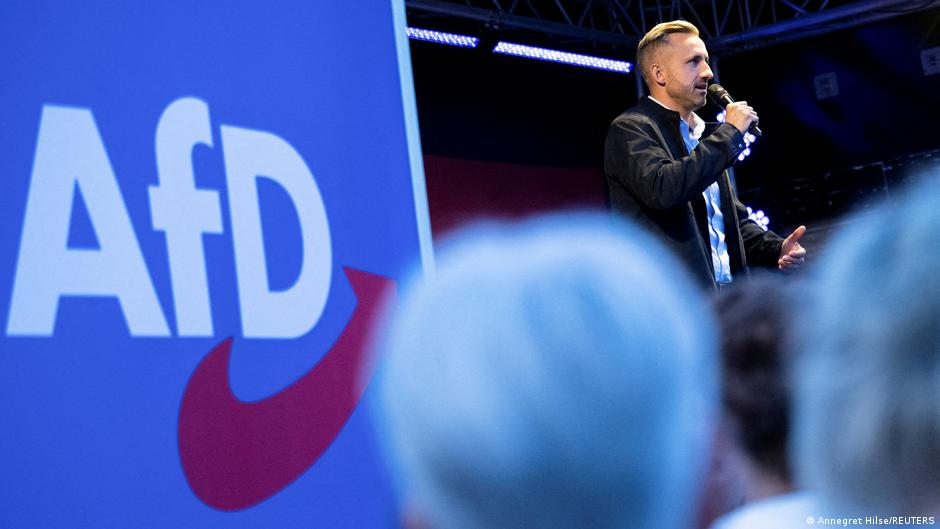
Siegmund, 35, is a former fragrance salesman with a substantial following on TikTok, where he has been received with something approaching pop-star enthusiasm at campaign events. He arrived at his polling station on Sunday morning on an East German-era moped painted in the AfD's colours, the same vehicle that served as a prominent prop throughout the campaign. Speaking outside, he told reporters he was optimistic the party would achieve "45%, and some".
His platform leans heavily on cultural and nationalist symbolism. He has pledged to launch what he calls a remigration and deportation offensive, ban rainbow flags from schools, halt construction of new wind farms, change the state's official slogan from "Think modern" to "Think German" and reintroduce the singing of the national anthem in schools. Economic policy has been largely absent from his public messaging.
Ostalgie and eastern grievance
Siegmund has deliberately capitalised on a mood of ostalgie, a nostalgia for aspects of life in communist East Germany, and on a broader sense among eastern Germans that they remain second-class citizens compared with those in the west. The moped was not a casual choice of transport; it was a signal. Three and a half decades after reunification, per capita incomes in Saxony-Anhalt remain well below the national average, and the state's population has been shrinking as younger residents migrate westward for work.
The AfD's message resonates in part because it channels genuine economic and cultural dislocation into a political programme that identifies immigration, cultural liberalism and the western political establishment as the sources of eastern disadvantage. Whether that programme addresses the underlying problems is a different question.
Pressure on Merz in Berlin
The election is the most significant electoral test yet for Chancellor Friedrich Merz, whose CDU heads the federal government in coalition. Merz came to office promising to revive Germany's struggling economy and reduce support for the AfD by taking a harder line on immigration. The economy has not recovered. Irregular immigration has fallen since he took office, but not enough to satisfy voters who have already moved their allegiance to the AfD.
In national polls, the CDU has been overtaken by the AfD, which is now positioning itself for the next federal election in 2029. A convincing win in Saxony-Anhalt will sharpen questions about whether Merz's strategy of competing with the AfD on immigration while maintaining the Brandmauer at the coalition level is viable. The CDU currently governs Saxony-Anhalt in coalition with two smaller parties under state premier Sven Schulze, but on roughly 23 per cent, Schulze's party faces a drastically reduced presence in the new parliament.
Economic and security warnings
The German Economic Institute has warned that the AfD's immigration policies would be "calamitous" for Saxony-Anhalt, a state with an ageing and dwindling population that depends heavily on foreign workers. Eurostat data on regional demographics shows the scale of the challenge: eastern German states face some of the most pronounced population decline in the European Union.
Separately, critics have raised concerns that an AfD-led state government could leak sensitive information to Russia, given the party's consistently Kremlin-friendly stance on foreign policy. The AfD has dismissed those claims and said it would instead seek to reform the domestic intelligence service, which it considers biased. That promise, if carried out, would place a state government in direct conflict with federal security institutions.
Civic opposition and fraud allegations
On Saturday, thousands of AfD opponents gathered in the state capital, Magdeburg, for what organisers called a festival of democracy. A message projected onto the facade of Magdeburg Cathedral read: "We do not abandon what we love. True love of the homeland is not the AfD." The bishop of Magdeburg, Gerhard Feige, told churchgoers that democracy carries the capacity to abolish itself, warning that "not everyone who votes or is elected democratically is a democrat."
Independent election observers are present at polling stations after the AfD alleged voter fraud, particularly in postal voting and at a specific retirement home. State authorities have denied the claims. The allegations mirror a pattern seen in other recent elections where the AfD has questioned the integrity of the process before results are known.
People mentioned
-
Gerhard Feige
Organisations
Alternative für Deutschland · Christian Democratic Union · Federal Office for the Protection of the Constitution · German Economic Institute