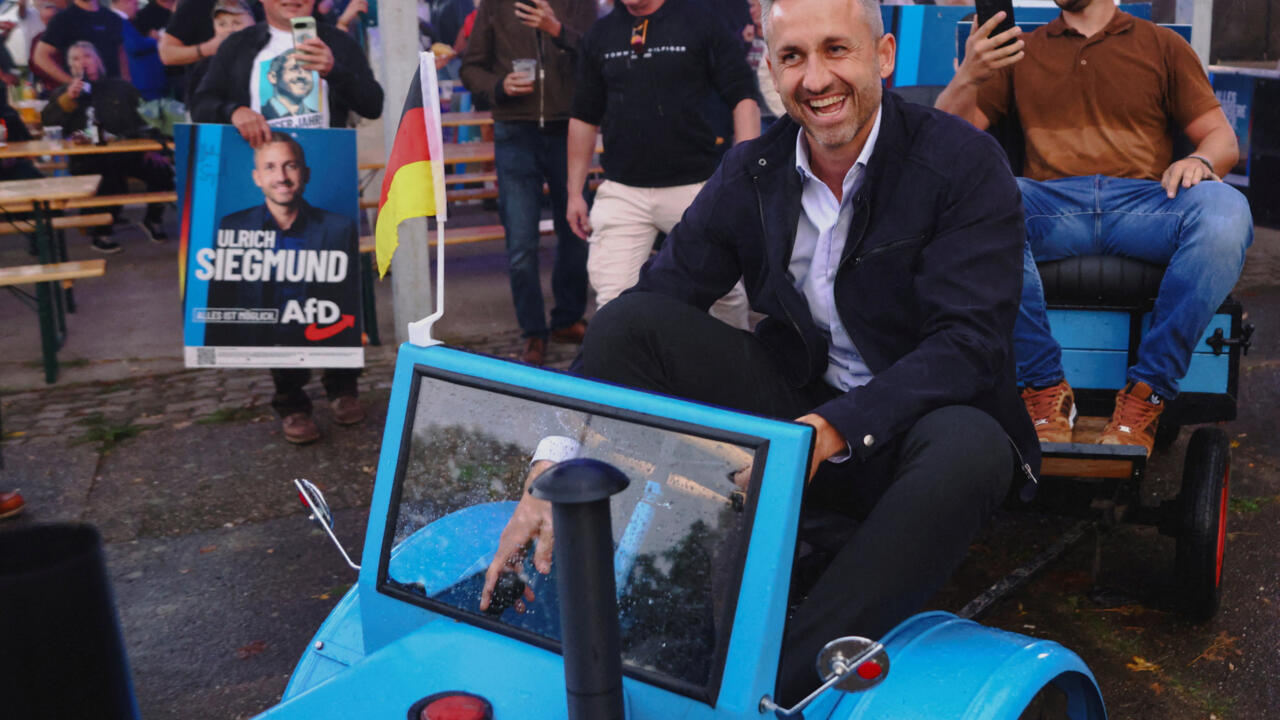
When voters in Saxony-Anhalt go to the polls, they may deliver a result without precedent in post-war German democracy: an outright majority for a far-right party. The Alternative für Deutschland (AfD) is pushing for exactly that in the eastern state, fielding a lead candidate whose campaign has traded the party's customary vitriol for a softer, more personable pitch.
Why an outright majority would be different
The AfD has already entered state parliaments across eastern Germany in large numbers. It has topped polls in several states and become the largest opposition force in others. But crossing the 50 percent threshold is something different entirely. It would hand the party a governing majority without the need for coalition partners, and it would render Germany's democratic firewall, the cross-party agreement not to cooperate with the AfD at any level, irrelevant.
German state elections use proportional representation, and outright majorities are rare under such systems for any party. The AfD's polling in eastern states has regularly exceeded 30 percent, but 50 percent remains a considerable leap. The party would need to consolidate not just its core supporters but also disillusioned voters from the centre-right Christian Democrats (CDU) and even some former left-wing voters.
Saxony-Anhalt's particular discontent
Saxony-Anhalt fits a now-familiar pattern of eastern German states where the AfD thrives. Federal statistics show the former East German states trailing western counterparts on income, employment and population growth. The state has ageing towns, shrinking industrial bases and a pervasive sense among many residents that reunification's promises went unfulfilled.
The contrast with the dynamism of Leipzig, barely an hour to the south, or Berlin further west, is sharp. Those cities attract investment, young workers and international attention. Many communities in Saxony-Anhalt feel they are watching prosperity from a distance, and that frustration has been a reliable engine for the AfD's growth.
A campaign built on charm
The AfD's lead candidate in the state has run a campaign that emphasises approachability over anger, a calculated softening of the party's image. The strategy recognises something the party's national rhetoric sometimes obscures: voters attracted to the AfD's positions on immigration and sovereignty are not all drawn to aggressive posturing. A personable campaign can broaden the base beyond committed ideologues to voters who simply feel left behind.
Whether charm alone can push the party past 50 percent is the question that will be answered at the ballot box. The AfD's national leadership has not always been disciplined about staying on message, and the party's more extreme voices have a habit of surfacing at inconvenient moments.
Russia, Leipzig and the security question
The election takes place against an awkward security backdrop. The German government this week directly accused Russia of a drone attack on a Ukrainian cargo plane at Leipzig Airport. The accusation underscores a tension that runs through the AfD's platform: the party's sympathetic stance towards Moscow sits alongside its focus on immigration as the primary threat facing Germany.
Voters in Saxony-Anhalt must decide whether they accept that framing, or whether Russian hostility, made tangible on German soil, should weigh more heavily than the AfD suggests. The question of how a party that questions the NATO consensus would govern a state with security responsibilities is one that the campaign has not fully addressed.
The European dimension
The AfD and France's National Rally share more than a sceptical view of Moscow. Both oppose a more federal European Union, and both are pushing at the boundaries of what mainstream politics considers acceptable. This week, Marine Le Pen's party floated a proposal to ban the Muslim headscarf in public spaces, a measure that would affect millions of French citizens. The two parties are not formally allied in a European parliamentary group, but their trajectories run parallel.
The question of what happens when parties that oppose European integration actually gain executive power is no longer theoretical. In Hungary and in parts of Italy, governments already challenge Brussels from within the system. An AfD state government in Germany would add a different dimension: a governing party in the EU's largest member state, in a region dependent on EU structural funds, actively hostile to the EU's political direction.
What governing alone would mean
State governments in Germany control education, policing and significant aspects of economic policy. An AfD-led state government could reshape policing priorities, alter school curricula and set its own course on immigration enforcement within the limits of federal law. Each of these would bring the state into conflict with federal authorities and with EU directives.
The practical consequences would be immediate and would force a response from Berlin. The federal government has limited tools to override a state government that commands a genuine democratic mandate, and any attempt to do so would be cast by the AfD as exactly the kind of elite overreach its voters resent.
People mentioned
Organisations
Alternative für Deutschland · National Rally