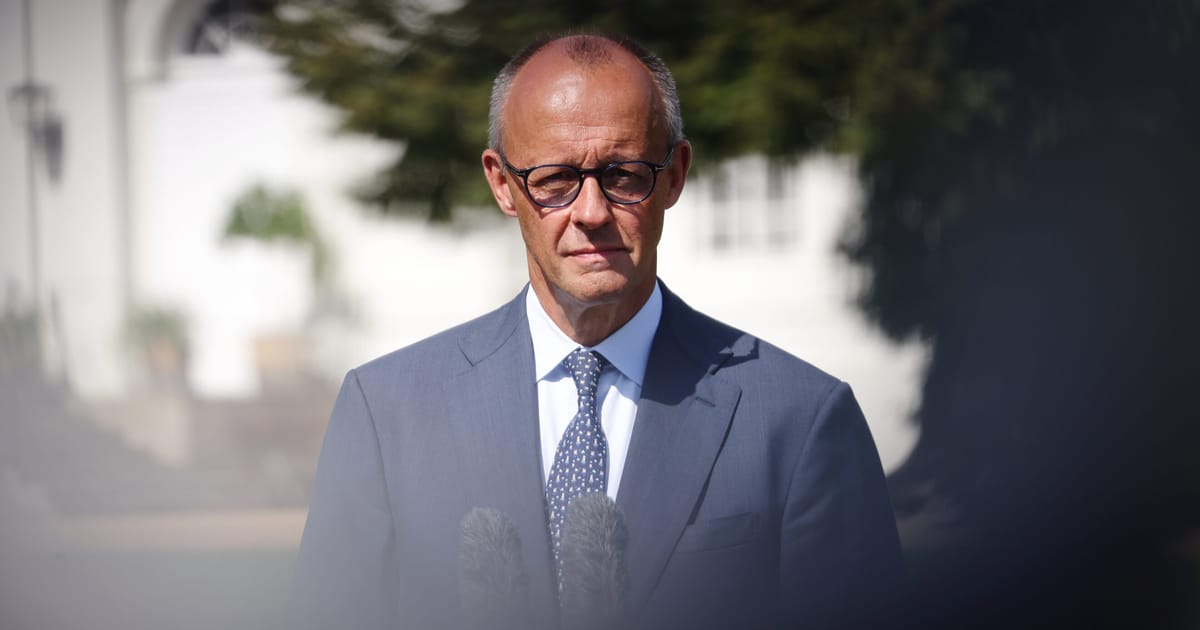
Friedrich Merz arrives at Sunday's Saxony-Anhalt election with no plausible path to a political victory. Every conceivable outcome, from an outright Alternative for Germany majority to a fragile conservative-led minority government dependent on far-left tolerance, carries a distinct flavour of humiliation for a chancellor who has held office for just sixteen months and already ranks as the least popular in postwar German history.
Pre-election polling places the AfD decisively ahead of Merz's Christian Democratic Union in the eastern state. If the far right secures an absolute majority in the Magdeburg parliament, Merz earns the ignominious distinction of being the national leader under whom a far-right party first assumed sole governing power since the Second World War. If the AfD falls short, the CDU must attempt to construct a coalition from the remaining parties, almost all of them to its left, while honouring a promise to cooperate with neither the AfD nor Die Linke.
The arithmetic that makes governing nearly impossible
The coalition mathematics are brutal. Current surveys suggest the AfD will win roughly thirty-five to thirty-eight percent of the vote, the CDU twenty-five to twenty-eight percent, Die Linke around twelve percent, the Social Democrats ten percent and the Greens six percent. Merz has ruled out formal cooperation with both the AfD and Die Linke. That leaves a theoretical CDU-SPD-Green combination that, even at the optimistic end of polling, struggles to reach a parliamentary majority.
In practice, any CDU-led administration would require at least the tacit support of Die Linke to elect a minister-president and pass legislation. The far-left party has signalled willingness to tolerate such an arrangement, as it does in Thuringia and Saxony, but would extract policy concessions. A CDU district association in Saxony-Anhalt has already rejected any government surviving only with the "goodwill, toleration or explicit consent" of Die Linke, calling a model that gives the Left a de facto veto over a centre-right government unacceptable.
Why an AfD majority might be the cleaner outcome for conservatives
Some CDU strategists in the state privately concede that an AfD absolute majority, while historically charged, would at least clarify the political landscape. Alexander Räuscher, a CDU member of the state parliament, argued that the moment Ulrich Siegmund becomes minister-president, "he's finished." The theory: governing forces the AfD to make concrete choices, on budgets, on administration, on the inevitable compromises of executive power, that could demystify the party and create an opening for a CDU resurgence from the opposition benches.
That calculation carries enormous risk. An AfD government in a German state would normalise far-right executive power, potentially shifting the Overton window nationally. It would also hand Merz's internal critics a potent argument: that his leadership and his firewall strategy have delivered the very outcome they were designed to prevent.
The firewall cracks in the East
The firewall, the CDU's pledge never to govern with the AfD, has always been more fragile in eastern Germany. Michael Kretschmer, the CDU minister-president of neighbouring Saxony, put it bluntly in July: "Anyone who still talks about firewalls hasn't recognised the signs of the times." His comment reflected a growing conviction among eastern conservatives that the firewall forces them into coalitions with the left, which in turn fuels the AfD's narrative that the CDU has become indistinguishable from its progressive rivals.
This tension is not new. In Thuringia, the CDU tolerates a minority government led by the Left party's Bodo Ramelow. In Saxony, Kretschmer governs with the SPD and Greens but relies on Die Linke's abstention for key votes. Both arrangements are cited by AfD propagandists as proof that the mainstream right has surrendered to the left. The Saxony-Anhalt election threatens to replicate this dynamic on a larger stage, with a chancellor whose authority is already fraying.
Merz's denial and the gathering leadership crisis
In a television interview last Sunday, Merz insisted he was "not speculating today about what will happen the day after [the election]." He pledged to "assess the situation in light of the election results" and do everything possible to keep the radicals from power. The performance struck many observers as detached from the reality his own party describes. Julian Schache, a CDU politician from Magdeburg, acknowledged that "given the dissatisfaction, the poll numbers and the fact that there are additional elections coming up next year … the pressure for fundamental change will naturally increase." He added that he could "certainly imagine that some will push for Friedrich Merz to step down."
The term Kanzlertausch, chancellor swap, has entered conservative discourse with a seriousness unseen since the early days of the Merkel era. Unlike Angela Merkel, who survived countless electoral setbacks through sheer institutional dominance, Merz lacks a protective majority in the Bundestag or the party apparatus. His approval ratings have hovered near historic lows for months. A string of defeats in Saxony-Anhalt, Mecklenburg-Western Pomerania and Berlin this month, followed by four more state elections in 2027, could make his position untenable before the next federal election.
The campaign trail hostility
Merz's personal unpopularity in the East is palpable. During rare campaign appearances in Saxony-Anhalt this week, he was booed. Protesters shouted "Pinocchio" and "warmongerer", the latter a reference to his stance on Taurus missile deliveries to Ukraine, forcing the cancellation of a planned press statement. Eastern CDU candidates have quietly made clear they do not want the chancellor on their campaign materials. The disconnect between the national leadership and the regional party base has rarely been this visible.
Election integrity challenges already underway
Complicating the post-election landscape, the AfD has begun laying the groundwork to contest the result. The party has issued press releases casting doubt on mail-in ballots, and Siegmund has amplified similar concerns on social media. This mirrors a strategy deployed by right-wing populists across Europe and the United States: pre-emptively delegitimise the count in case the outcome disappoints. German election administrators insist the system is robust, but the mere fact that a major party is questioning the process before votes are cast signals a further erosion of democratic consensus.
What happens after the ballots are counted
The immediate focus shifts to coalition talks, or the lack thereof. If the AfD wins an absolute majority, Siegmund will seek election as minister-president, likely requiring multiple ballots as other parties refuse to support him. The CDU would then face a choice: vote for an AfD premier (breaking the firewall) or abstain (allowing him to win with a plurality on the third ballot). Either path damages Merz.
If the AfD falls short, CDU state leader Sven Schulze must attempt to form a minority government with the SPD and Greens, negotiating a tolerance agreement with Die Linke. The Left party's price will likely include social policy concessions, rent controls, education spending, migration policy softening, that the CDU's right wing will reject. A collapse of those talks would trigger new elections, prolonging the paralysis.
For now, the chancellor's strategy appears to consist of waiting for Sunday and hoping the numbers allow a narrative he can sell. His party, from Magdeburg to Munich, is no longer waiting. The conversation has moved from whether Merz can win to how long he can last.
People mentioned
-
Michael Kretschmer
-
Julian Schache
Organisations
Christian Democratic Union · Alternative for Germany · Social Democratic Party · Alliance 90/The Greens · Die Linke