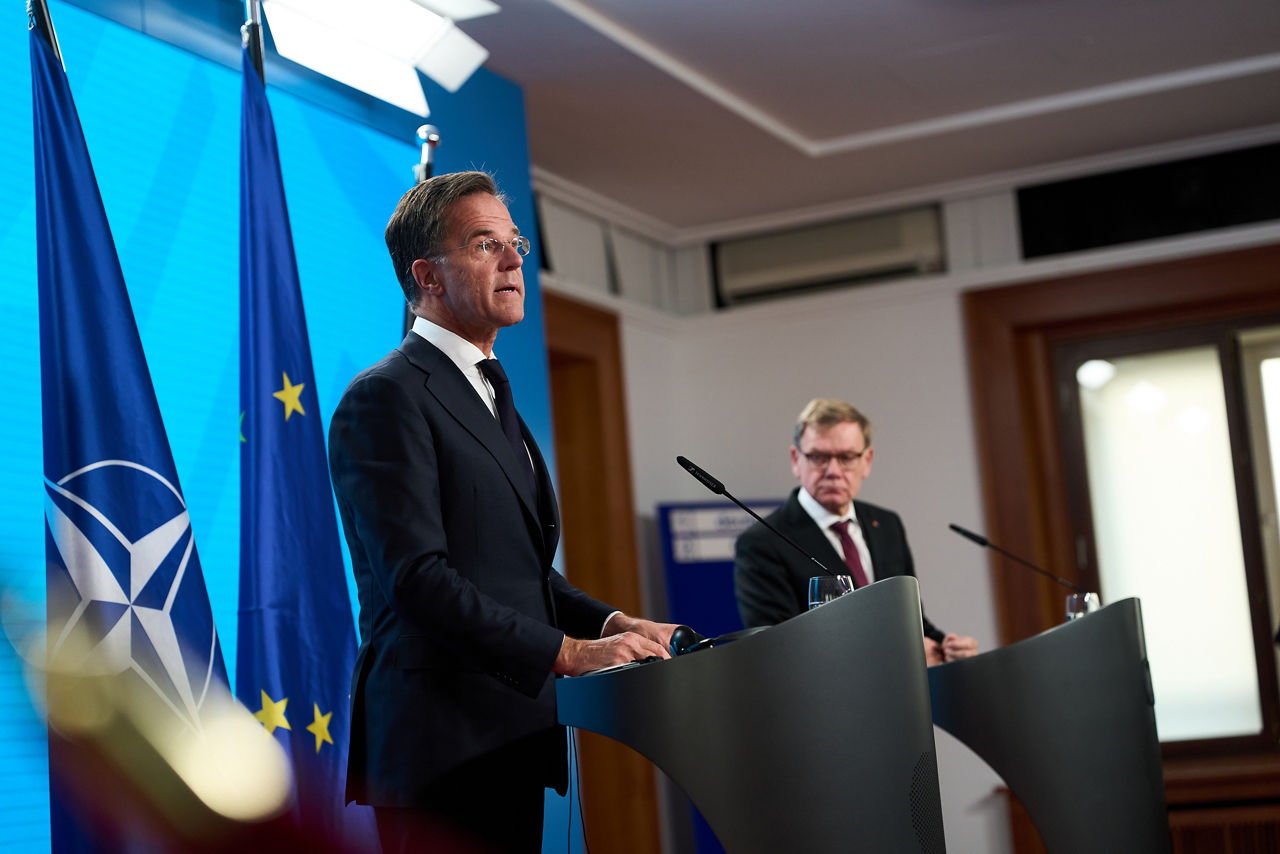
NATO Secretary General Mark Rutte chose the annual German Heads of Mission Conference in Berlin on 10 September to deliver his clearest statement yet on what the alliance calls NATO 3.0: a structural shift in which European members and Canada assume far more of the burden for continental defence. Speaking alongside Foreign Minister Johann Wadephul, Rutte described Germany as the pace-setter for that transformation, pointing to concrete deployments and a reawakening defence industry as evidence that Berlin is no longer waiting for Washington to lead.
The NATO 3.0 concept and the burden-sharing argument
Rutte's formulation, that security is not something the United States should do for Europe but with Europe, has been building since the 2022 Madrid summit, but the Berlin speech gave it a sharper institutional label. NATO 3.0, as he defined it, is the most profound transformation of the alliance since the Cold War. The subtext is unmistakable: the era in which European capitals could treat the US security guarantee as an open-ended subsidy is ending, regardless of who occupies the White House. Rutte did not say so explicitly, but the logic of his argument implies that the next US administration, whether Republican or Democrat, will demand measurable European capacity before committing American forces to new crises.
The Secretary General's audience, the heads of every German diplomatic mission worldwide, was deliberate. He was speaking to the officials who must translate military commitments into political language in capitals from Tokyo to Brasília. If NATO 3.0 is to mean more than a slogan, the foreign service has to sell a German-led European pillar that looks credible to partners who have grown used to American dominance.
Concrete deployments on the eastern flank
Rutte cited three specific German contributions. A new armoured brigade is now permanently stationed in Lithuania, giving NATO a combat-ready formation on the alliance's north-eastern border. The First German-Netherlands Corps has assumed a new command role on the eastern flank, integrating Dutch and German headquarters staff into a single operational structure. German aircraft and ships are actively supporting NATO's deterrence and defence missions across the Baltic and North Sea. These are not pledges for a future budget cycle; they are forces in place today.
The Lithuania brigade matters because it solves a persistent gap. Since the enhanced Forward Presence battlegroups were established in 2017, NATO has relied on rotating contributions that never quite added up to a full brigade. A permanent German formation changes the calculus for Russian planners, who can no longer assume the alliance's tripwire is lightly held. The German-Netherlands Corps integration, meanwhile, is a rare example of two allies merging command functions at the operational level, something NATO has urged for decades but rarely achieved.
Defence industrial revival as economic argument
Rutte devoted considerable time to Germany's defence industry, from established primes to newer start-ups. "You are producing more, and doing more for our Alliance," he said, adding that revitalising the industrial base is good for security and for economies. The claim is contestable. German defence procurement has historically been plagued by slow decision-making, export restrictions and a fragmented customer base. If the industrial base is truly reviving, it will show up in order books and delivery timelines, not in speeches. Rutte's framing, linking security and prosperity, is an attempt to make defence spending politically palatable to a German public still wary of militarism.
The economic argument also serves a wider NATO purpose. The alliance's new defence production action plan, agreed in 2024, aims to shift the European industrial base from peacetime boutique production to wartime surge capacity. Germany, as Europe's largest economy, is the test case. If Berlin can streamline procurement and align export policy with alliance needs, the model spreads. If it cannot, the whole NATO 3.0 architecture stalls.
Leipzig airport attack and the hybrid threshold
The most striking moment came when Rutte and Wadephul addressed what the Secretary General called Russia's "reckless hybrid attack" at Leipzig airport. Details remain classified, but the language, "hybrid attack" rather than "incident" or "sabotage", signals that NATO's intelligence agencies have attributed a deliberate, state-directed operation against German civilian infrastructure. Rutte's declaration that "NATO stands in full solidarity with Germany. You have 31 friends and Allies by your side" invokes Article 4 consultations at minimum, and potentially Article 5 if the attack meets the alliance's threshold for an armed attack.
The episode illustrates why NATO 3.0 cannot be purely about conventional deterrence. Hybrid operations, cyber intrusions, sabotage, disinformation, migration weaponisation, fall below the threshold that triggers collective defence but erode security nonetheless. Germany, with its open infrastructure and central geography, is uniquely exposed. The alliance's response, as Rutte framed it, will be more support for Ukraine. That linkage, punishing Russian hybrid aggression in Europe by escalating military aid to Kyiv, has become the default NATO playbook since 2022.
Ukraine support as the alliance's strategic anchor
Rutte and Wadephul were explicit: the answer to Russian aggression, whether hybrid or conventional, is deeper support for Ukraine. The logic is circular but deliberate. A Ukrainian victory, or at least a sustainable defensive line, validates the NATO 3.0 premise that Europeans can secure their neighbourhood with American backing but not American substitution. A Ukrainian collapse would expose the eastern flank directly, requiring US forces to return in numbers that no European capital wants and Washington may refuse.
Germany's role here is pivotal. Berlin has become Kyiv's second-largest military donor after Washington, supplying air defence systems, artillery and armoured vehicles. But German deliveries have often lagged behind announcements, and the Taurus missile question, whether to supply long-range strike capability, remains unresolved. Rutte's praise for German leadership is also pressure: keep the pipeline moving, because the alliance's credibility depends on it.
People mentioned
Organisations
NATO · Government of Germany · First German-Netherlands Corps