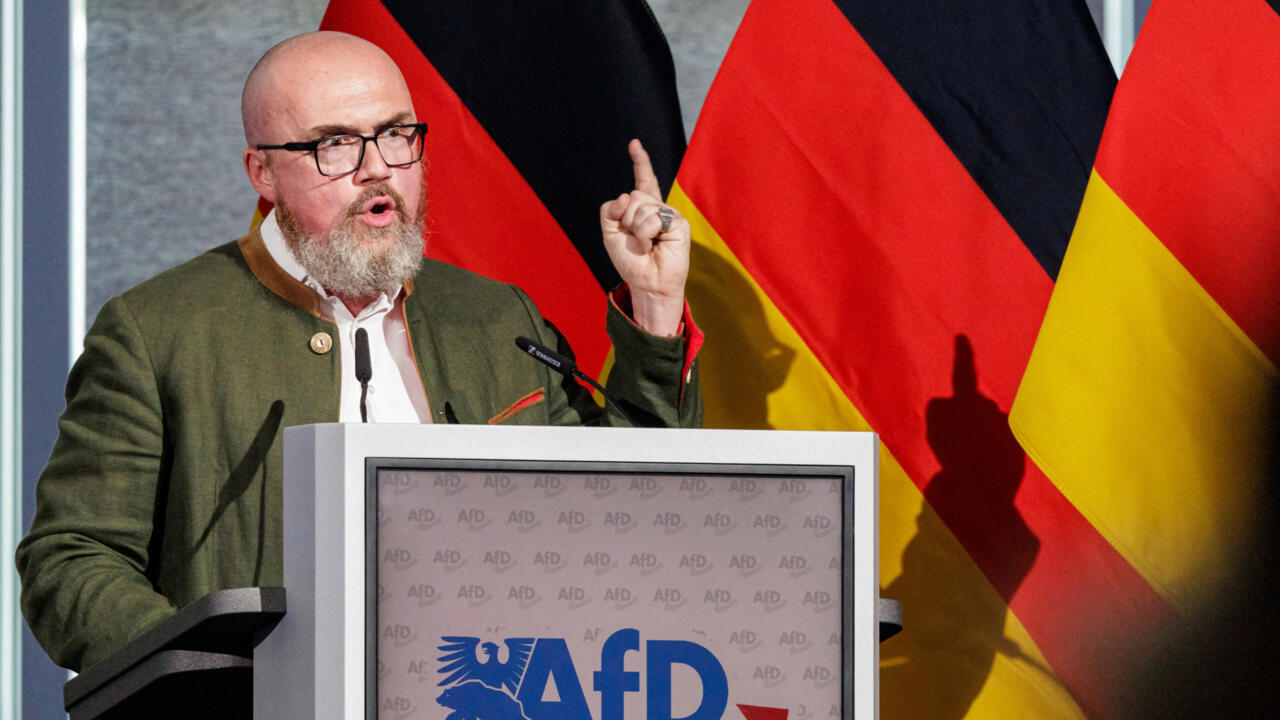
A proposal from the CDU's Harz district association to rule out any minority government that survives only with the toleration of the Left Party has exposed a faultline in Saxony-Anhalt's conservatives less than a week before the state election. The document, co-authored by state lawmaker Alexander Räuscher, argues that a centre-right administration dependent on the "goodwill, toleration or explicit consent" of the Left would hand the Alternative for Germany a permanent campaign weapon. If adopted, the red line would eliminate the only parliamentary arithmetic that has kept the far right out of executive power in neighbouring eastern states.
The Harz proposal and its immediate fallout
The Harz district association's motion rejects what it calls a "de facto veto" for the Left Party over a CDU-led government. Räuscher told FOCUS he would seek the expulsion of any CDU member who negotiates with either the AfD or the Left, drawing a symmetrical cordon sanitaire that mirrors the party's long-standing refusal to cooperate with the far right. The proposal has not been adopted by the state party, but its publication has forced the leadership into a public confrontation days before a vote that could reshape eastern German politics.
Sven Schulze, the incumbent minister-president and CDU lead candidate, moved quickly to contain the damage. "That is the opinion of a single party member," he told Stern. "No decision has been made on this, and it will not be a topic of discussion in the coming days." The language was deliberate: Schulze neither endorsed nor formally repudiated the substance, but he insisted the matter would not distract the campaign. Behind the scenes, however, the proposal reflects a calculation that has been building for months among CDU activists who believe the party's eastern electorate punishes any perceived accommodation with the Left.
The arithmetic that makes the proposal dangerous
The danger of the Harz line is not symbolic. Polling consistently places the AfD at around 42 percent in Saxony-Anhalt, with the CDU trailing at roughly 22 percent. The Left Party, the SPD and the Greens together command a share that, in previous elections, has allowed a CDU-led minority government to survive with Left toleration, the model currently operating in Saxony and Thuringia. If the Harz proposal becomes binding CDU policy, that model evaporates. The combined AfD and Left delegations would then hold a blocking minority in the Landtag, meaning no government can be formed without the explicit or tacit support of one of them.
This is not a hypothetical scenario. In the 2021 state election, the CDU won 37.1 percent and formed a coalition with the SPD and FDP. That coalition collapsed in 2024 over budget disputes, leaving Schulze to lead a minority administration tolerated by the Left. The current polling suggests a return to a three-party coalition is unlikely; the FDP is hovering near the five-percent threshold, and the SPD has slipped into single digits in some surveys. The arithmetic that made 2021 possible has disappeared.
Schulze's balancing act and the national leadership's silence
Schulze's dismissal of the Harz motion as a fringe opinion carries risks of its own. If he wins on Sunday and attempts to govern with Left toleration, the only plausible path to a CDU-led government, he will face immediate accusations of betrayal from the party's right wing, potentially triggering a leadership challenge. If he rules out Left support to appease the Harz faction, he must either find a majority without them, arithmetically near-impossible, or accept an AfD minister-president. The national CDU under Friedrich Merz has so far avoided prescribing a solution. Merz has ruled out a formal coalition with the Left at federal level but left open the possibility of minority governments seeking shifting majorities, a formulation that offers Schulze no cover in Magdeburg.
The silence from Berlin is conspicuous. In Thuringia and Saxony, CDU state branches have navigated similar dilemmas by tolerating minority governments backed by the Left, arguing that the alternative, an AfD-led administration, is worse. The Harz proposal explicitly rejects that logic. Its authors calculate that the reputational damage of governing with Left support outweighs the risk of an AfD premier, a judgment that, if widely shared, would represent a strategic rupture for the CDU in eastern Germany.
Historical precedent and the AfD breakthrough scenario
No far-right party has held a German state premiership since 1945. The AfD's branch in Saxony-Anhalt, led by Martin Reichardt, is classified as a proven right-wing extremist entity by the state's domestic intelligence agency, a designation upheld by the courts. An AfD minister-president would not only break a post-war taboo; it would give the party control over police, education and cultural policy in a state of 2.1 million people, along with a seat in the Bundesrat, the federal council where states veto legislation.
The pathway to that outcome is procedural. If no candidate for minister-president secures an absolute majority in the first two ballots in the new Landtag, a third ballot requires only a relative majority. In a fragmented parliament where the AfD is the largest single party, its candidate could prevail if all other parties refuse to coalesce around an alternative. The Harz proposal, by ruling out the only cross-ideological majority that excludes the AfD, makes that scenario more likely, not less.
The Left Party's role and the limits of the cordon
The Left Party in Saxony-Anhalt, led by Eva von Angern, has positioned itself as the guarantor of democratic stability, offering toleration to a CDU minority government without demanding cabinet posts. That offer remains on the table. The CDU's refusal to accept it, or its inability to accept it without fracturing, reveals the limits of the cordon sanitaire strategy. The cordon was designed to isolate the AfD; it now risks isolating the CDU from the parliamentary majorities needed to govern.
Von Angern has warned that a CDU rejection of Left support would be "a gift to the AfD." The Left's own polling hovers around 10 to 12 percent, enough to be decisive in a tight parliament but insufficient to enter government in its own right. Its voters, concentrated in the post-industrial north of the state, have historically backed the party as a bulwark against the far right. If the CDU makes that bulwark unusable, those voters face a choice between abstention and a protest vote that could further boost the AfD.
What happens after Sunday
The election takes place on 7 September. The new Landtag must convene within 30 days, and the minister-president election follows. If the CDU emerges as the largest non-AfD party, a likely outcome even with its current polling, Schulze will face the first test of whether the Harz line holds. He could attempt to form a Kenya coalition (CDU, SPD, Greens) if the numbers allow, but the Greens are polling below five percent in several surveys, and the SPD's decline makes a three-party majority improbable. A Germany coalition (CDU, SPD, FDP) faces the same FDP threshold problem.
The coming days will reveal whether the Harz motion is a pressure tactic or a preview of the CDU's post-election posture. Schulze's authority rests on his ability to deliver a result that keeps the AfD out of the Staatskanzlei. If the arithmetic forces his hand, the party will discover whether its members in the Harz, and beyond, are prepared to accept an AfD premier as the price of ideological purity. The answer will reverberate far beyond Saxony-Anhalt's borders.
People mentioned
Organisations
Christian Democratic Union · Alternative for Germany · The Left Party