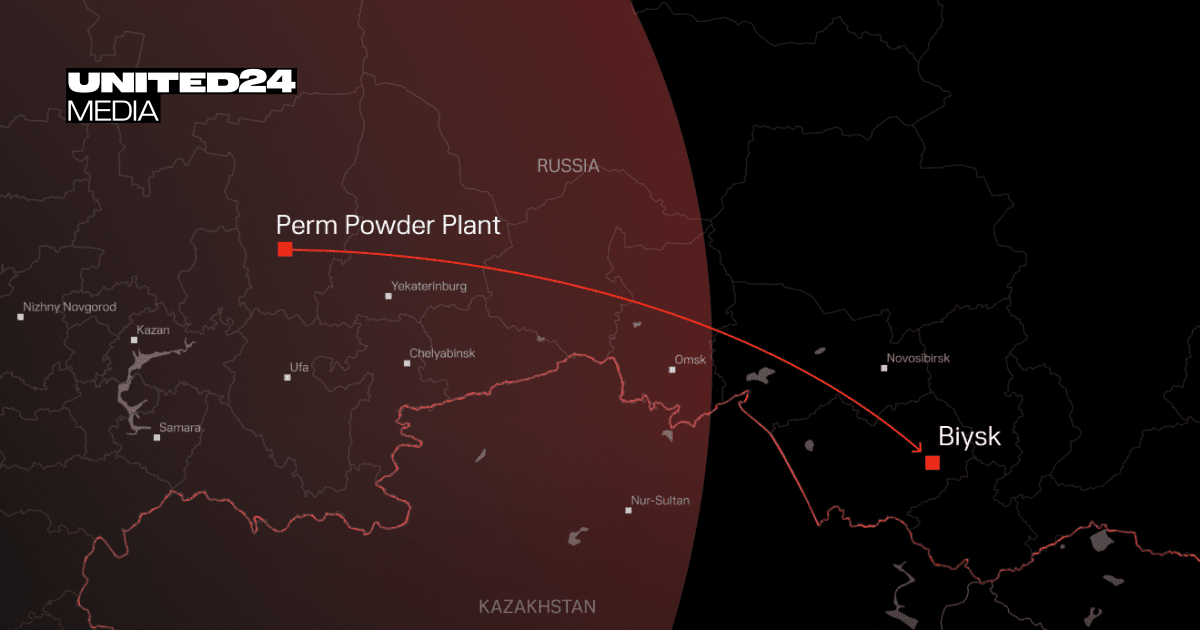
Russia is constructing a vast new missile component factory in western Siberia, roughly 3,000 kilometres from the Ukrainian front line and well beyond the reach of Kyiv's longest-range drones. The project, documented in internal government agreements, supply contracts and budgets obtained by UNITED24 Media, represents one of the largest single investments in the Russian military-industrial complex since the full-scale invasion began.
A factory the size of 72 football pitches
The Perm Powder Plant (PPZ), a Soviet-era cornerstone of Russia's solid-propellant supply chain, secured rights to 20 land plots totalling 140.7 hectares near Biysk in the Altai Region on 22 July 2025. Those plots have been consolidated into a single site. The fenced industrial complex will cover about 51 hectares, roughly 72 football pitches, with 60 buildings planned, 38 of them principal production halls covering 48,742 square metres. The main construction contract is valued at RUB 50.87 billion, backed by a RUB 32.85 billion loan from PJSC Promsvyazbank, a state-owned lender that serves as the financial arm of the defence sector. Total committed capital: RUB 65.3 billion, or approximately $750 million at current rates.
From ballistic to composite propellant
The technical specifications reveal a deliberate shift in capability. The original Perm plant has specialised in ballistic solid propellant, the older formulation used in systems such as the Grad and Smerch multiple-launch rocket systems. The Biysk site is designed specifically for composite propellant, which uses ammonium perchlorate as a high-energy oxidiser blended into a "working powder mixture". Composite propellants deliver higher specific impulse and are standard in modern tactical and strategic missiles, including the Pantsir and Buk air-defence families. Document codes 42A6, 98E6 and 9X342, identified in Soviet and Russian nomenclature as ignition charges and solid-propellant grains, appear repeatedly. The military designation 17A6, procured in 2018 by AO KBP Instrument Design Bureau in Tula for Pantsir systems, also features in the supply chain.
Defended against threats that do not yet exist
Perhaps the most revealing detail is the security architecture. Multiple buildings are specified with "protective enclosing structures from unmanned aerial vehicles", and the documentation explicitly calls for Pantsir-M air defence batteries to guard the site. Ukraine's deepest confirmed strike to date hit the Omsk oil refinery at roughly 2,500 km. Biysk sits another 500 km further east. The Kremlin is therefore hardening a facility against a threat envelope that neither Ukraine nor any current NATO asset can reach, unless the planning horizon assumes a future conflict in which alliance aircraft or missiles operate from forward bases, or Ukrainian drone range extends dramatically.
Logistics, not just latitude
Distance from the front is not the only rationale. Biysk sits adjacent to the Federal Research and Production Center Altai, a major Soviet-era research institute for explosives and propellants, and the Biysk Oleum Plant, which produces oleum (fuming sulfuric acid) used in nitration processes. The Biysk Flax Company and Biysk Flax Mill supply textile reinforcements for composite charge casings. Clustering the new production line beside these existing suppliers reduces transport risk for hazardous materials and shortens the supply chain for specialised inputs. The cadastral records confirm the site's coordinates and boundaries, allowing independent verification of the scale.
War economy on a wartime timeline
The project roadmap runs from July 2025 to October 2026 for permitting and construction, with full production capacity expected by November 2026. Erecting 38 principal buildings and commissioning hazardous chemical lines in 16 months is extraordinary by any industrial standard. It implies unlimited access to labour, prefabricated modules, and regulatory shortcuts, hallmarks of a defence programme granted top-priority status. The speed also suggests the Russian leadership expects the war in Ukraine to continue well into 2027 at minimum, and wants the additional missile throughput available before any potential negotiation or freeze.
Investing while the budget burns
The investment sits awkwardly alongside the Kremlin's public fiscal narrative. Russia's federal budget deficit widened to 2.4% of GDP in 2024, oil and gas revenues have fallen below pre-war levels, and the rouble has lost more than a third of its value against the dollar since 2021. Western sanctions have severed access to high-precision machine tools and specialised electronics. Yet the state can still mobilise three-quarters of a billion dollars for a single propellant plant, financed off-balance-sheet through a policy bank that does not answer to commercial credit committees. The choice to fund composite propellant, a higher-value, higher-technology product, rather than simply expanding ballistic lines indicates an intent to modernise the missile arsenal, not just replenish it.
A signal to Moscow's neighbours
For NATO's eastern flank, the facility changes the calculus of attrition. If Russia can produce Pantsir and Buk missiles at higher rates using modern propellant, the density of air-defence coverage along the alliance's border increases, complicating any future suppression-of-enemy-air-defences campaign. The plant's proximity to the Kazakh border, less than 200 km, also places a strategic Russian defence asset inside Central Asia's security perimeter, a region where Moscow has been deepening military ties through the CSTO and bilateral agreements.
Organisations
Perm Powder Plant · PJSC Promsvyazbank · AO KBP Instrument Design Bureau · Federal Research and Production Center Altai · Biysk Oleum Plant