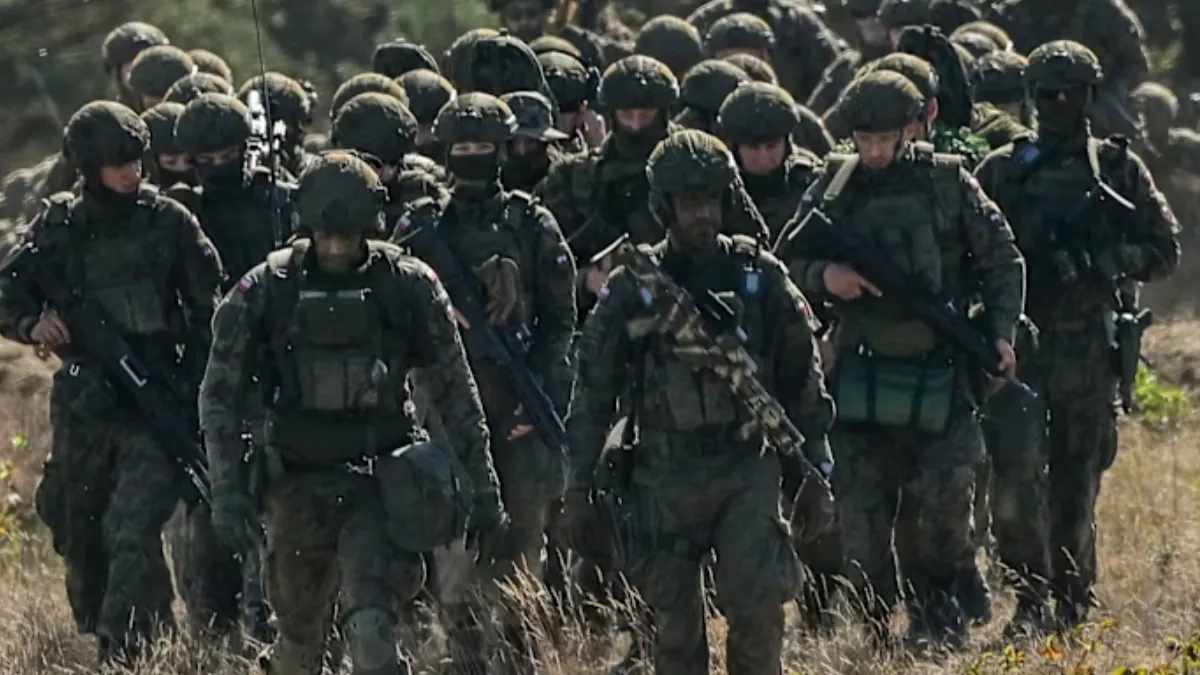
Moldova marked 35 years of independence on 27 August with something the country has never done before: soldiers marching through Chișinău in a formal military parade. For a republic whose constitution has proclaimed permanent neutrality since 1994, the decision to put armed forces on public display was deliberate. A state that once counted on staying out of great-power conflicts now appears to calculate that being seen is safer than staying quiet.
The timing is not accidental. The parade came eight months after Moldova's 2025 elections, in which the pro-European camp held off a Russian-backed campaign to derail the country's EU accession path. Moldova's intelligence service and independent monitors documented disinformation operations and covert financing tied to Moscow. The result held. The margin was narrow enough, though, to raise hard questions about whether pro-European sentiment can survive indefinitely without more tangible backing from the West.
Russian forces on Moldovan soil
Between 1,000 and 1,500 Russian soldiers remain stationed in Transnistria, the narrow breakaway strip along the Ukrainian border that Chișinău has not controlled since the early 1990s. The conflict is described as frozen, but it is not dormant. Hybrid attacks against Moldovan institutions, from cyber operations to coordinated disinformation, have become routine. Moldova sits outside both NATO and the EU, meaning it lacks the collective defence commitments that cover most of the continent.
The country's neutral status, written into the constitution when Moldova had negligible military capacity, increasingly looks less like a strategic choice and more like a constraint imposed by geography and history. The parade through the capital was, among other things, a public acknowledgement that neutrality alone no longer provides the cover it once seemed to.
Defence spending rising from a low base
Moldova has begun to respond with resources that, while modest in absolute terms, represent a sharp shift for one of Europe's poorest economies. Defence spending has climbed from roughly 0.3 per cent of GDP in 2020 to approximately 0.6 per cent today. The National Defence Development Programme, recently adopted, sets a target of 1 per cent by 2030, which would amount to a near-tripling over the course of a decade.
Equipment has followed money. Germany has delivered 19 Piranha-3H armoured personnel carriers and in 2026 began transferring the more capable Piranha-5 vehicles. France signed a defence cooperation agreement in March 2024. The United Kingdom established its own defence and security partnership with Chișinău in November 2024.
A dense network of European support
Beyond bilateral ties, Moldova has secured institutional backing from Brussels. The EU-Moldova Security and Defence Partnership, signed in May 2024, was the first such agreement the European Union concluded with a non-member state. An EU Partnership Mission operates on the ground, and close to €200 million in European Peace Facility funding has been directed to Moldova since 2021.
The architecture is genuinely dense. Training programmes, vehicle donations and budget support all communicate that European capitals wish Moldova well. What they do not communicate to Moscow is that aggression against Moldova would trigger a defined response. The distinction between support and a guarantee is not academic. It is the difference between having partners who send equipment and having partners who commit to your defence.
Precedents for non-NATO commitments
The standard argument against extending security assurances to Moldova is that it is not a NATO member and cannot expect the protection of Article 5. Recent European practice, however, shows that commitments short of full alliance membership are both possible and precedented.
In May 2022, the United Kingdom signed mutual security declarations with Finland and Sweden, binding London to their defence during the period between their NATO applications and formal accession. More directly, Britain, France, Germany and Italy each concluded bilateral security agreements with Ukraine in 2024, making explicit commitments to a non-allied state facing Russian aggression. These are the same four capitals already funding and training Moldova's armed forces.
There is also hard infrastructure on Moldova's border. The Aegis Ashore missile defence installation at Deveselu in Romania, a NATO asset, provides radar coverage extending into Moldovan airspace regardless of whether that was its original design purpose.
What Chișinău is asking for
Moldova is not requesting NATO membership in the near term. What its officials and allied advocates have pushed for is a set of bridge instruments: bilateral security assurances from the coalition of Romania, France, Germany and the United Kingdom, modelled on the Ukraine and Finland-Sweden agreements; participation in NATO's regional missile and air defence planning; accelerated access to EU joint defence procurement, so that current equipment donations become a baseline rather than a ceiling; and a published timetable linking security assurances to EU accession, rather than a vague direction of travel.
The underlying argument is that a country does not triple its defence spending, sign defence pacts with three major powers, and parade its army for the first time in three and a half decades because it feels secure. The parade through Chișinău was a signal that neutrality, as doctrine, has run its course.
Organisations
North Atlantic Treaty Organization · European Union · European Peace Facility