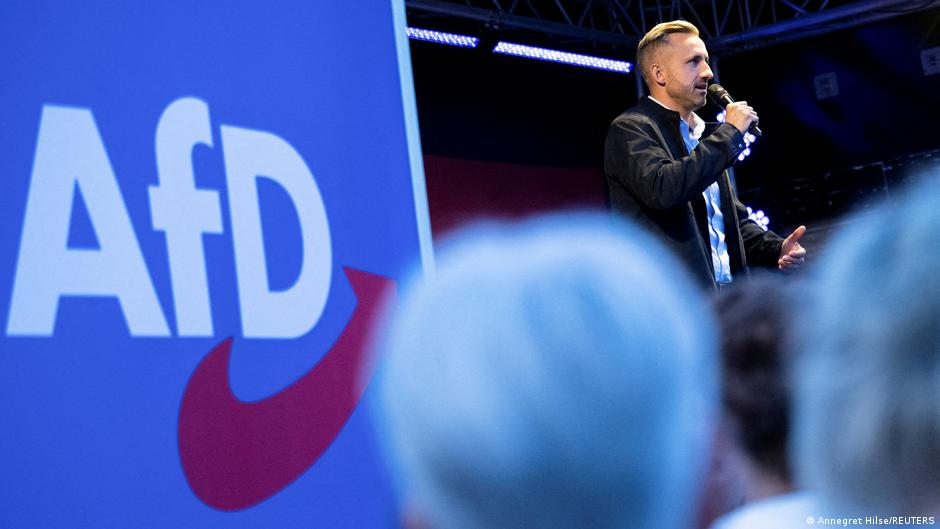
The Alternative for Germany (AfD) has taken a commanding lead in the Saxony-Anhalt state election, putting its lead candidate Ulrich Siegmund in line to become state premier. The result would give the far-right party, whose regional chapter is classified as "confirmed far-right" by Germany's domestic intelligence agency, its first chance to govern an eastern German state. Yet the AfD's draft programme collides with federal law, European law and the state's own economic needs at almost every point.
Deportation promises meet legal limits
The AfD's central pledge is blunt: "deportation from minute one." The party's election programme states its goal as deporting as many immigrants without residency permits as possible. It proposes more detention pending deportation, mandatory work for asylum seekers, and the complete elimination of state funding for integration programmes, which it labels an "asylum industry."
The programme also calls for excluding children and adolescents who lack permanent residency from regular schools, and for establishing a "Remigration Task Force" within the state government to coordinate asylum policy.
Most of these measures exceed what a state government can legally do. Deportation authority rests with the federal government, not individual states. Creating separate school classes for refugee children could violate both European and international law. The AfD has not explained how it would implement its programme within existing legal constraints, or whether it intends to challenge those constraints through the courts or federal legislative channels.
A shrinking state that needs workers
Saxony-Anhalt has lost population more severely than any other German state since reunification. Its population fell from roughly 2.9 million in 1990 to 2.1 million today, according to Federal Statistical Office figures. The state has been short of skilled workers for years, particularly in nursing and elderly care, sectors that depend heavily on immigrant labour across Germany.
The AfD's answer to the labour shortage is not immigration but a "return programme" for Germans living abroad, complete with a "return bonus" covering housing and childcare. The programme does not specify how many returnees it expects, what the bonus would cost, or how many skilled workers it would realistically attract. Germans who have left for higher wages or better career prospects abroad would need substantial incentives to return to a state where wages remain below the national average.
Reint Gropp, president of the Halle Institute for Economic Research, has warned that an AfD government would likely worsen the shortage. "Highly qualified professionals, in particular, have options," he told Die Welt. "If they feel they are unwelcome or can expect hostility, they will choose other regions."
Citizen patrols and the rule of law
The AfD programme declares that regular police are "overwhelmed" and proposes a "voluntary citizen patrol" as a "third pillar of local security." The description stops short of detailing the patrol's powers or oversight mechanisms, but the proposal has drawn sharp criticism from legal scholars.
Thomas Feltes, a legal scholar and criminologist at Ruhr University Bochum, wrote in the Legal Tribune Online that only the police are authorised to use force to protect the public. A "citizen patrol," he argued, would amount to a vigilante group that increases rather than reduces fear of crime: "Where such groups are active, the fear of crime is only stoked, not only among the participants, but above all among everyone else, and not just among 'concerned' citizens."
Foreign policy beyond state reach
Germany's 16 state governments have virtually no authority over foreign or defence policy. The AfD's programme nonetheless calls for rapprochement with Russia and an end to sanctions, positions that are largely symbolic given federal control over sanctions policy. The party also wants to expand Russian language instruction in schools and recruit native Russian speakers to teach it.
On Ukraine, it calls for a "return offensive" to send Ukrainian refugees back, though a state government cannot deport Ukrainians: that is regulated at the federal level. An AfD state premier would, however, carry weight in the Bundesrat, the upper chamber representing the states. Even without legislative power over foreign affairs, the platform signals a shift in political tone that could influence federal debates, particularly on sanctions renewal and military support for Ukraine.
Rewriting culture and history
The AfD's programme extends well beyond migration. It calls for a "patriotic cultural policy" and rejects Bauhaus architecture, which originated in Saxony-Anhalt and is among the state's most celebrated cultural exports, as "too globalist."
On education, the party describes Germany's process of confronting its Nazi-era crimes as the "perpetuation of a guilt complex" and wants school curricula changed accordingly. Rainbow flags would be banned in schools as symbols of diversity. The programme also proposes ending state funding for pro-democracy projects, cutting financial support that many civil society organisations in the state depend on.
People mentioned
Organisations
Alternative for Germany · Halle Institute for Economic Research · Ruhr University Bochum