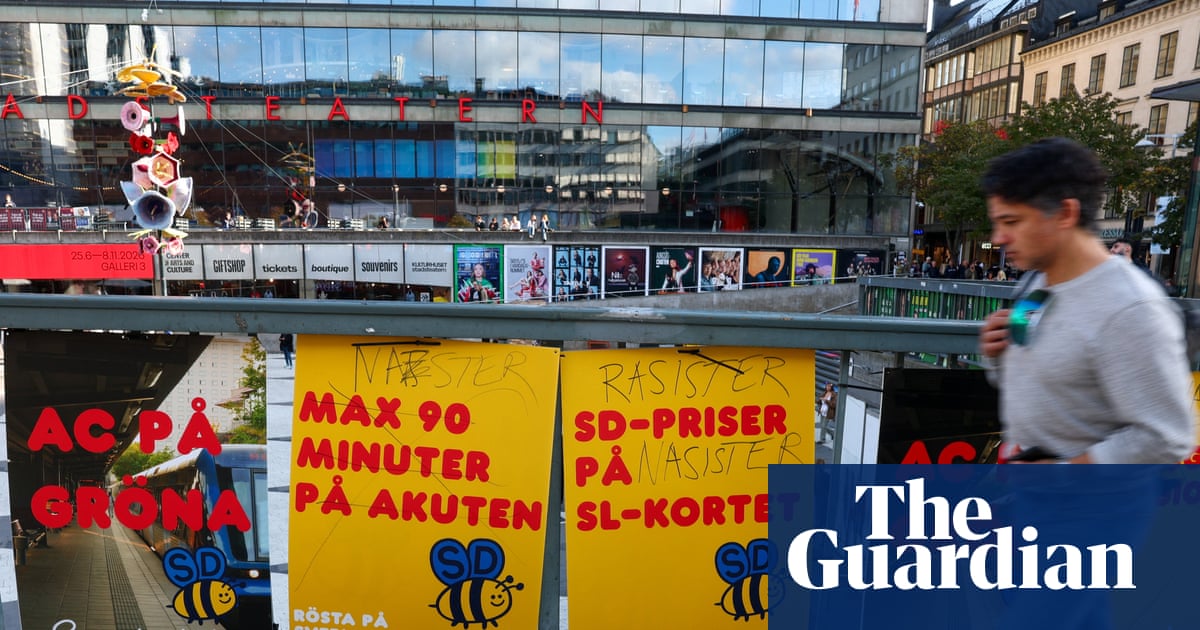
Sweden votes on Sunday in a parliamentary election where the most consequential question is not simply who wins, but whether a far-right party takes cabinet seats for the first time. The Sweden Democrats, an anti-immigration party that grew out of nationalist and neo-Nazi movements, are in line for ministerial portfolios if Prime Minister Ulf Kristersson secures another term. That is a big if. The final major poll before election day, conducted between September 2 and 10, gave the four centre-left parties 50.8 per cent support, translating to an estimated 180 seats in the 349-seat Riksdag. Kristersson's right-wing bloc, including the Sweden Democrats, trailed at 47.6 per cent, or 169 seats.
From cordon sanitaire to coalition partner
The Sweden Democrats were founded in 1988 and spent two decades treated as political untouchables. Every mainstream party refused to negotiate with them. The organisation has since apologised for its early links to extremist movements and rebuilt itself around opposition to immigration and Euroscepticism. That rebranding delivered results. In the 2022 election, the Sweden Democrats won 20.5 per cent of the vote, overtaking Kristersson's Moderates to become the country's second largest party.
Kristersson broke the cordon sanitaire after that result. His minority coalition of Moderates, Christian Democrats and Liberals could not govern alone, so he offered the Sweden Democrats policy influence in exchange for parliamentary support. The deal gave Akesson's party significant leverage over immigration and crime policy. Sweden subsequently adopted some of the strictest asylum and border rules in Europe, according to Eurostat's migration statistics.
That arrangement was a confidence-and-supply agreement. Sweden Democrats politicians did not sit in the cabinet. Kristersson has now promised full coalition membership and ministerial posts if he wins re-election. Akesson is reportedly demanding between 12 and 14 portfolios. Moving from external support to inside government would mark a structural change in Swedish politics: a party that was shunned a decade ago would help run the state.
Why the left's lead may not be enough
Even if the centre-left wins the most seats, forming a government will be difficult. The bloc comprises the Social Democrats, the Greens, the Centre Party and the Left Party. The Centre Party and the Left Party have each said they will not serve in a government that includes the other. That mutual exclusion makes coalition-building awkward even with a combined majority.
The ideological gaps are wide. The Left Party wants a wealth tax on billionaires and opposes new nuclear reactors. The Centre Party, once an agrarian movement now repositioned as socially liberal, disagrees on both counts. The Greens are hostile to nuclear power. The Social Democrats, Sweden's largest party, would almost certainly lead any left-wing government, but the internal contradictions could force them into a minority administration vulnerable to the same parliamentary arithmetic that brought Andersson down before.
Magdalena Andersson became Sweden's first female prime minister in November 2021. Her tenure lasted days. Her budget was voted down, a coalition partner withdrew, and she resigned. Her party won the most seats in 2022 but could not assemble a governing majority. She now argues that higher public spending is needed to help households with rising costs and to reinforce the welfare state.
A campaign that failed to find its focus
Sweden faces genuine problems. Gang-related violence has plagued cities for years. Inflation and energy costs have strained household budgets. The welfare state is under pressure from an ageing population. Yet the campaign has struggled to settle on a single dominant theme.
Nicholas Aylott, an associate professor at Södertörn University, put it plainly: the campaign had been unsatisfactory because nothing really stuck. He added that it would be somewhat sensational if the governing parties made up the polling gap, but that the result was not certain.
Both blocs back military rearmament and continued support for Ukraine. Both say they will address the cost of living. The disagreement is over method. The left proposes higher spending on welfare and public services. The right points to its record on crime and immigration, arguing that tougher enforcement is the answer. Voters on both sides are motivated by genuine concerns. Kurt Flodin, a 79-year-old pensioner in Stockholm, said the most important thing was that the right wing won, to continue what they had started on crime. Jenny Larsson, a theatre worker celebrating her 54th birthday on election day, said she was unhappy with politicians blaming immigration for things that were not caused by immigration.
The wider European picture
Sweden is not alone in confronting the question of far-right participation in government. Italy's Brothers of Italy, which traces its origins to post-fascist movements, leads the current coalition in Rome. The Finns Party has held cabinet positions in Helsinki. In Germany, Alternative for Germany, which opposes immigration and favours closer ties with Russia, won a state election recently. Marine Le Pen leads polls for next year's French presidential vote.
What makes Sweden distinctive is the speed of the shift. A party that was treated as politically radioactive a decade ago is now in contention for a dozen ministerial portfolios. Sweden's reputation for social democratic consensus and liberal values made that exclusion seem permanent. The 2022 election demolished that assumption. Sunday's vote will determine how far the transformation goes.
People mentioned
Organisations
Swedish Social Democratic Party · Sweden Democrats · Moderate Party · Centre Party · Left Party · Green Party