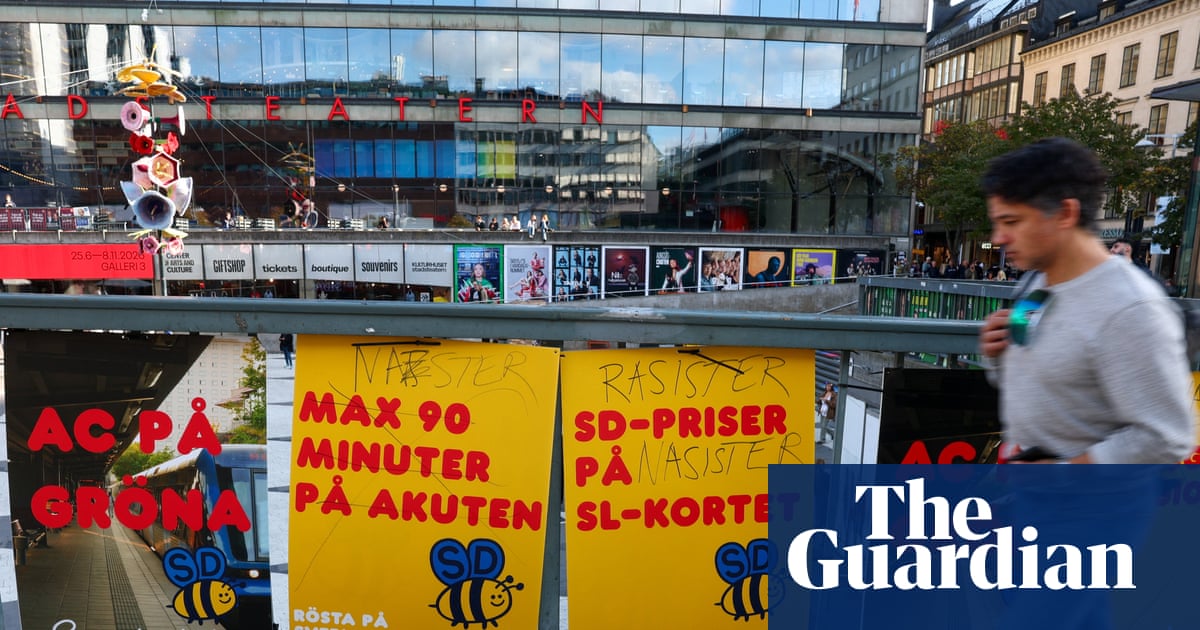
Sweden's general election on Sunday could deliver something the country's political establishment spent decades vowing to prevent: a far-right party holding ministerial portfolios. The Sweden Democrats, who captured more than a fifth of the vote in 2022 and became the country's second-largest party, have spent four years propping up Prime Minister Ulf Kristersson's minority coalition from outside the cabinet. This time, they want in.
Jimmie Akesson, the Sweden Democrats' leader, has left no room for ambiguity. His party would be "either in government or in opposition" after the vote, he said. The Liberals, one of Kristersson's three junior coalition partners, have dropped their longstanding objection to sharing cabinet tables with the Sweden Democrats. If the right-of-centre bloc holds its parliamentary majority, a four-party government becomes a real possibility.
A party once shunned now sets the terms
When the Sweden Democrats first entered the Riksdag in 2010, every other party refused to negotiate with them. Twelve years later, they won 73 of 349 seats on 20.54 per cent of the vote. Kristersson's three-party coalition, comprising the Moderates, Christian Democrats and Liberals, commands only a combined 101 seats. Without the Sweden Democrats' 73, the government would fall.
The current arrangement, governed by the Tido Agreement signed after the 2022 vote, gave the Sweden Democrats policy influence without ministerial posts. They used that leverage to push through some of the strictest asylum and immigration rules in Sweden's modern history. They also pressed the government to reconsider national climate targets, arguing Sweden should set no goals more ambitious than those agreed at European Union level, on the grounds that stricter targets would burden industry and motorists.
Moving from external support to formal cabinet participation would give the Sweden Democrats direct control over government departments, not merely influence exercised through a side agreement. That is a qualitative shift, not a symbolic one.
The opposition's impossible equation
The opposition bloc leads in most final polls, but its path to power is far from straightforward. Former prime minister Magdalena Andersson's Social Democrats want to govern with support from the Green Party, the Left Party and the Centre Party. The Centre Party has flatly refused to sit in any cabinet that includes the Left Party, saying it would rather face an extraordinary election. The Left Party, meanwhile, is demanding ministerial positions.
Swedish Television has described the conflict as an "impossible equation." The four parties have not agreed on a government formula, and unless one side yields, even a comfortable opposition vote share may not produce a functioning administration.
Healthcare tops the agenda
Crime and immigration dominated the 2022 campaign. This time, healthcare leads voters' concerns. An SVT/Verian survey published on 20 August found 64 per cent of respondents ranked healthcare among the most important political issues, up from 55 per cent in May.
The two main blocs offer different prescriptions. The Moderates want to cut the maximum waiting-time guarantee from 90 days to 30. The Social Democrats have pledged to increase healthcare funding in line with inflation.
Migration remains a dividing line. The Sweden Democrats are the only parliamentary party still calling for further restrictions after the election. Several opposition parties want to ease some of the measures introduced during Kristersson's term.
The Liberals' survival could decide everything
The smallest party in the governing bloc may determine whether it retains power. The Liberals won 4.61 per cent of the vote and 16 seats in 2022, barely clearing the 4 per cent threshold required for parliamentary representation. For much of the current term they have polled below that line, raising the prospect that their seats could simply disappear.
Final surveys are more encouraging. Ekot/Indikator put the Liberals at 5.4 per cent; SVT/Verian at 5.5 per cent. If those numbers hold on Sunday, Kristersson's bloc retains a plausible path to 175 seats. If the Liberals fall below 4 per cent, their representation vanishes and the right-of-centre majority almost certainly goes with them.
A Nordic pattern with European resonance
Sweden's election does not take place in isolation. A week before the vote, Germany's Alternative for Germany took 43.8 per cent in the Saxony-Anhalt state election, a record result that has sharpened debate across Europe about how mainstream conservative parties should handle the radical right. Germany's established parties still refuse to cooperate with AfD at any level. Sweden has already moved from isolating the Sweden Democrats to depending on them.
The Nordic region offers a closer comparison. In Finland, the Finns Party serves in the governing coalition, a development the Finnish Institute of International Affairs has described as evidence of radical-right influence becoming embedded in Nordic politics. Sweden Democrats' entry into government would mark a further step along the same path.
People mentioned
Organisations
Sweden Democrats · Riksdag · Social Democratic Party · Moderate Party · Liberal Party of Sweden · Christian Democratic Party