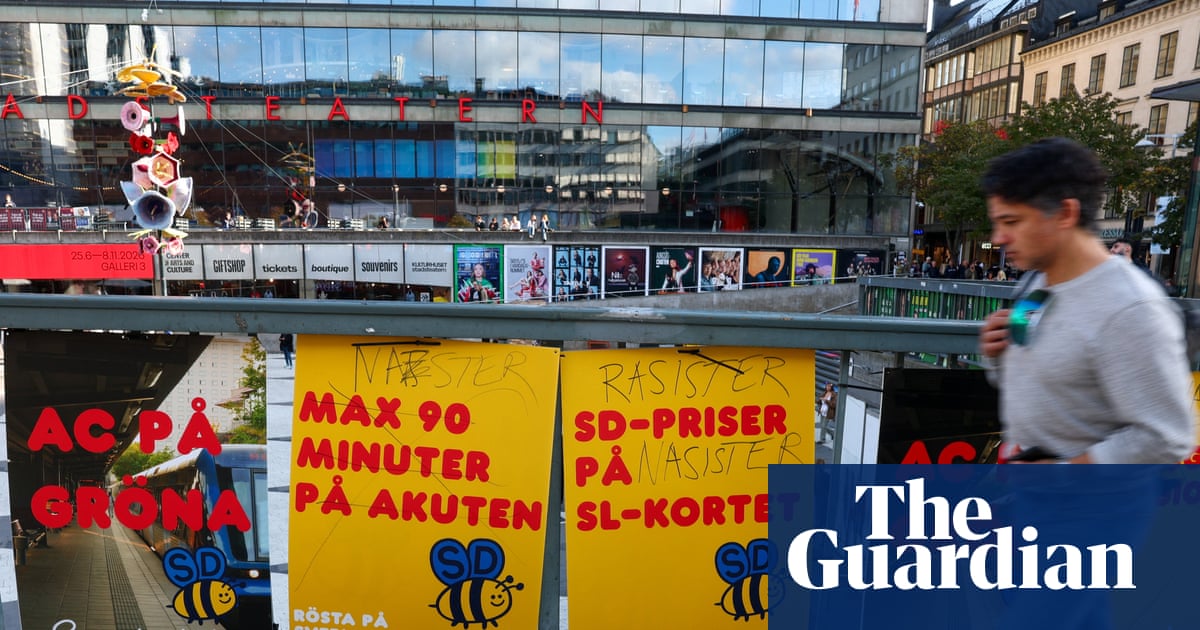
Sweden votes on Sunday in a general election that could place a party born in far-right nationalism inside government for the first time. The Sweden Democrats, who have spent the past four years propping up Prime Minister Ulf Kristersson's minority coalition from outside, are polling at roughly 19 per cent. A strong result for the centre-right bloc would probably give them ministerial posts, a prospect that would have been unthinkable a decade ago.
The numbers frame the shift. In 2015, Sweden took in 163,000 asylum seekers, the second highest per capita figure in Europe, equivalent to one arrival for every 60 residents. A decade on, annual asylum claims have fallen by 96 per cent, reaching a 40-year low. Both left and right governments have tightened migration law in successive rounds. The Sweden Democrats did not create this consensus, but they have pushed it further and faster than any mainstream party was willing to attempt alone.
From nationalist fringe to governing partner
Founded in 1988, the Sweden Democrats spent their early years as a marginal movement with links to the extreme right. An internal investigation later confirmed that some founders held neo-Nazi affiliations. Jimmie Åkesson, who took over as leader in 2005, set about expelling openly racist members and imposing a formal ban on racism within the party. The makeover was deliberate and sustained. Support climbed from single digits to a fifth of the electorate.
Åkesson's appeal rests on his everyman persona, according to Jenny Madestam, a political scientist at Södertörn University. "He's not up on a high horse and he has a knack for explaining complicated issues in an easy, understandable way. He is the guy next door," she says. His rhetoric borrows from Trumpist language, promising to make Sweden "great again".
The argument for inclusion
Since 2022, Kristersson's centre-right coalition has governed as a minority, relying on the Sweden Democrats for parliamentary support without granting them cabinet seats. Some Conservatives initially argued that bringing the party into the parliamentary fold would contain its influence. That claim now looks threadbare. The Sweden Democrats have shaped the agenda on immigration and criminal justice, and Kristersson has himself made the case that only a formal coalition including them can deliver the stable majority Sweden needs to tackle national security and gang crime.
The party's 2026 programme signals what it would push for in office: reducing migration to the lowest feasible level, deporting foreign nationals accused of serious crimes, imposing harsher sentences, and holding down fuel and energy costs.
Cash to leave Sweden
One policy has drawn particular attention. In July, during the election campaign, the Sweden Democrats paid for advertisements promoting a "remigration grant" of around 350,000 Swedish crowns for migrants willing to leave the country. One advert read: "Do you miss Mogadishu? The remigration grant will help you get home."
So far this year, 171 people have accepted the offer. The party wants to extend the scheme to immigrants who hold Swedish citizenship, provided they agree to renounce it and depart. The programme, and the blunt language surrounding it, has intensified debate about whether the Sweden Democrats' agenda amounts to managed integration or a more radical attempt to reverse multiculturalism entirely.
Germany's AfD result raises the stakes
Sweden's election comes days after the Alternative for Germany (AfD) finished first in the Saxony-Anhalt state election, the first time a far-right party has come within reach of governing at state level in Germany since the Second World War. The result sent shockwaves through Berlin and drew a public endorsement from US President Donald Trump, who criticised Germany's "absolutely horrible immigration rules and regulations".
The Swedish vote will be read alongside the German result as another measure of how far Europe's political centre has shifted. Mainstream parties across the continent have adopted tougher language on migration in response to far-right pressure. Sweden is a case study: the country that once took in more asylum seekers per capita than almost any other EU state has, under successive governments, made those arrivals far harder. According to Frontex data on migration flows, the Nordic states have seen some of the steepest declines in arrivals in recent years.
A knife-edge vote
Polls suggest a tight contest. The centre-left opposition, led by Social Democrat Magdalena Andersson, holds a small but narrowing lead. Jan Guillou, a Swedish author and political commentator, frames the choice starkly: "The election is a referendum on the Sweden Democrats; whether we continue to go down a far-right path."
Birgitta Ohlsson, who served as European Affairs minister between 2010 and 2014 and now sits as a Center Party lawmaker, warns that entry into government would deepen the damage. "If the Sweden Democrats enter government, that would have an enormously negative impact on the liberal ideals of our country. We've already seen the effects while they've been outside government, and it would be ten times worse."
One area of near-uniform agreement is foreign policy. Nicholas Aylott, associate professor of political science at Södertörn University, notes that Sweden's response to Russia's war in Ukraine cuts across party lines. "The biggest threat to Sweden's security is from the war in Ukraine and there is almost complete consensus in Sweden about support for Ukraine and deep antipathy towards Russia," he says. The Sweden Democrats share this stance, removing one potential fault line from the campaign.
People mentioned
-
Jan Guillou
Organisations
Sweden Democrats · Social Democrats · Center Party · Alternative for Germany