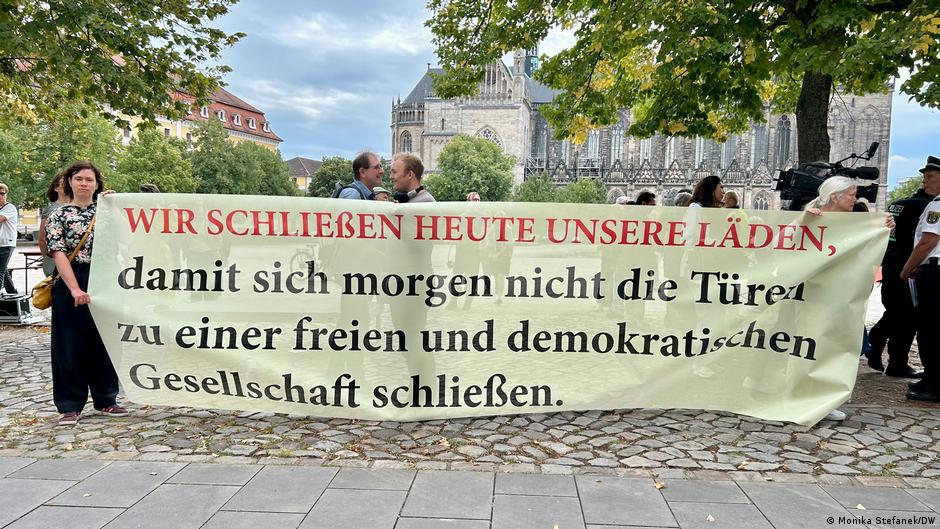
When the Alternative for Germany (AfD) took 43.8% of the vote in Saxony-Anhalt, the reaction among the state's roughly 6,120 residents of Turkish origin was visceral. Business owners contacted Gökay Sofuoglu, co-chair of the Turkish Community in Germany (TGD), to say they were considering closing down and leaving the state. Some talked about leaving the country entirely.
"After the AfD's success, some were thinking of shutting up shop and leaving, first Saxony-Anhalt, then Germany," Sofuoglu told Deutsche Welle. The initial panic has since tempered. On follow-up conversations, Sofuoglu said, business owners have decided to wait and see how the new state government takes shape before making irreversible decisions.
A demographic the state can ill afford to lose
Saxony-Anhalt is one of Germany's oldest and most sparsely populated states. According to the Federal Statistical Office, its 2.1 million residents include just over 249,000 people with a migration background, roughly 10% of the total. The Turkish-origin population is small in absolute terms, but the state's chronic labour shortages and ageing population make every working-age resident count. Irmak, a woman of Turkish descent who moved to Leipzig 12 years ago and asked not to be identified by her real name, put it plainly: even a change of government would not alter the state's need for workers and young people.
The calculation is straightforward. If even a fraction of the Turkish-origin entrepreneurs and skilled workers in eastern Germany decide that the political climate has become intolerable, the regional economy pays a price. These are not abstract concerns. Small and medium-sized enterprises across the east already struggle to fill vacancies. Germany's Federal Statistical Office has documented persistent demographic decline in Saxony-Anhalt for years.
Fear of violence, not just rhetoric
Sofuoglu raised a concern that goes beyond policy disagreement: the possibility that an emboldened far right will turn to violence. He pointed to the National Socialist Underground (NSU), a neo-Nazi cell that carried out a series of racially motivated murders between 2000 and 2007, killing ten people, eight of them of Turkish origin. The NSU case exposed catastrophic failures in German domestic intelligence, which had long dismissed the possibility of organised right-wing terrorism. Sofuoglu said there is now a fear that similar attacks could recur, and that the authorities might again fail to investigate them properly.
That fear is not hypothetical. Germany's domestic intelligence agency, the Bundesamt für Verfassungsschutz, has repeatedly warned about the rising threat of right-wing extremism. The AfD itself is classified as a suspected right-wing extremist entity at the federal level, and its branches in several eastern states, including Saxony-Anhalt, are under formal observation.
Why banning the AfD could backfire
Calls to ban the AfD have grown louder since the election result. Alaz Sümer, a lawyer who works with a Berlin-based non-governmental organisation advising migrants on getting foreign qualifications recognised in Germany, thinks this would be a mistake. A ban would not eliminate the underlying movement, he argued. Instead, a new party would form, and more extreme elements might drift into less visible and harder-to-monitor organisations. The result would be a Germany that is "even more uninhabitable" for migrants, he said.
Sümer, who is completing a PhD on extreme-right political parties, believes the established parties have failed to address the structural problems that allowed the AfD to flourish. Simply condemning the party is insufficient. "Saying 'the AfD is bad, the AfD is dangerous' is the easy way," he said. "We already know that."
A problem bigger than one party
Several of those interviewed made the same underlying point: the AfD's success is a symptom, not the disease itself. Irmak said the result was predictable and that government policies had failed to address citizens' needs, creating fertile ground for the far right. Sümer went further, arguing that racism in Germany predates the AfD and would persist regardless of the party's fortunes. The issues migrants face were not created by the AfD, he said, even if the party has amplified them.
Sofuoglu framed the moment in similarly broad terms. The rise of the AfD, he said, is not merely a migration issue. He views it as a threat to Germany's democratic constitution, one that should concern all democratic forces, not just minority communities. People of Turkish descent, he acknowledged, tend to perceive the threat in personal and immediate terms, focusing on what the party's rise means for their safety and livelihoods. But the larger danger, he insisted, is to the constitutional order itself.
The economic bind
There is a bitter irony in the AfD's strength in the east. The states where the party polls highest, Saxony-Anhalt among them, are precisely those with the most acute demographic challenges: ageing populations, outward migration of young skilled workers, and persistent labour shortages. The Turkish-origin residents who are now contemplating departure are part of the thin layer of working-age people keeping regional economies functional. If they leave, the states that voted for the AfD will be poorer for it, in the most literal sense.
People mentioned
-
Gökay Sofuoglu
-
Alaz Sümer
Organisations
Alternative for Germany · Turkish Community in Germany · Federal Statistical Office of Germany